
Ever wondered why mirrors work, why straws look bent in...
 Science5 visualizaciones·Actualizado Jun 7, 2026·7 páginas
Understanding Light and Its Optical Properties
1 / 7
1
of 7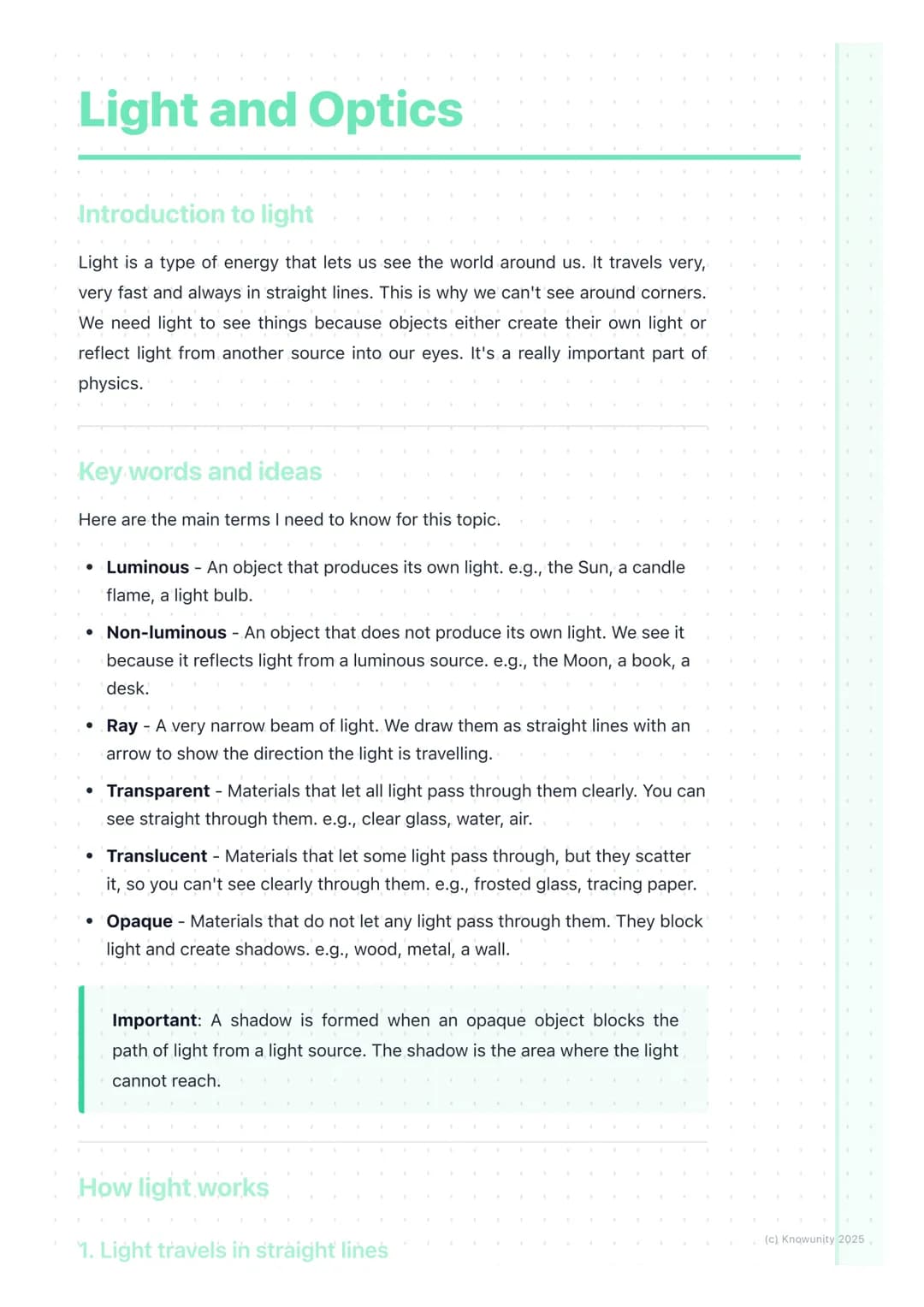
Introduction to Light
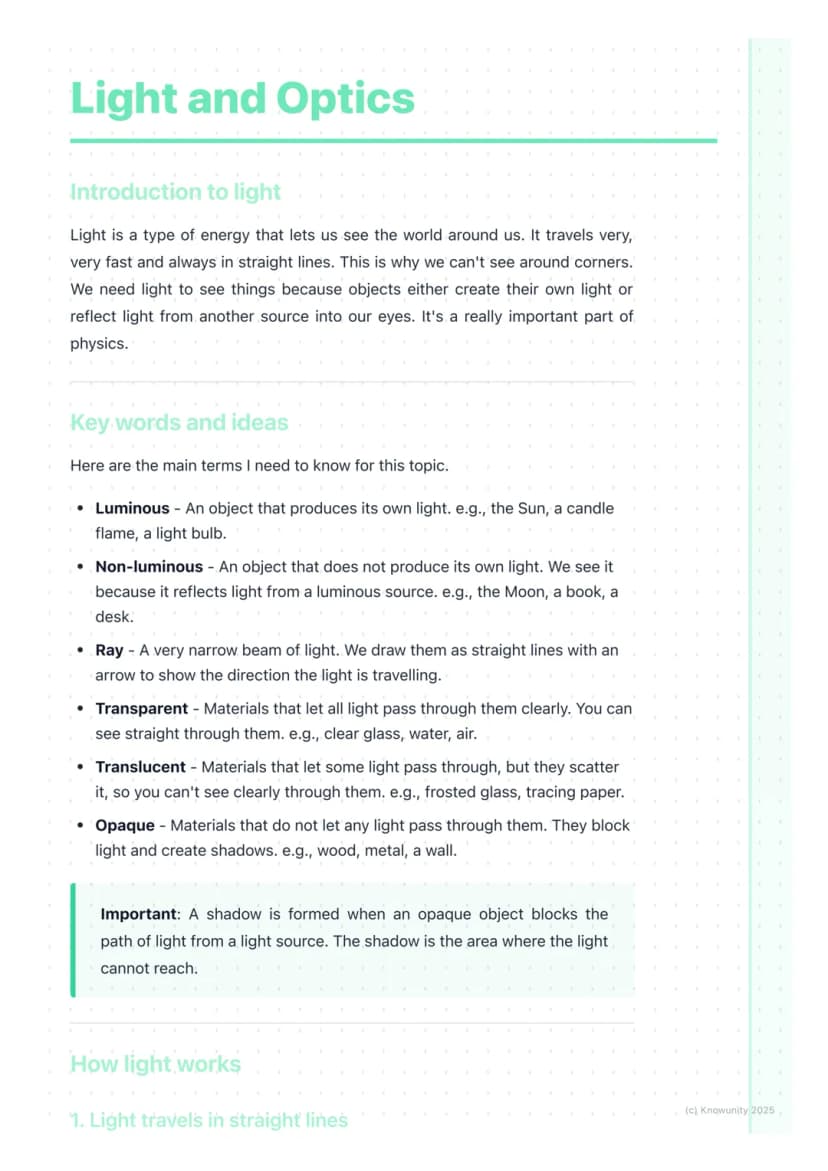
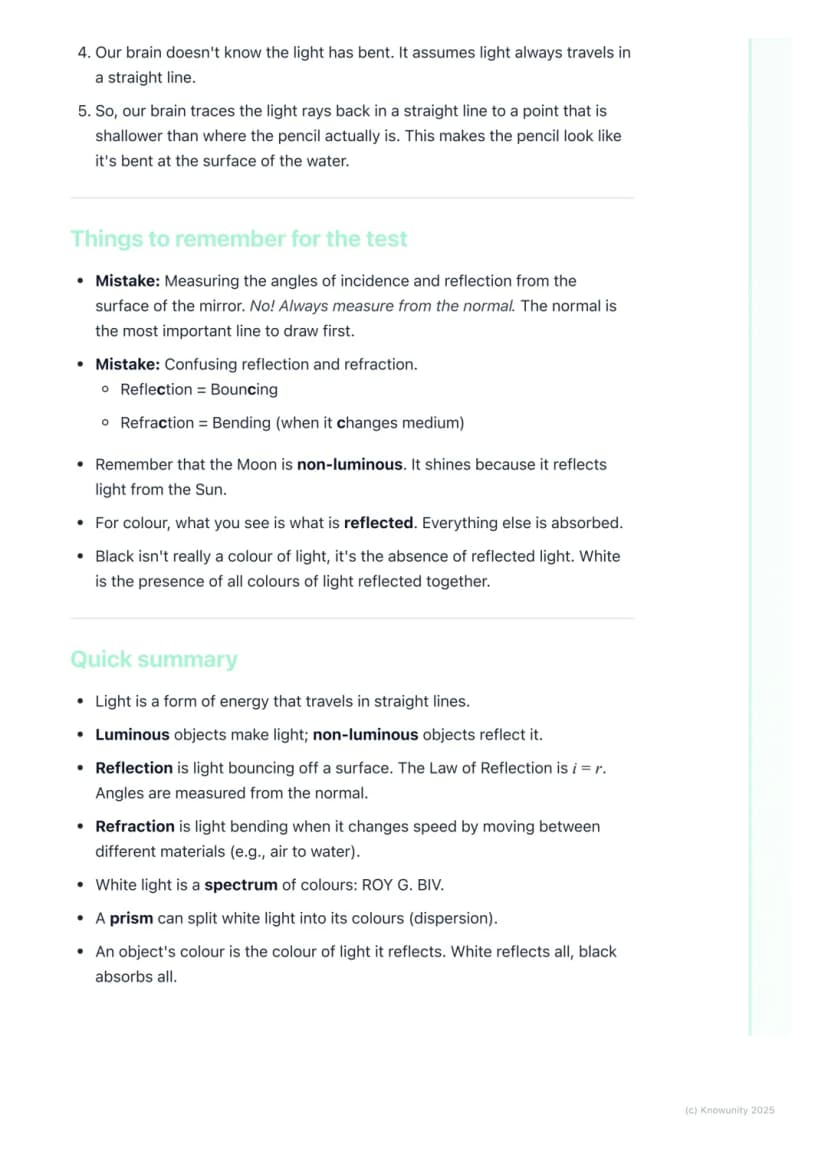
Light is literally everywhere around you right now, and without it, you wouldn't be able to read this! It's a form of energy that travels incredibly fast and always moves in perfectly straight lines. This is exactly why you can't peek around corners without actually moving your head.
Everything you see falls into two categories: luminous objects (like the sun, light bulbs, or your phone screen) that create their own light, and non-luminous objects (like this page, your desk, or even the moon) that we only see because they bounce light from luminous sources into our eyes.
When light hits different materials, three things can happen. Transparent materials like clear glass let all light pass through cleanly. Translucent materials like frosted bathroom windows let some light through but scatter it so you can't see clearly. Opaque materials like walls block all light completely, which creates shadows behind them.
Quick Tip: Remember that shadows form because opaque objects block light's straight-line path - no bending allowed!
2
of 7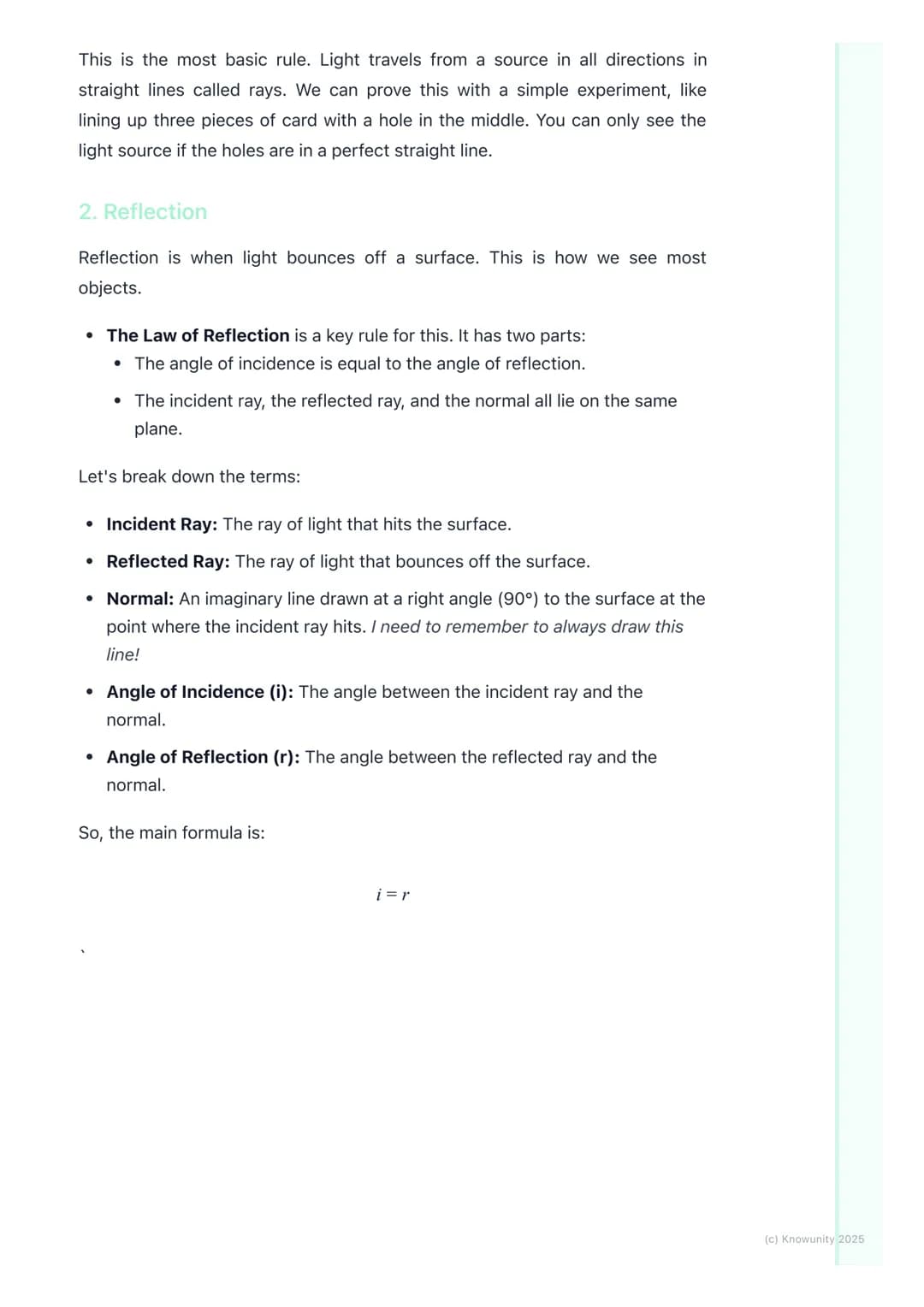
Reflection: When Light Bounces
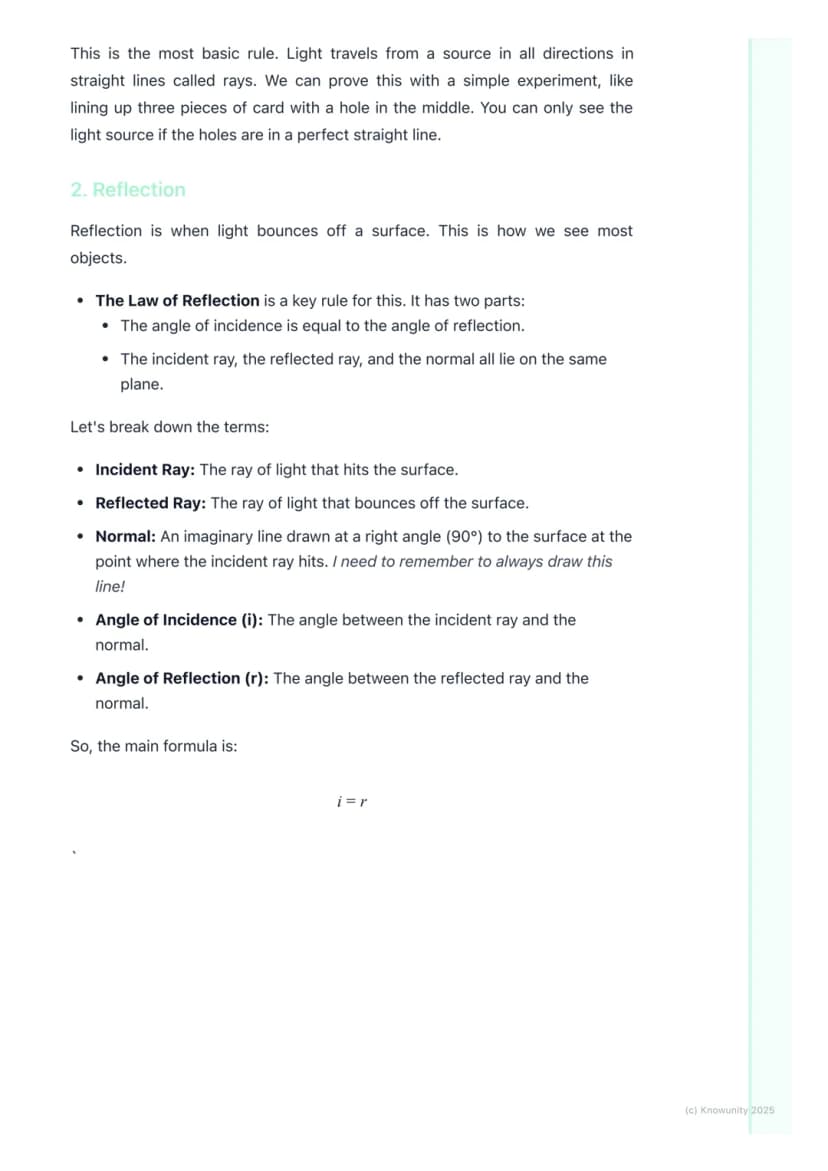
Reflection happens every time you look in a mirror, but it's actually occurring constantly all around you. Most objects you see aren't making light themselves - they're reflecting it into your eyes.
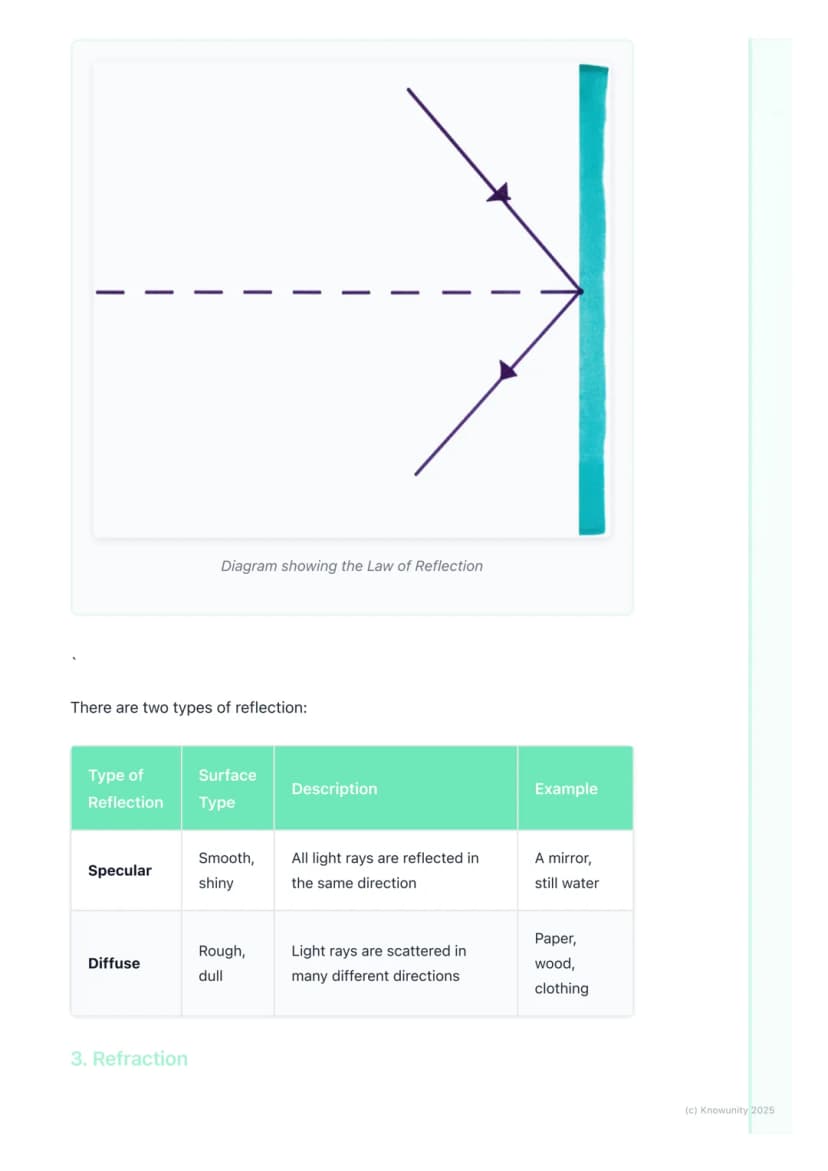
The Law of Reflection is your key rule here, and it's beautifully simple: the angle going in equals the angle coming out. When measuring these angles, always use the normal - an imaginary line drawn at 90° to the surface where the light hits.
There are two types of reflection you'll encounter. Specular reflection happens on smooth surfaces like mirrors, where all light rays bounce off in the same direction, giving you a clear image. Diffuse reflection occurs on rough surfaces like paper or clothing, where light scatters in all directions - this is why you can't see your reflection in a jumper!
Remember: Always measure angles from the normal, not from the surface itself - this is the most common mistake in reflection problems!
3
of 7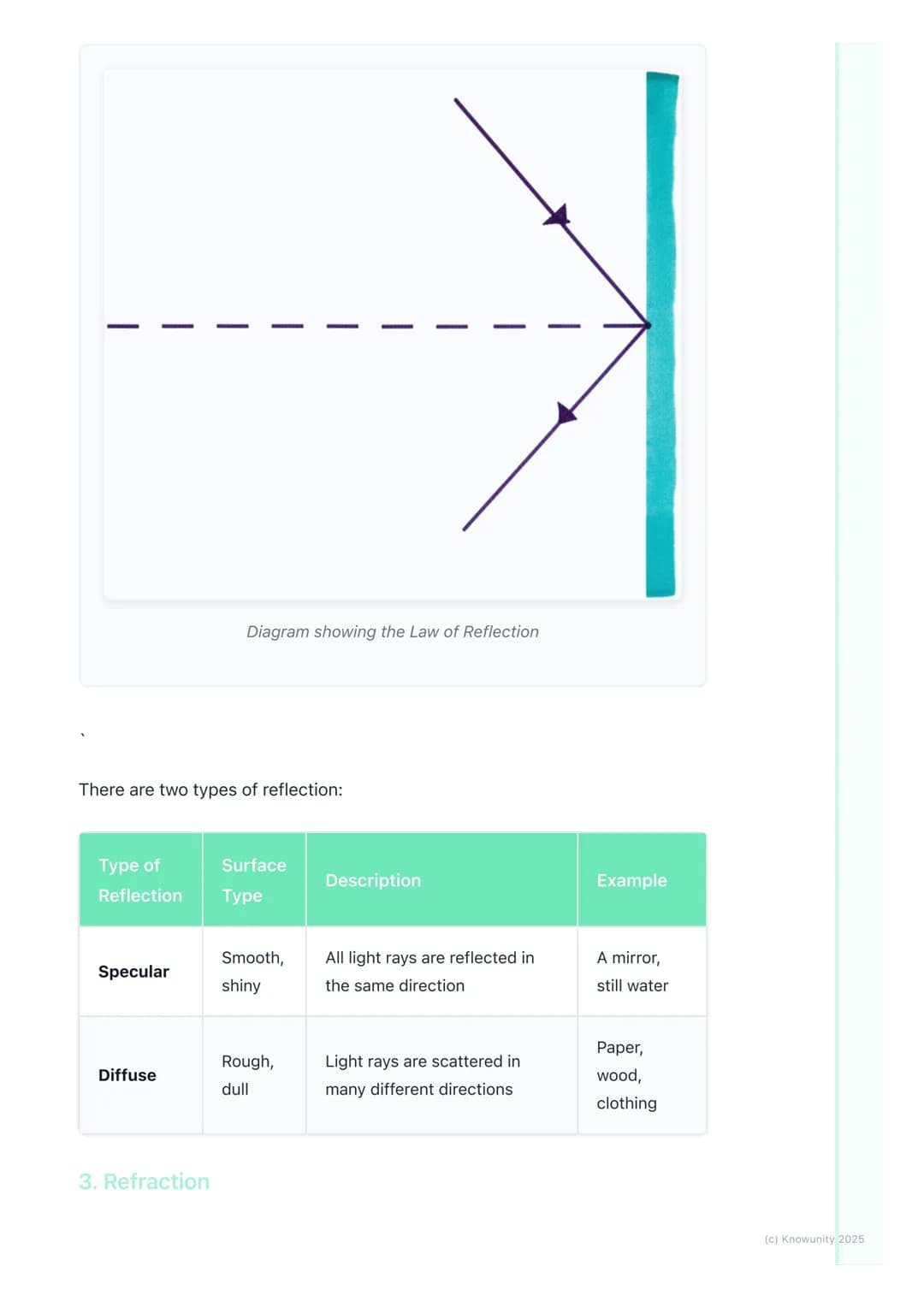
Refraction: When Light Bends
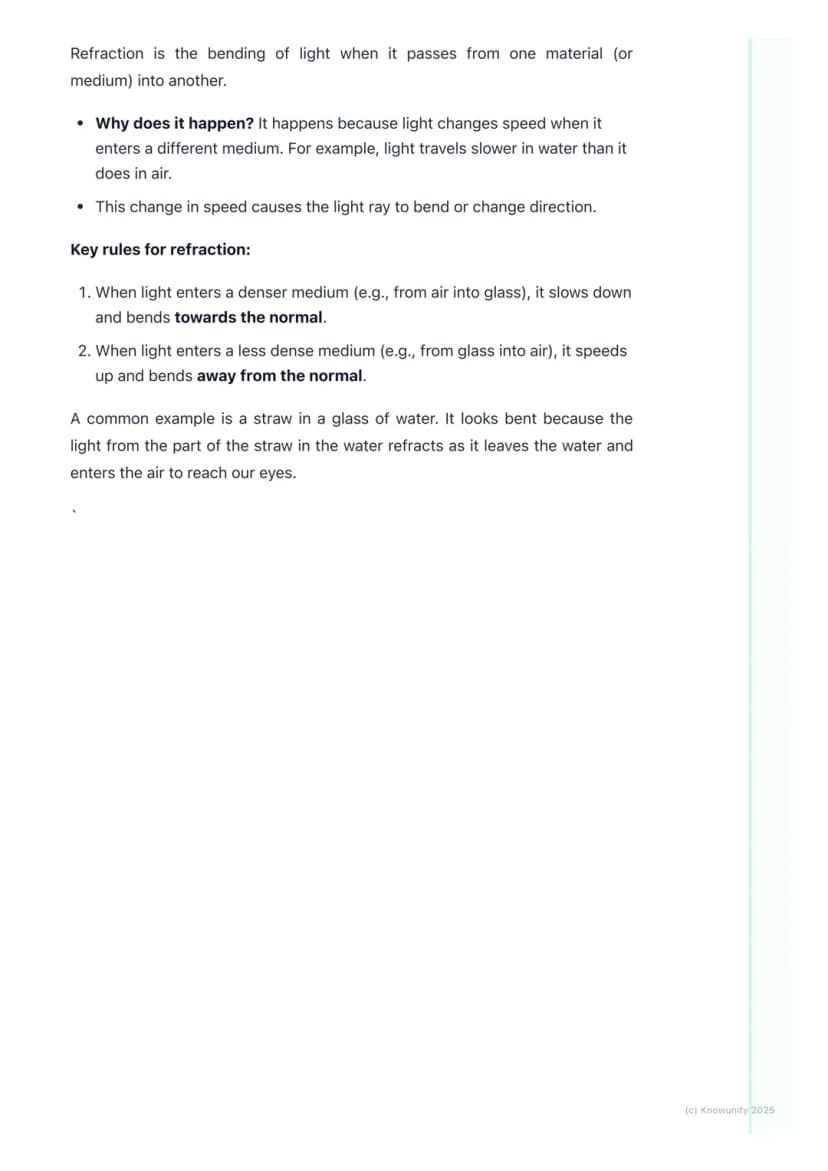
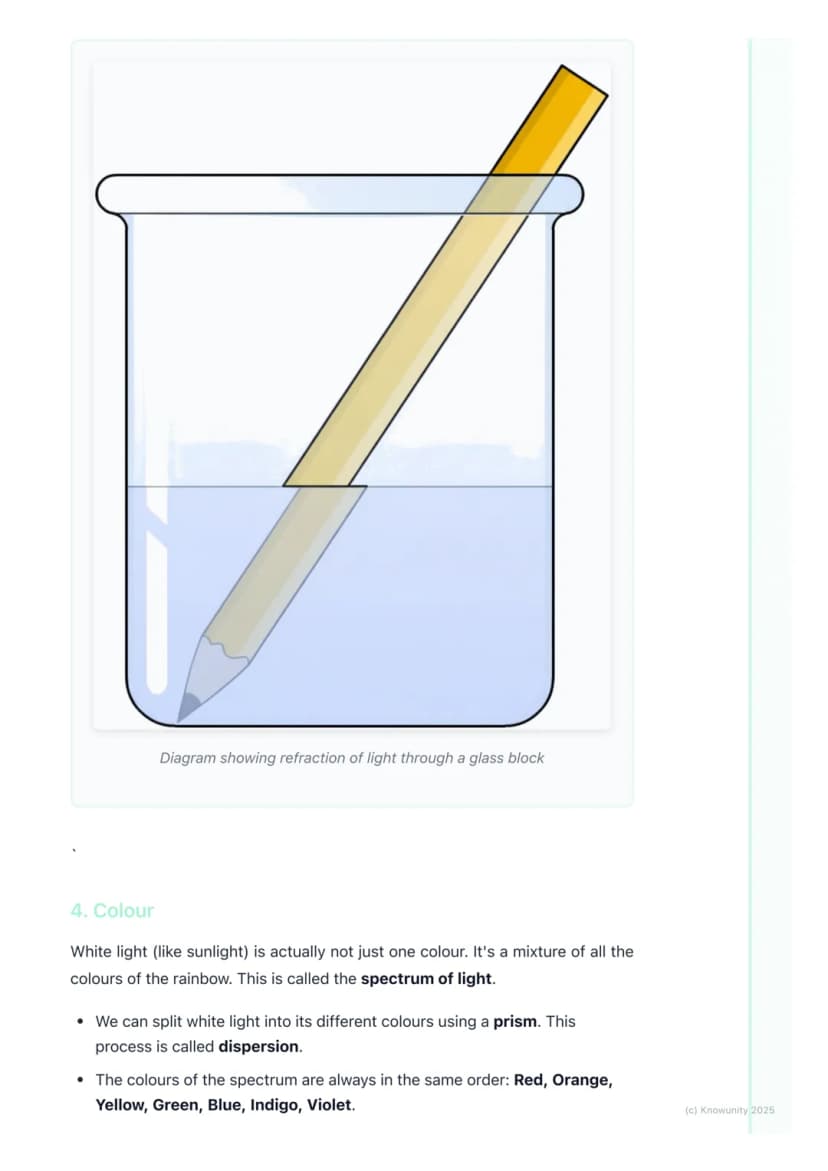
Refraction is the reason that straw in your drink looks wonky, and it happens because light changes speed when moving between different materials. When light slows down entering a denser material (like going from air into water), it bends towards the normal. When it speeds up entering a less dense material, it bends away from the normal.
This bending tricks your brain because your eyes assume light always travels in straight lines. So when light from the underwater part of that straw bends as it leaves the water, your brain traces it back in a straight line to the wrong position, making the straw appear bent at the water's surface.
You'll see refraction everywhere once you start looking for it - from swimming pools that look shallower than they really are, to glasses that help people see clearly by bending light in just the right way.
Key Point: Denser materials slow light down and bend it towards the normal; less dense materials speed it up and bend it away!
4
of 7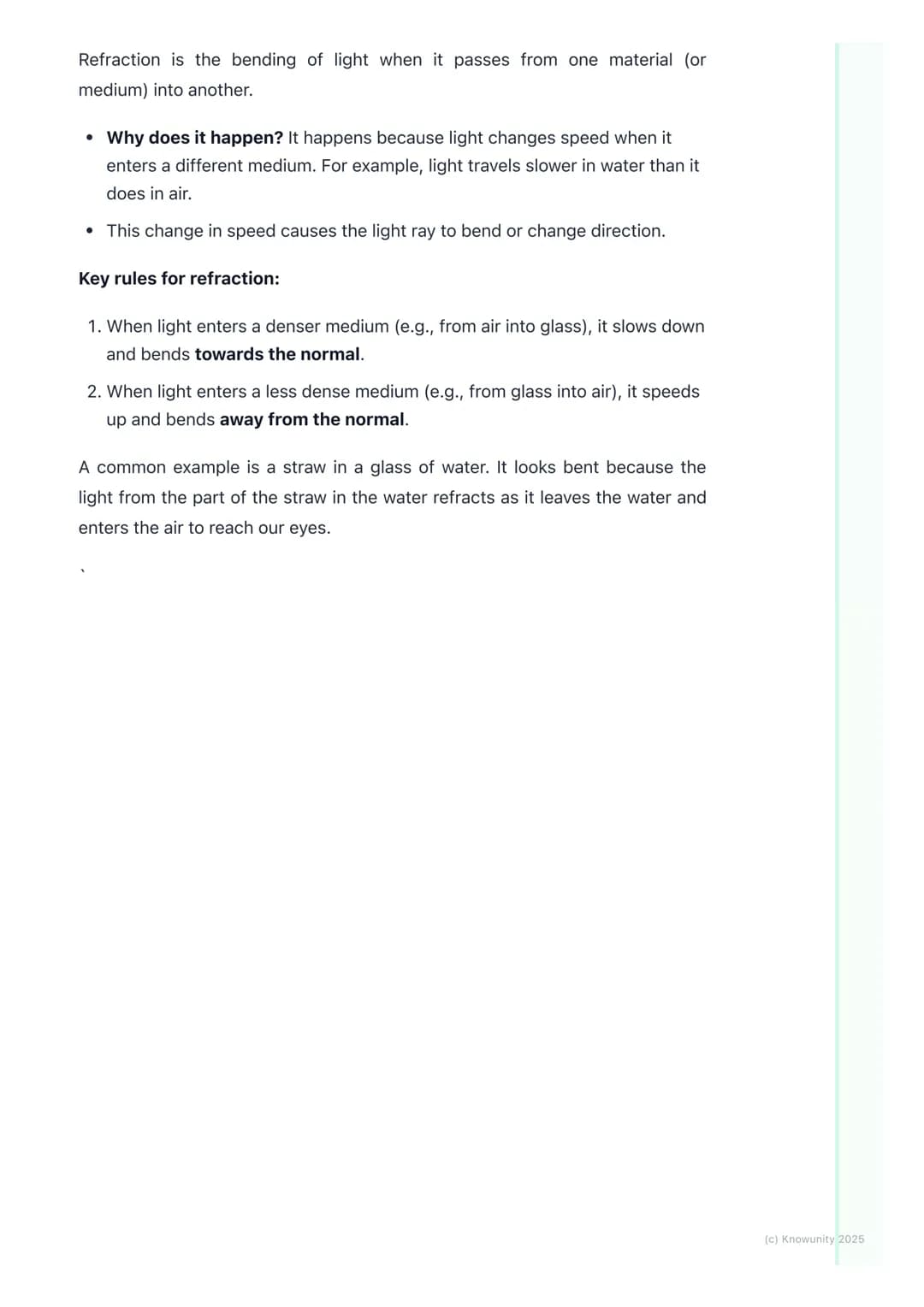
Colour and the Light Spectrum
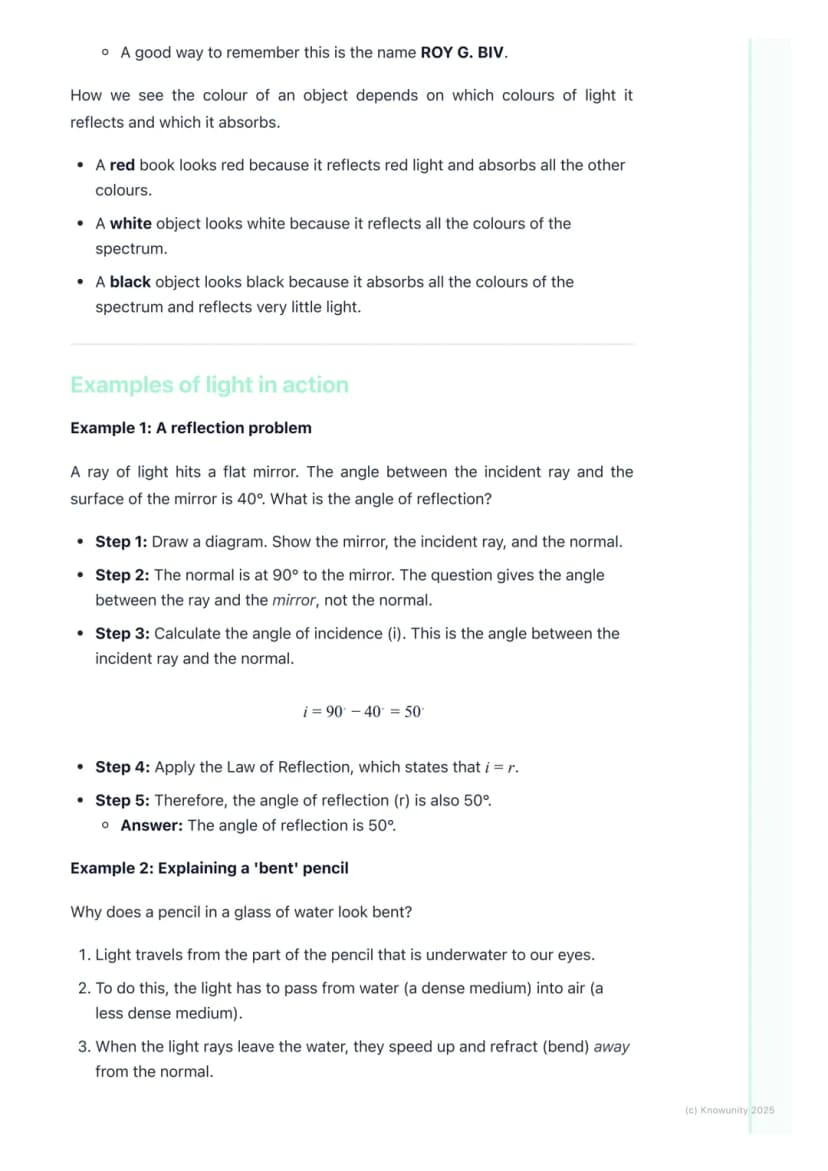
Here's something brilliant: white light isn't actually white at all! It's a secret mixture of all the colours of the rainbow hiding in plain sight. You can reveal this hidden spectrum using a triangular piece of glass called a prism, which splits white light through a process called dispersion.
The colours always appear in the same order: Red, Orange, Yellow, Green, Blue, Indigo, Violet - remember it as ROY G. BIV. Each colour bends by a slightly different amount as it passes through the prism, which is why they separate out.
The colour you see when looking at any object is actually the colour it reflects back to your eyes. A red apple looks red because it reflects red light and absorbs all the other colours. White objects reflect everything, which is why they can look brilliant in sunlight. Black objects absorb almost everything, reflecting very little light back to you.
Think About It: If you shine red light on a blue object, it will look black because there's no blue light for it to reflect back to you!
5
of 7
Solving Light Problems
When tackling reflection problems, always start by drawing a clear diagram with the normal line. If you're given the angle between the incident ray and the surface, remember to subtract it from 90° to find the angle from the normal. Then simply apply i = r (angle of incidence equals angle of reflection).
For refraction questions, focus on what happens when light changes medium. Moving into denser materials (air to water) bends light towards the normal, whilst moving to less dense materials (water to air) bends it away. This explains everyday observations like why swimming pools look shallower than they are.
Colour problems usually involve thinking about what gets reflected versus what gets absorbed. Remember that the colour you see is always what's being reflected - everything else disappears because it's absorbed by the object.
Exam Tip: Don't confuse reflection (bouncing) with refraction (bending when changing medium) - they're completely different processes!
6
of 7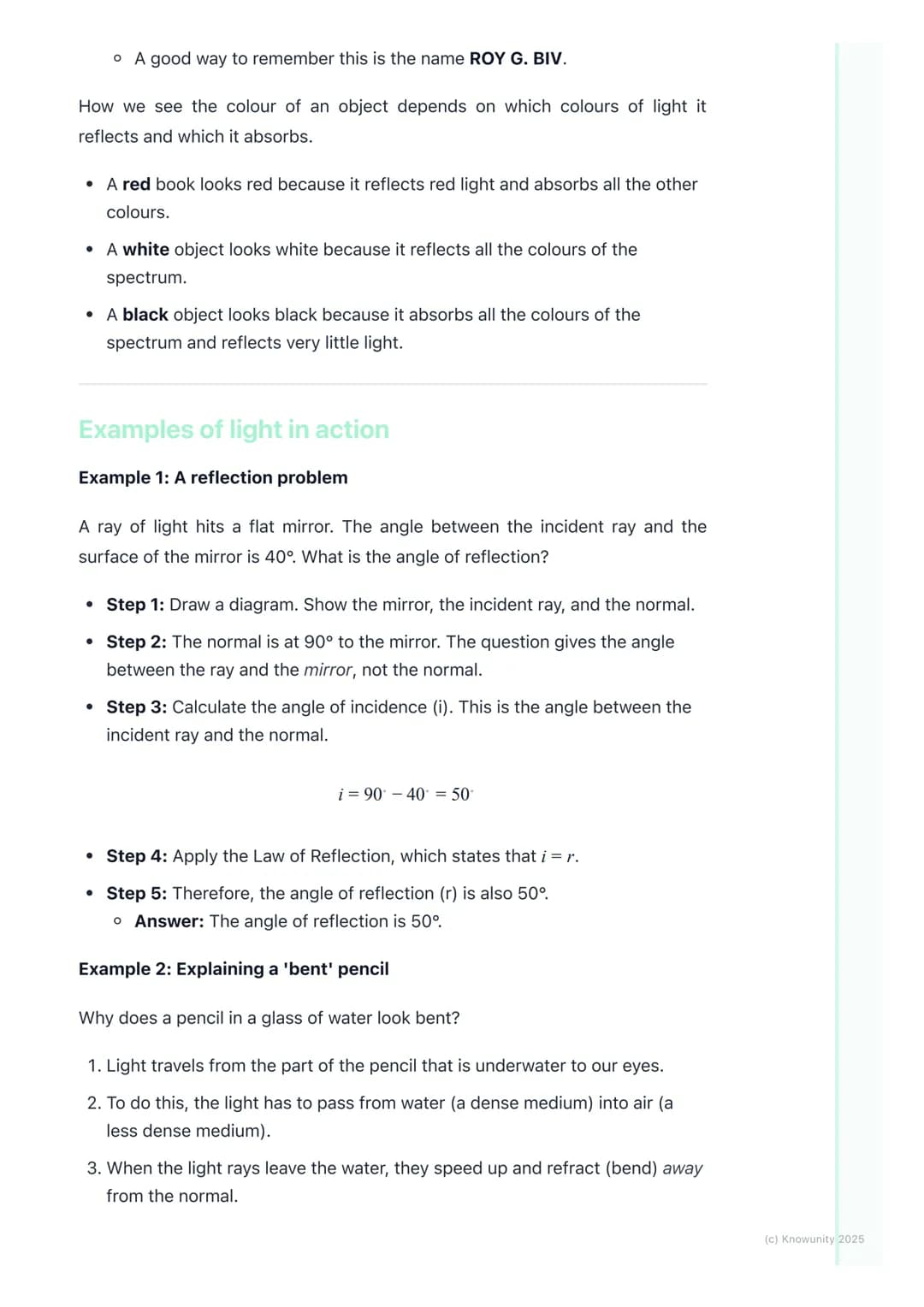
7
of 7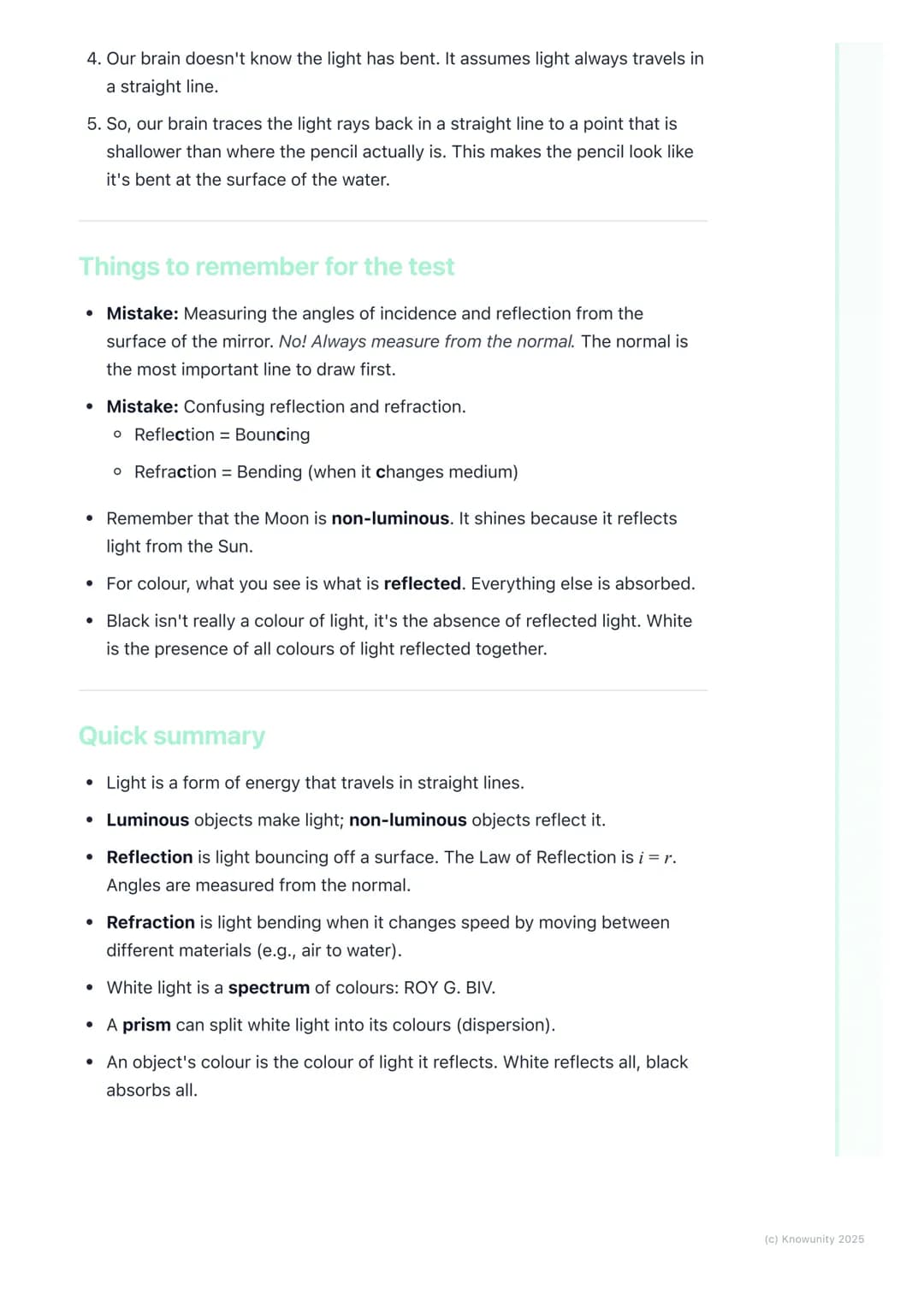
Pensamos que nunca lo preguntarías...
¿Qué es Knowunity AI companion?
Nuestro compañero de IA está específicamente adaptado a las necesidades de los estudiantes. Basándonos en los millones de contenidos que tenemos en la plataforma, podemos dar a los estudiantes respuestas realmente significativas y relevantes. Pero no se trata solo de respuestas, el compañero también guía a los estudiantes a través de sus retos de aprendizaje diarios, con planes de aprendizaje personalizados, cuestionarios o contenidos en el chat y una personalización del 100% basada en las habilidades y el desarrollo de los estudiantes.
¿Dónde puedo descargar la app Knowunity?
Puedes descargar la app en Google Play Store y Apple App Store.
¿Knowunity es totalmente gratuito?
¡Sí lo es! Tienes acceso totalmente gratuito a todo el contenido de la app, puedes chatear con otros alumnos y recibir ayuda inmeditamente. Puedes ganar dinero utilizando la aplicación, que te permitirá acceder a determinadas funciones.
Contenidos más populares de Science
6ScienceScience/Physics notes - Speed, density, work
Speed density work formulas
5th Year81
ScienceAtomic Structure and the Periodic Table
Students will learn about the structure of atoms, including protons, neutrons, and electrons, and how elements are organised and classified in the Periodic Table based on their electronic configuration and chemical properties.
5th Year41
ScienceHuman Body Systems
An introduction to major human body systems such as the digestive, circulatory, respiratory, and nervous systems, understanding their basic functions.
2nd Year131
ScienceJunior Cert Science Notes: The Cell
Notes on the Cell
3rd Year261
ScienceCells
Junior cert science cells summary
1st Year611
ScienceHuman Reproductive System
A basic overview of the male and female reproductive systems, including their main structures and functions.
TY191
Contenidos más populares
9 Irish
IrishIrish oral questions and answers
Questions and answers for the leaving cert oral
5th Year4264
 English
Key Quotes : Sive
Key Quotes and explanations: Sive
6th Year2842
IrishIrish oral questions
Outline of oral questions
5th Year2055
IrishIníon- le hÁine Durkin
Aine Durkin’s poem, Iníon: Themes & summary
5th Year890
IrishIrish poetry 2027
Iníon + Dínit an Bhróin
5th Year1153
IrishLC HL notes- Iníon (poem)
Includes poem in English and Irish, theme, key words & phrases
5th Year2304
EnglishCultural Context : Shawshank Redemption : Sive : Small Things Like These
Comparative Study : Cultural Context : Shawshank Redemption, Sive and Small Things Like These
6th Year1430
IrishMo Ghrá-sa (Idir Lúibíní)
Notes on mo ghrá-sa
5th Year380
IrishAn Gaeilge Aiste
Irish Language essay
6th Year1320
¿No encuentras lo que buscas? Explora otros temas.
Mira lo que dicen nuestros usuarios. Les encantó — y a ti también te encantará.
4.6/5App Store
4.7/5Google Play
La app es muy fácil de usar y está muy bien diseñada. Hasta ahora he encontrado todo lo que estaba buscando y he podido aprender mucho de las presentaciones. Definitivamente utilizaré la aplicación para un examen de clase. Y, por supuesto, también me sirve mucho de inspiración.
Pablousuario de iOS
Esta app es realmente genial. Hay tantos apuntes de clase y ayuda [...]. Tengo problemas con matemáticas, por ejemplo, y la aplicación tiene muchas opciones de ayuda. Gracias a Knowunity, he mejorado en mates. Se la recomiendo a todo el mundo.
Elenausuaria de Android
Vaya, estoy realmente sorprendida. Acabo de probar la app porque la he visto anunciada muchas veces y me he quedado absolutamente alucinada. Esta app es LA AYUDA que quieres para el insti y, sobre todo, ofrece muchísimas cosas, como ejercicios y hojas informativas, que a mí personalmente me han sido MUY útiles.
Anausuaria de iOS
Science5 visualizaciones·Actualizado Jun 7, 2026·7 páginasUnderstanding Light and Its Optical Properties
Ever wondered why mirrors work, why straws look bent in water, or how we actually see colours? Light is the energy that makes all of this possible, and understanding how it behaves will help you make sense of the world...
1
of 7
Inscríbete para ver los apuntes. ¡Es gratis!
- Acceso a todos los documentos
- Mejora tus notas
- Únete a millones de estudiantes
Introduction to Light
Light is literally everywhere around you right now, and without it, you wouldn't be able to read this! It's a form of energy that travels incredibly fast and always moves in perfectly straight lines. This is exactly why you can't peek around corners without actually moving your head.
Everything you see falls into two categories: luminous objects (like the sun, light bulbs, or your phone screen) that create their own light, and non-luminous objects (like this page, your desk, or even the moon) that we only see because they bounce light from luminous sources into our eyes.
When light hits different materials, three things can happen. Transparent materials like clear glass let all light pass through cleanly. Translucent materials like frosted bathroom windows let some light through but scatter it so you can't see clearly. Opaque materials like walls block all light completely, which creates shadows behind them.
Quick Tip: Remember that shadows form because opaque objects block light's straight-line path - no bending allowed!
2
of 7Inscríbete para ver los apuntes. ¡Es gratis!
- Acceso a todos los documentos
- Mejora tus notas
- Únete a millones de estudiantes
Reflection: When Light Bounces
Reflection happens every time you look in a mirror, but it's actually occurring constantly all around you. Most objects you see aren't making light themselves - they're reflecting it into your eyes.
The Law of Reflection is your key rule here, and it's beautifully simple: the angle going in equals the angle coming out. When measuring these angles, always use the normal - an imaginary line drawn at 90° to the surface where the light hits.
There are two types of reflection you'll encounter. Specular reflection happens on smooth surfaces like mirrors, where all light rays bounce off in the same direction, giving you a clear image. Diffuse reflection occurs on rough surfaces like paper or clothing, where light scatters in all directions - this is why you can't see your reflection in a jumper!
Remember: Always measure angles from the normal, not from the surface itself - this is the most common mistake in reflection problems!
3
of 7Inscríbete para ver los apuntes. ¡Es gratis!
- Acceso a todos los documentos
- Mejora tus notas
- Únete a millones de estudiantes
Refraction: When Light Bends
Refraction is the reason that straw in your drink looks wonky, and it happens because light changes speed when moving between different materials. When light slows down entering a denser material (like going from air into water), it bends towards the normal. When it speeds up entering a less dense material, it bends away from the normal.
This bending tricks your brain because your eyes assume light always travels in straight lines. So when light from the underwater part of that straw bends as it leaves the water, your brain traces it back in a straight line to the wrong position, making the straw appear bent at the water's surface.
You'll see refraction everywhere once you start looking for it - from swimming pools that look shallower than they really are, to glasses that help people see clearly by bending light in just the right way.
Key Point: Denser materials slow light down and bend it towards the normal; less dense materials speed it up and bend it away!
4
of 7Inscríbete para ver los apuntes. ¡Es gratis!
- Acceso a todos los documentos
- Mejora tus notas
- Únete a millones de estudiantes
Colour and the Light Spectrum
Here's something brilliant: white light isn't actually white at all! It's a secret mixture of all the colours of the rainbow hiding in plain sight. You can reveal this hidden spectrum using a triangular piece of glass called a prism, which splits white light through a process called dispersion.
The colours always appear in the same order: Red, Orange, Yellow, Green, Blue, Indigo, Violet - remember it as ROY G. BIV. Each colour bends by a slightly different amount as it passes through the prism, which is why they separate out.
The colour you see when looking at any object is actually the colour it reflects back to your eyes. A red apple looks red because it reflects red light and absorbs all the other colours. White objects reflect everything, which is why they can look brilliant in sunlight. Black objects absorb almost everything, reflecting very little light back to you.
Think About It: If you shine red light on a blue object, it will look black because there's no blue light for it to reflect back to you!
5
of 7Inscríbete para ver los apuntes. ¡Es gratis!
- Acceso a todos los documentos
- Mejora tus notas
- Únete a millones de estudiantes
Solving Light Problems
When tackling reflection problems, always start by drawing a clear diagram with the normal line. If you're given the angle between the incident ray and the surface, remember to subtract it from 90° to find the angle from the normal. Then simply apply i = r (angle of incidence equals angle of reflection).
For refraction questions, focus on what happens when light changes medium. Moving into denser materials (air to water) bends light towards the normal, whilst moving to less dense materials (water to air) bends it away. This explains everyday observations like why swimming pools look shallower than they are.
Colour problems usually involve thinking about what gets reflected versus what gets absorbed. Remember that the colour you see is always what's being reflected - everything else disappears because it's absorbed by the object.
Exam Tip: Don't confuse reflection (bouncing) with refraction (bending when changing medium) - they're completely different processes!
6
of 7Inscríbete para ver los apuntes. ¡Es gratis!
- Acceso a todos los documentos
- Mejora tus notas
- Únete a millones de estudiantes
7
of 7Inscríbete para ver los apuntes. ¡Es gratis!
- Acceso a todos los documentos
- Mejora tus notas
- Únete a millones de estudiantes
Pensamos que nunca lo preguntarías...
¿Qué es Knowunity AI companion?
Nuestro compañero de IA está específicamente adaptado a las necesidades de los estudiantes. Basándonos en los millones de contenidos que tenemos en la plataforma, podemos dar a los estudiantes respuestas realmente significativas y relevantes. Pero no se trata solo de respuestas, el compañero también guía a los estudiantes a través de sus retos de aprendizaje diarios, con planes de aprendizaje personalizados, cuestionarios o contenidos en el chat y una personalización del 100% basada en las habilidades y el desarrollo de los estudiantes.
¿Dónde puedo descargar la app Knowunity?
Puedes descargar la app en Google Play Store y Apple App Store.
¿Knowunity es totalmente gratuito?
¡Sí lo es! Tienes acceso totalmente gratuito a todo el contenido de la app, puedes chatear con otros alumnos y recibir ayuda inmeditamente. Puedes ganar dinero utilizando la aplicación, que te permitirá acceder a determinadas funciones.
Contenidos más populares de Science
6ScienceScience/Physics notes - Speed, density, work
Speed density work formulas
5th Year81
ScienceAtomic Structure and the Periodic Table
Students will learn about the structure of atoms, including protons, neutrons, and electrons, and how elements are organised and classified in the Periodic Table based on their electronic configuration and chemical properties.
5th Year41
ScienceHuman Body Systems
An introduction to major human body systems such as the digestive, circulatory, respiratory, and nervous systems, understanding their basic functions.
2nd Year131
ScienceJunior Cert Science Notes: The Cell
Notes on the Cell
3rd Year261
ScienceCells
Junior cert science cells summary
1st Year611
ScienceHuman Reproductive System
A basic overview of the male and female reproductive systems, including their main structures and functions.
TY191
Contenidos más populares
9IrishIrish oral questions and answers
Questions and answers for the leaving cert oral
5th Year4264
EnglishKey Quotes : Sive
Key Quotes and explanations: Sive
6th Year2842
IrishIrish oral questions
Outline of oral questions
5th Year2055
IrishIníon- le hÁine Durkin
Aine Durkin’s poem, Iníon: Themes & summary
5th Year890
IrishIrish poetry 2027
Iníon + Dínit an Bhróin
5th Year1153
IrishLC HL notes- Iníon (poem)
Includes poem in English and Irish, theme, key words & phrases
5th Year2304
EnglishCultural Context : Shawshank Redemption : Sive : Small Things Like These
Comparative Study : Cultural Context : Shawshank Redemption, Sive and Small Things Like These
6th Year1430
IrishMo Ghrá-sa (Idir Lúibíní)
Notes on mo ghrá-sa
5th Year380
IrishAn Gaeilge Aiste
Irish Language essay
6th Year1320
¿No encuentras lo que buscas? Explora otros temas.
Mira lo que dicen nuestros usuarios. Les encantó — y a ti también te encantará.
4.6/5App Store
4.7/5Google Play
La app es muy fácil de usar y está muy bien diseñada. Hasta ahora he encontrado todo lo que estaba buscando y he podido aprender mucho de las presentaciones. Definitivamente utilizaré la aplicación para un examen de clase. Y, por supuesto, también me sirve mucho de inspiración.
Pablousuario de iOS
Esta app es realmente genial. Hay tantos apuntes de clase y ayuda [...]. Tengo problemas con matemáticas, por ejemplo, y la aplicación tiene muchas opciones de ayuda. Gracias a Knowunity, he mejorado en mates. Se la recomiendo a todo el mundo.
Elenausuaria de Android
Vaya, estoy realmente sorprendida. Acabo de probar la app porque la he visto anunciada muchas veces y me he quedado absolutamente alucinada. Esta app es LA AYUDA que quieres para el insti y, sobre todo, ofrece muchísimas cosas, como ejercicios y hojas informativas, que a mí personalmente me han sido MUY útiles.
Anausuaria de iOS