
The respiratory system is essential for supplying oxygen to our...
 Physical Education3 visualizaciones·Actualizado Jun 10, 2026·7 páginas
Understanding the Respiratory System: Breathing and Oxygen
1 / 7
1
of 7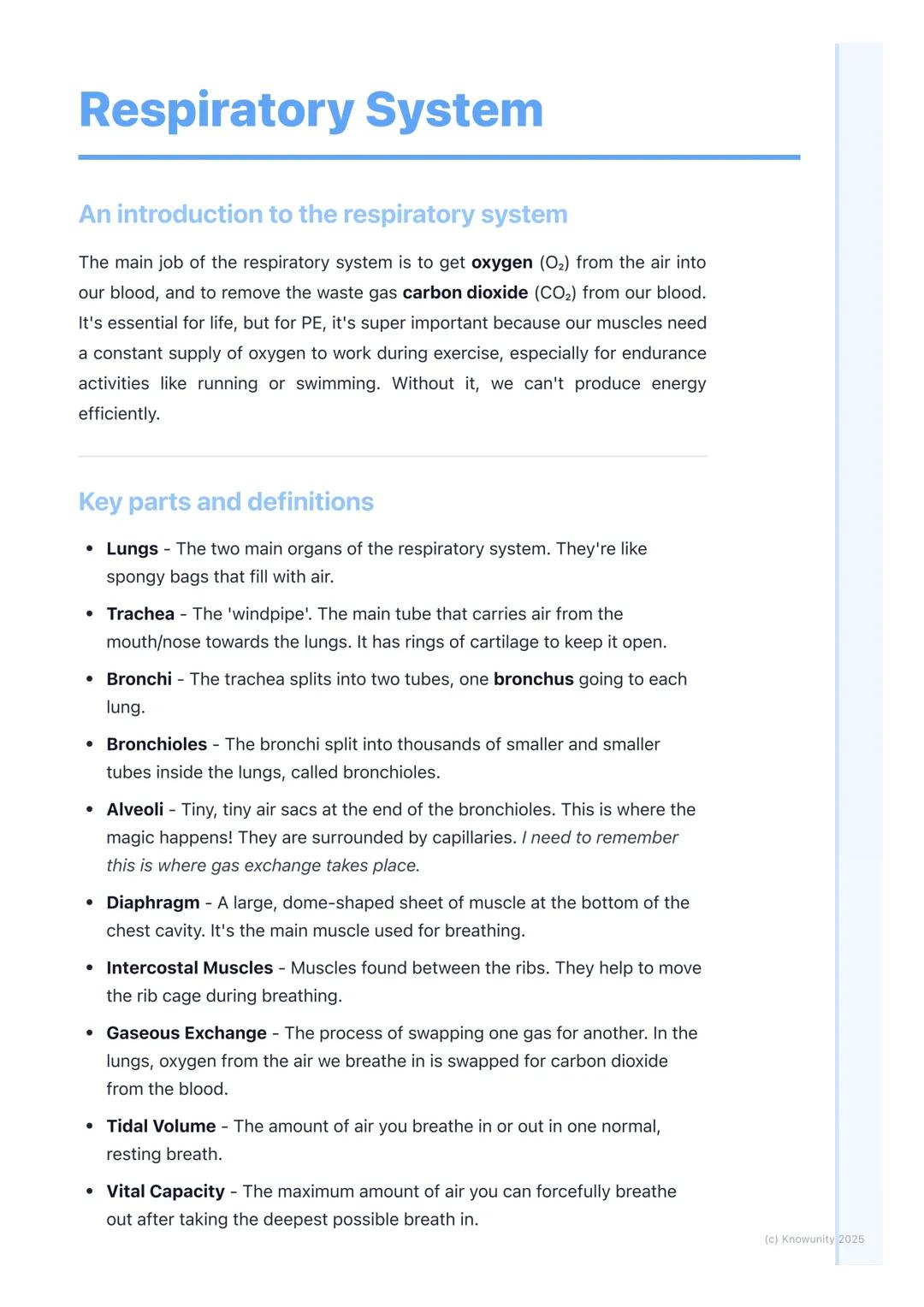
Respiratory System Basics
Your respiratory system has one critical job: getting oxygen into your blood and removing carbon dioxide. This exchange is absolutely essential for your muscles during exercise, especially when you're doing activities like running or swimming that require endurance.
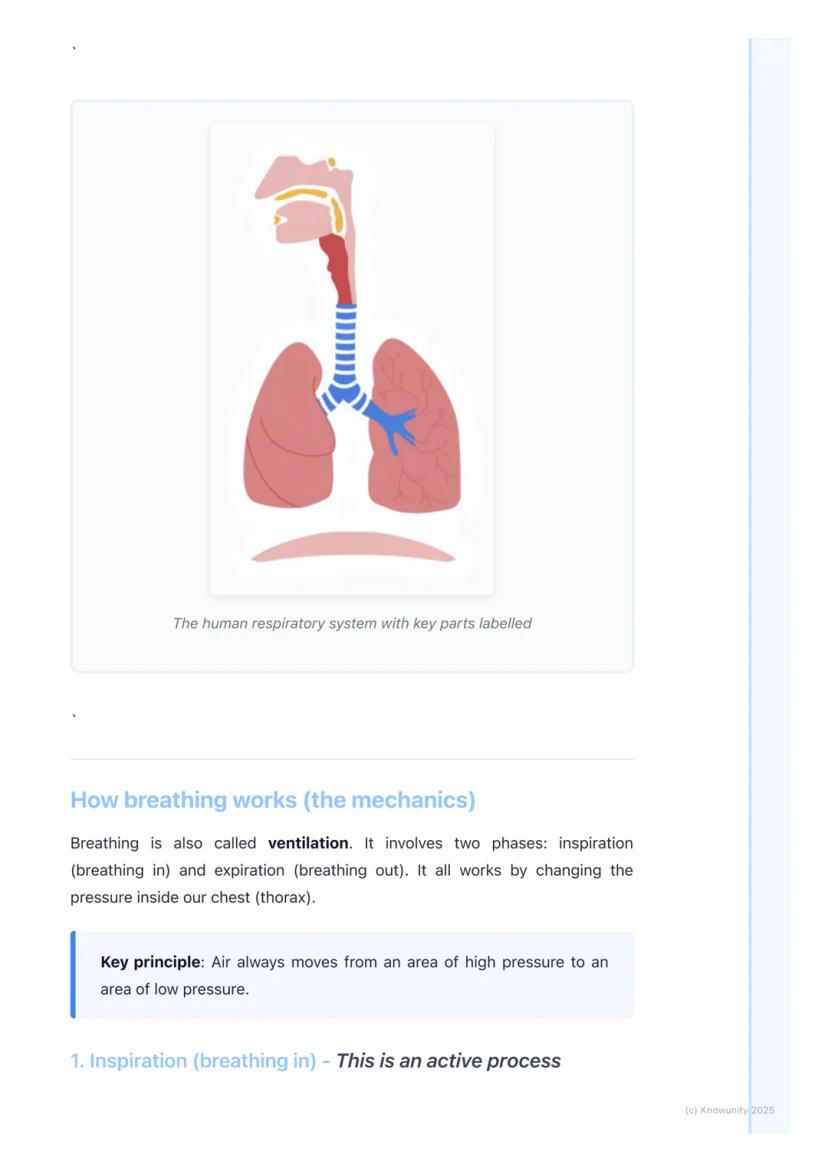
The system has several key parts working together. Your lungs are the main organs - spongy bags that fill with air. Air travels down your trachea (windpipe), which branches into two bronchi (one for each lung), which further divide into thousands of tiny bronchioles. At the end of these tiny tubes are alveoli - microscopic air sacs where the actual gas exchange happens.
Two important muscles control your breathing: the diaphragm and the intercostal muscles (between your ribs). When you exercise, these muscles work harder to increase your tidal volume (the amount of air per normal breath) and use more of your vital capacity (maximum possible breath).
Remember this! The alveoli are where the magic happens - this is where oxygen enters your bloodstream and carbon dioxide exits. This process is called gaseous exchange and it's the whole point of breathing!
2
of 7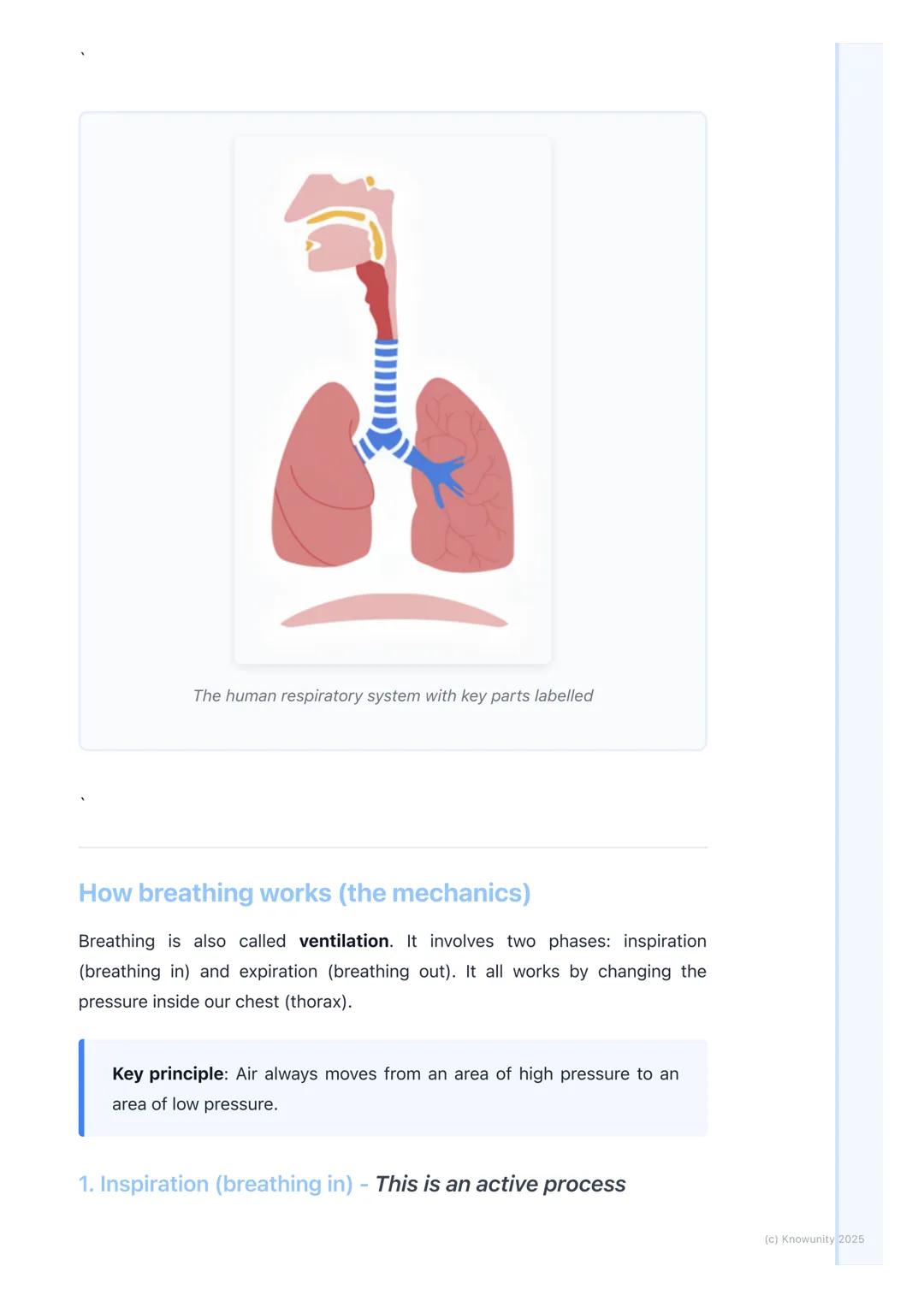
How Breathing Works
Breathing (also called ventilation) works on a simple principle: air always moves from high-pressure areas to low-pressure areas. Your body cleverly changes the pressure inside your chest to pull air in and push it out.
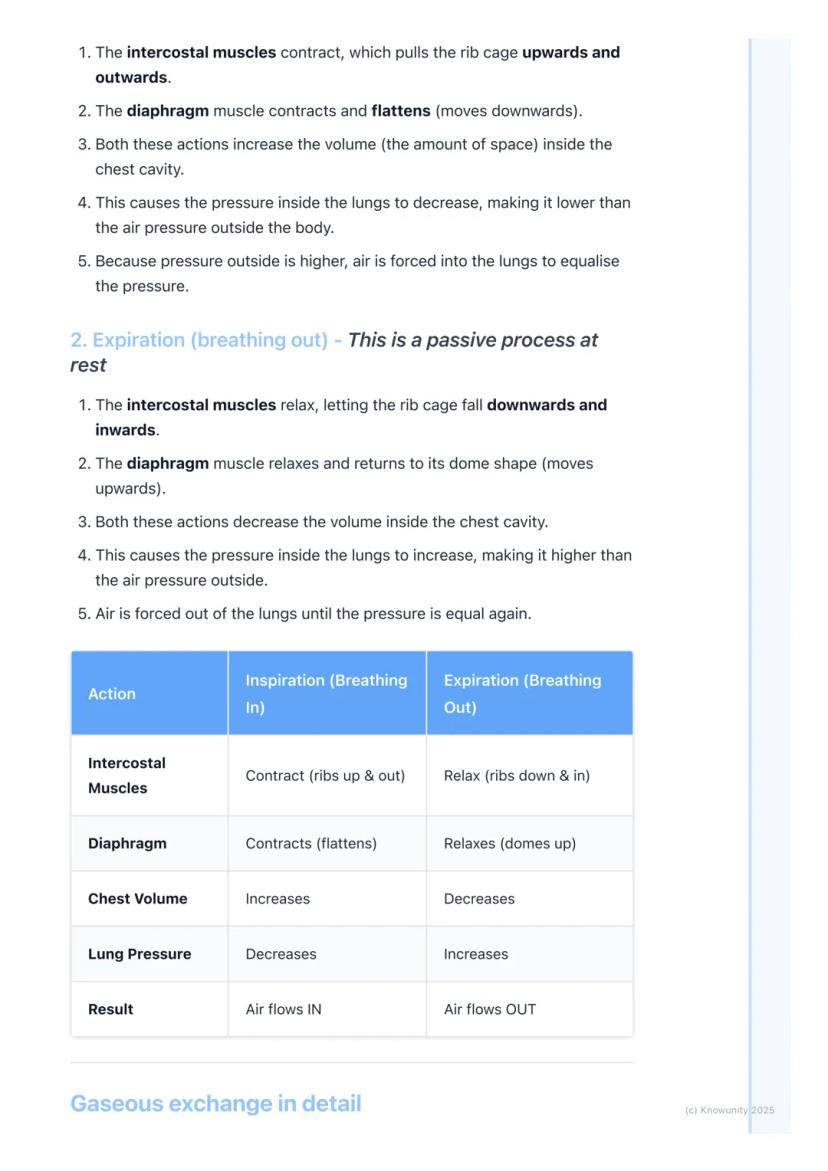
When you breathe in (inspiration), your body actively works to create a vacuum effect. Your intercostal muscles contract, pulling your ribcage up and out, while your diaphragm contracts and flattens downward. These movements increase the space inside your chest, which lowers the air pressure in your lungs below the pressure outside your body. Air rushes in to balance the pressure - it's like creating a mini vacuum!
When you're resting, breathing out (expiration) happens passively. Your muscles relax, allowing your ribcage to fall and your diaphragm to dome upward. This decreases the space in your chest, increases the pressure in your lungs, and forces air out until the pressure equalizes.
Exam tip! Remember that inspiration (breathing IN) is an active process requiring muscle contraction, while normal expiration is passive and happens through muscle relaxation.
3
of 7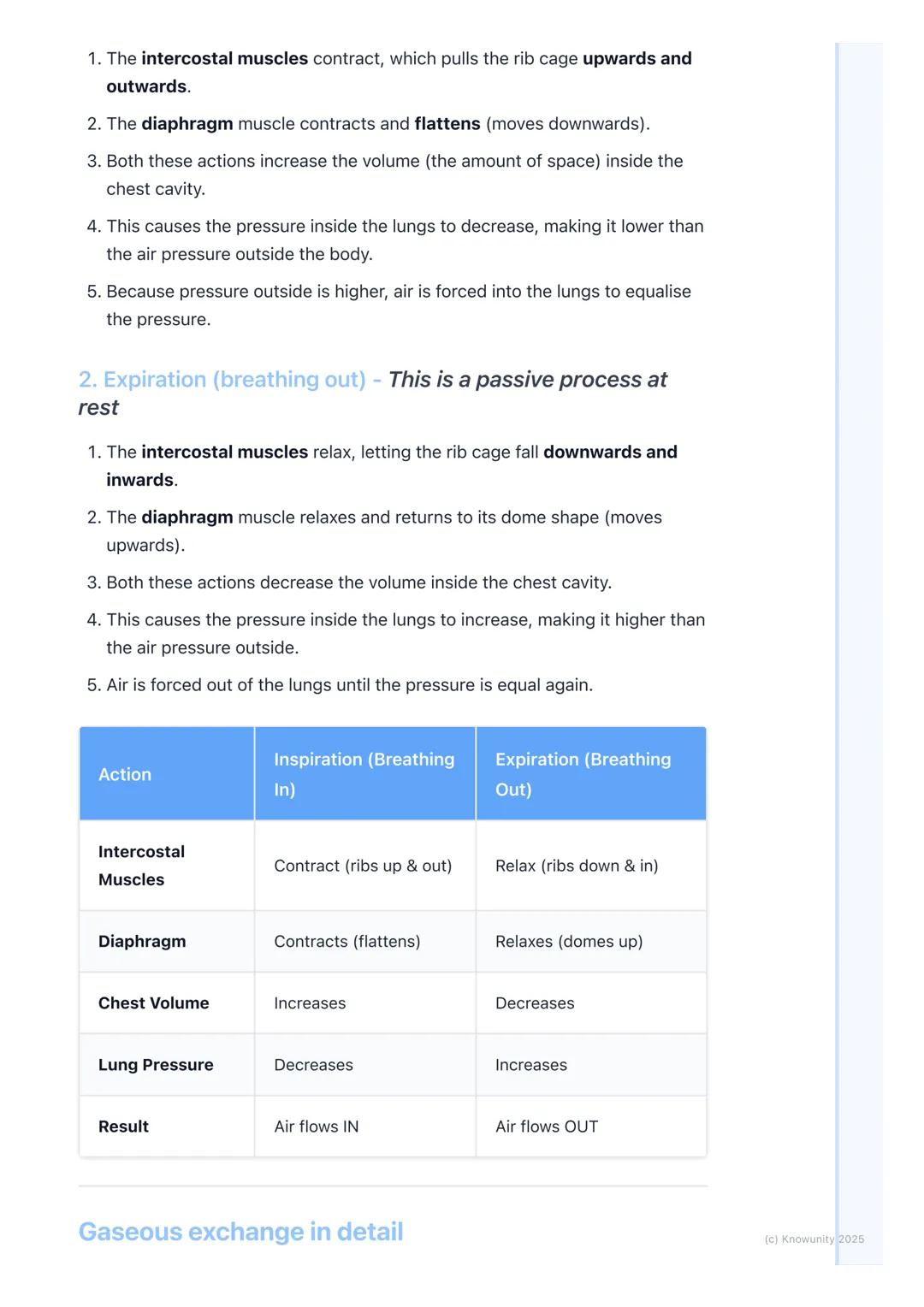
The Mechanics of Breathing
During inspiration (breathing in), several key actions happen in sequence. Your intercostal muscles contract, pulling your rib cage up and out. At the same time, your diaphragm contracts and flattens, moving downward. These actions increase the volume inside your chest cavity, which decreases the pressure in your lungs. Since the pressure is now lower than outside, air rushes into your lungs.
Expiration (breathing out) at rest works in the opposite way. Your intercostal muscles relax, allowing your rib cage to fall inward. Your diaphragm also relaxes, returning to its dome shape. These actions decrease the chest volume and increase lung pressure, forcing air out until the pressures equalize.
This pressure-volume relationship is crucial for breathing. When volume increases, pressure decreases (bringing air in). When volume decreases, pressure increases (pushing air out). Your body uses these simple physics principles to move air efficiently through your respiratory system.
Key point! The pressure-volume relationship follows an inverse pattern: when one goes up, the other goes down. This is the fundamental principle that makes breathing possible!
4
of 7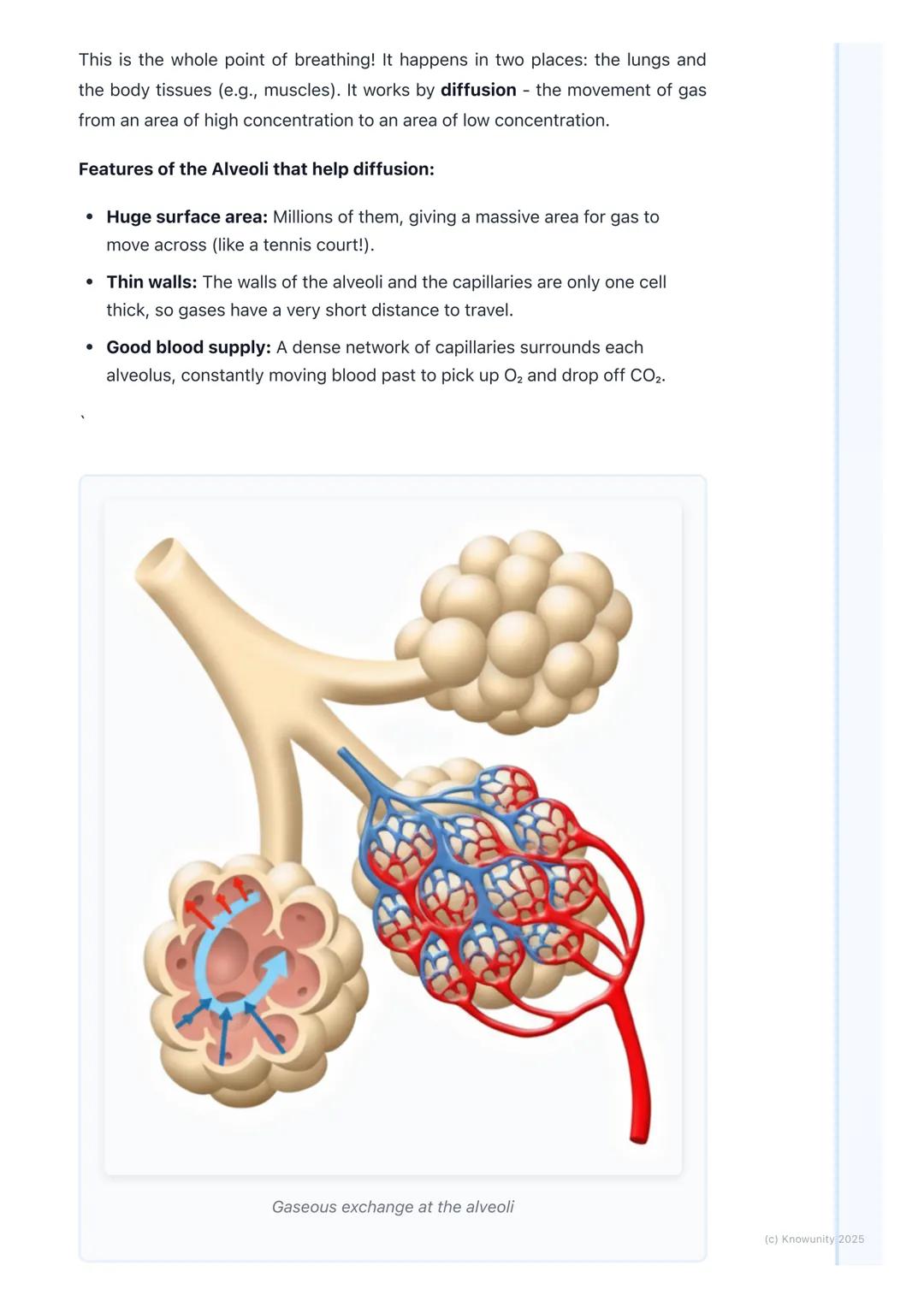
Gaseous Exchange
Gaseous exchange is the whole purpose of breathing and happens in two important locations: your lungs and your body tissues (like muscles). This process works through diffusion - gases naturally move from areas of high concentration to areas of low concentration.
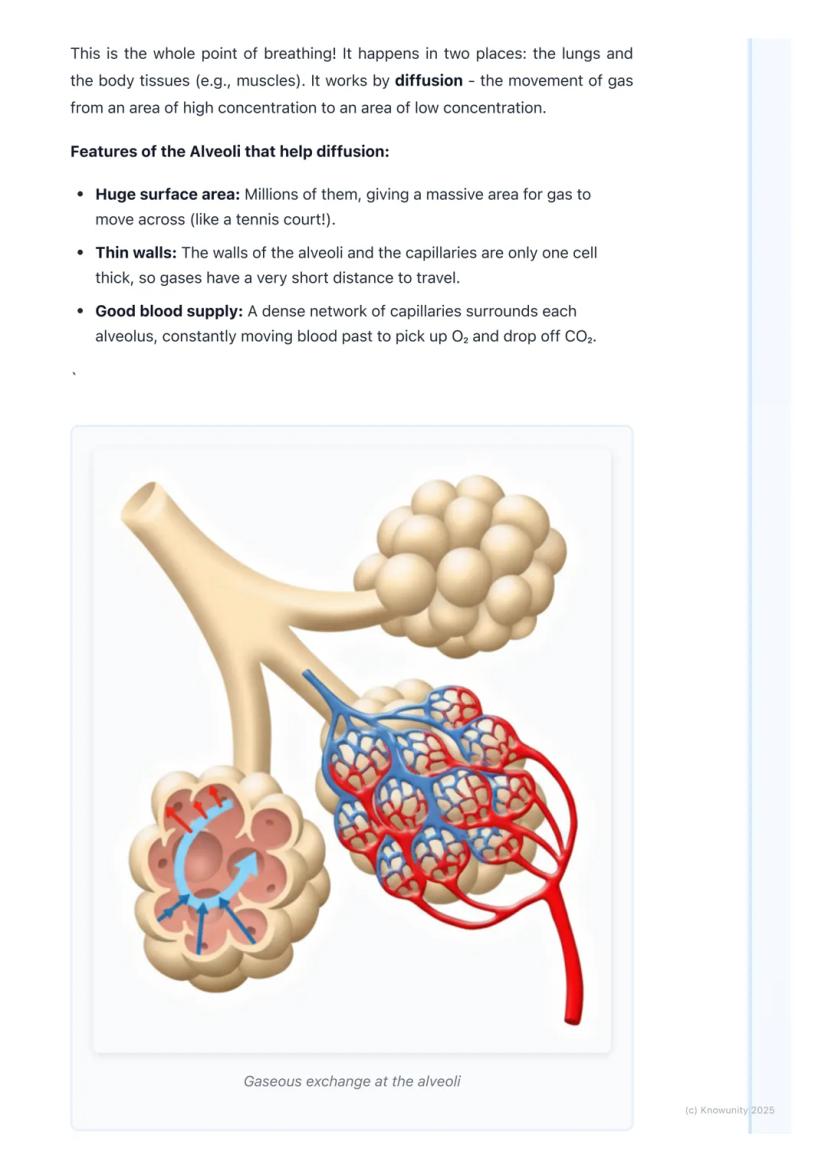
Your alveoli are perfectly designed for efficient gas exchange. They have a huge surface area - millions of tiny sacs that, if spread out, would cover a tennis court! Their walls are extremely thin - just one cell thick - so gases can pass through quickly. Each alveolus is surrounded by capillaries (tiny blood vessels), creating an extensive network that maximizes blood flow for gas exchange.
This incredible design means oxygen and carbon dioxide can move rapidly between your air and blood. The thin barriers and vast surface area make your lungs remarkably efficient at their job, which becomes especially important during exercise when your body demands more oxygen and produces more carbon dioxide.
Amazing fact! Your lungs contain about 600 million alveoli, giving you approximately 70-100 square meters of surface area for gas exchange - that's about the size of a tennis court packed into your chest!
5
of 7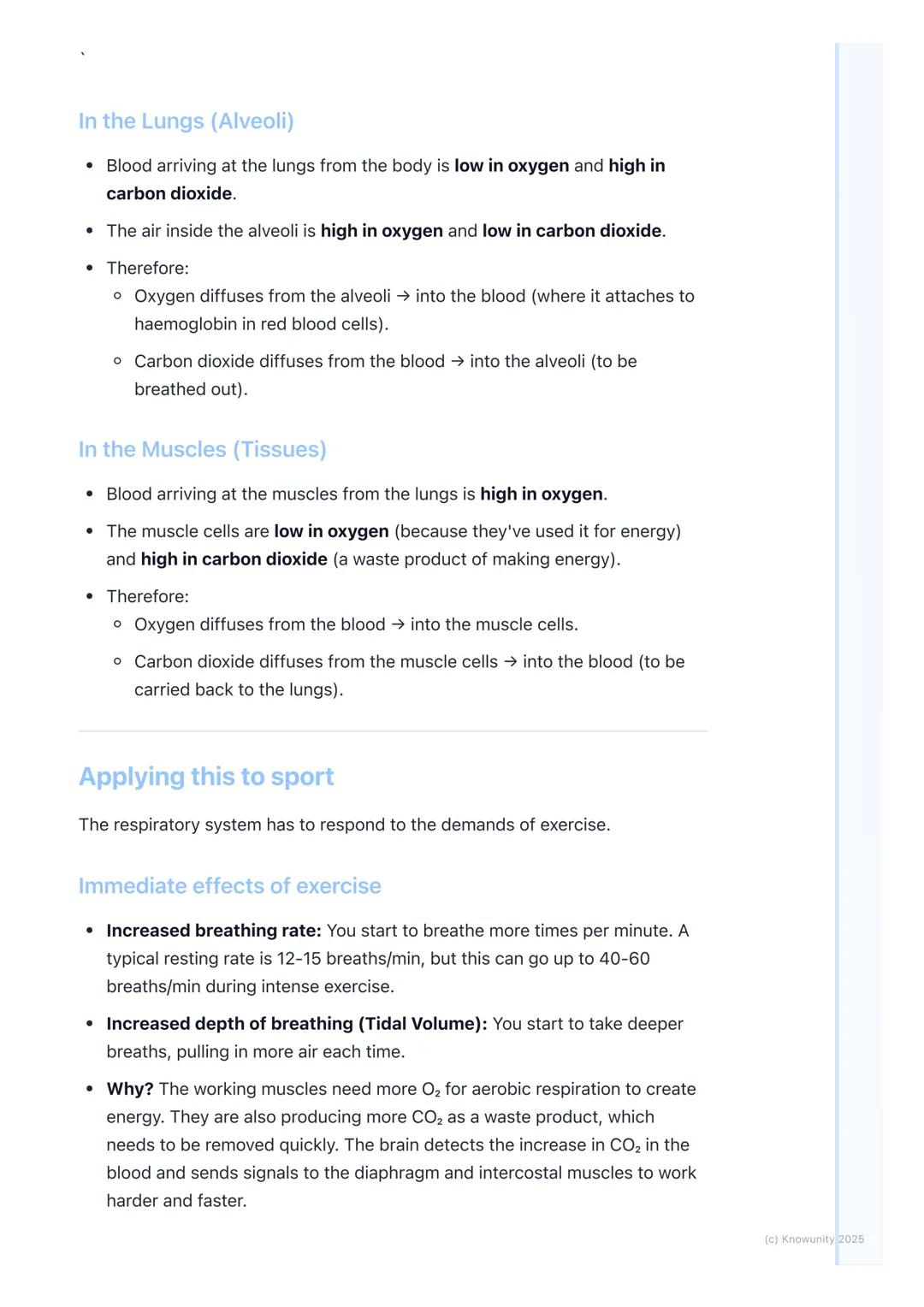
Gas Exchange in Action
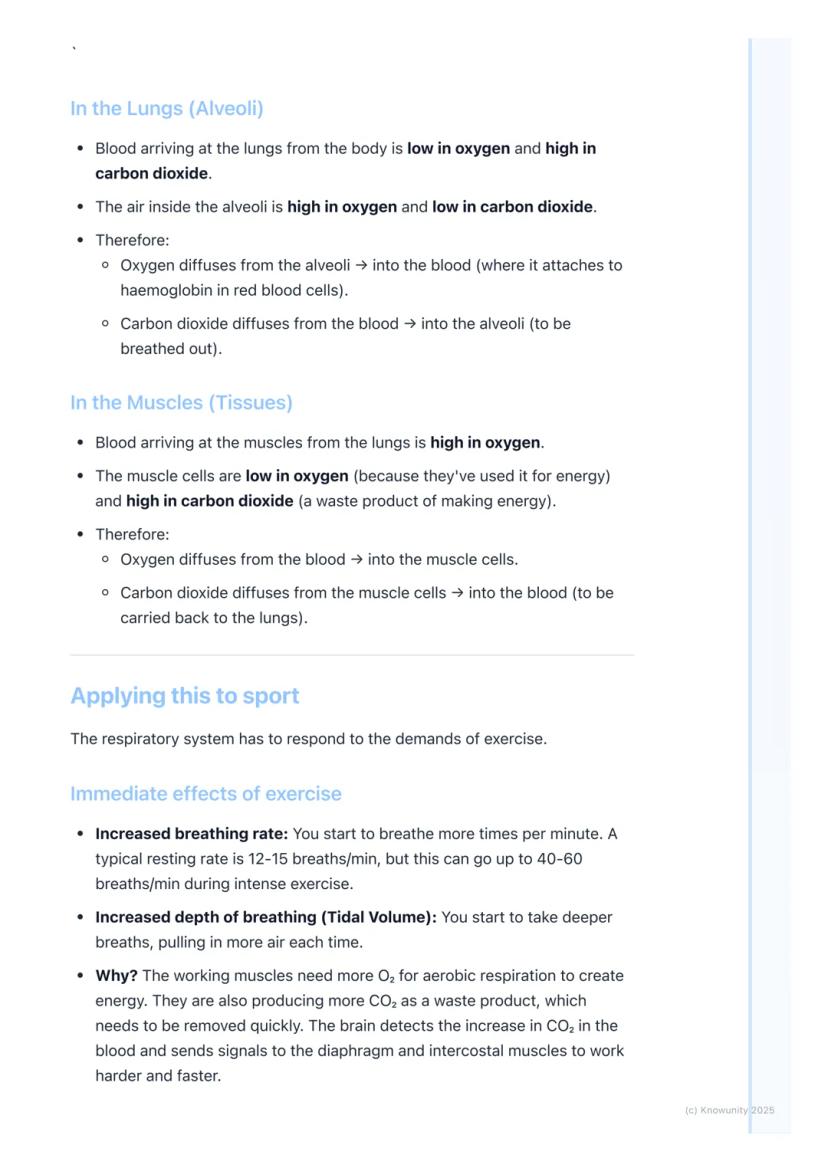
In your lungs, the blood arriving from your body is low in oxygen but high in carbon dioxide. Meanwhile, the air in your alveoli is oxygen-rich and has little carbon dioxide. This concentration difference causes oxygen to move from the alveoli into your blood (where it attaches to hemoglobin in red blood cells), while carbon dioxide moves from your blood into the alveoli to be exhaled.
The opposite happens in your muscles. Blood arriving from your lungs is oxygen-rich, while your working muscle cells have used up oxygen for energy and produced carbon dioxide as waste. This causes oxygen to move from your blood into your muscle cells, while carbon dioxide transfers from your muscles into your blood to be carried back to your lungs.
When you exercise, this entire system shifts into high gear. Your breathing rate increases dramatically from a typical resting rate of 12-15 breaths per minute to potentially 40-60 breaths during intense activity. You also take deeper breaths, increasing your tidal volume. These changes happen because your working muscles need more oxygen for energy production and are creating more carbon dioxide that needs to be removed.
Sports connection! Your brain doesn't actually detect low oxygen - it responds to rising carbon dioxide levels in your blood. This triggers faster, deeper breathing during exercise to get rid of the excess CO₂ your muscles are producing!
6
of 7
Effects of Training on Breathing
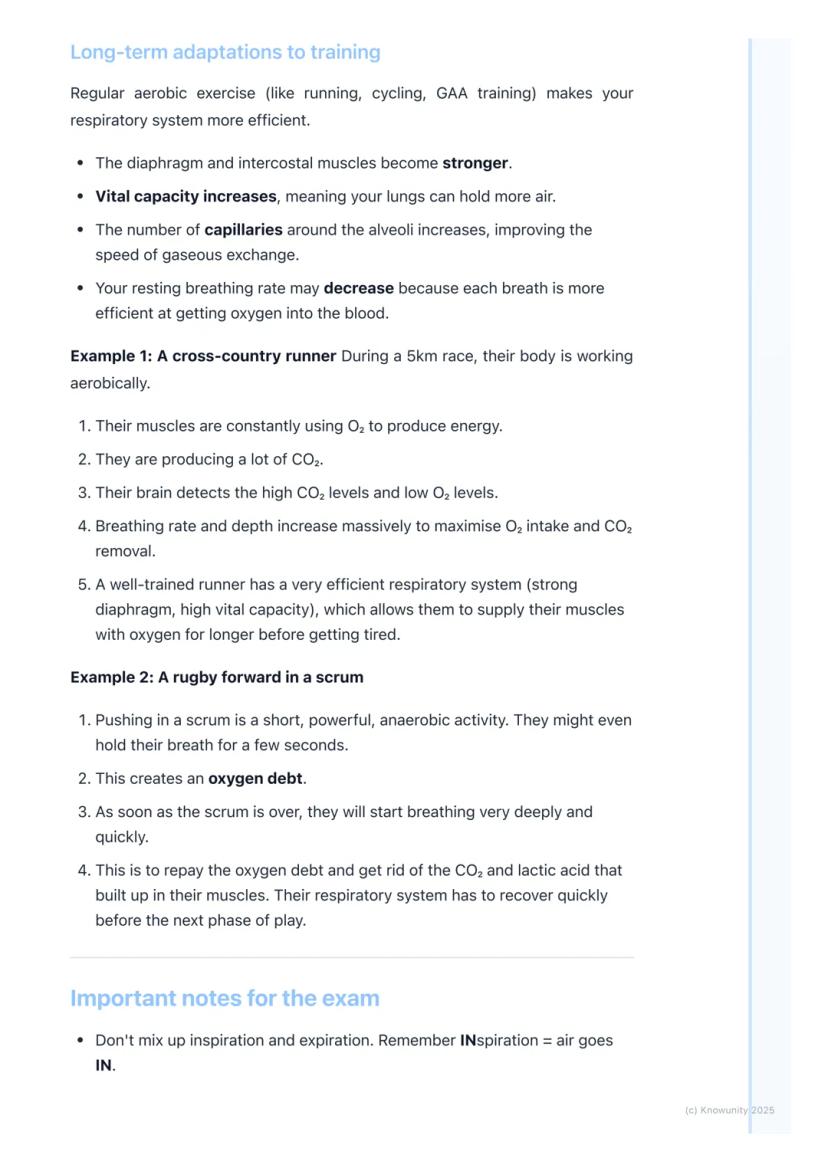
Regular aerobic exercise creates remarkable adaptations in your respiratory system. Your diaphragm and intercostal muscles become stronger, allowing for more powerful breathing. Your vital capacity increases, meaning your lungs can hold more air with each breath. The number of capillaries around your alveoli increases, improving how quickly gases can exchange. Many athletes even develop a lower resting breathing rate because each breath becomes more efficient.
These adaptations look different depending on your sport. A cross-country runner's body works aerobically during a 5km race, constantly using oxygen to produce energy. Their respiratory system adapts to maximize oxygen intake and carbon dioxide removal. With training, their stronger respiratory muscles and increased vital capacity allow them to supply oxygen to working muscles much more efficiently.
For a rugby forward in a scrum, the dynamics change. When pushing in a scrum - a short, powerful, anaerobic activity - they might even momentarily hold their breath. This creates an oxygen debt. After the scrum, they'll breathe deeply and quickly to repay this debt and clear the carbon dioxide and lactic acid that built up. Their respiratory system must recover rapidly before the next play.
Training benefit! After regular aerobic training, your breathing becomes more efficient even when you're not exercising. Many endurance athletes develop a resting breathing rate as low as 6-8 breaths per minute because each breath delivers more oxygen!
7
of 7
Key Points for Exams
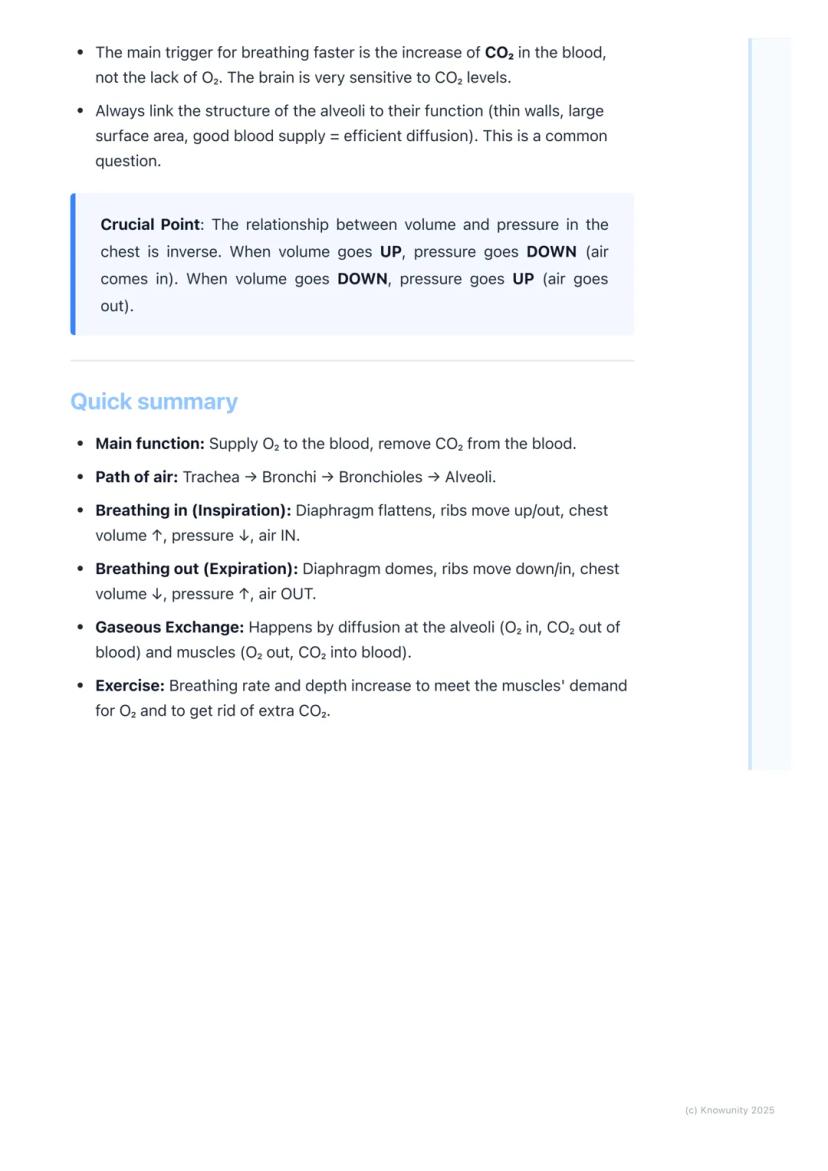
When preparing for exams on the respiratory system, pay special attention to common confusion points. Don't mix up inspiration (breathing in) and expiration (breathing out) - remember "INspiration means air goes IN." Understand that your brain primarily responds to increased carbon dioxide in your blood, not decreased oxygen, when triggering faster breathing.
Questions frequently ask about alveoli structure and function connections. Be ready to explain how their thin walls, vast surface area, and extensive blood supply enable efficient gas exchange. Also master the inverse relationship between chest volume and pressure - when volume increases, pressure decreases (bringing air in); when volume decreases, pressure increases (pushing air out).
To summarize the entire system: Air travels through your trachea, bronchi, and bronchioles to reach your alveoli. During inspiration, your diaphragm flattens and ribs move up/out to increase chest volume, decrease pressure, and draw air in. During expiration, your diaphragm domes and ribs move down/in, decreasing volume, increasing pressure, and pushing air out. Gas exchange happens at both your alveoli and muscles through diffusion. During exercise, your breathing rate and depth increase to meet your muscles' higher oxygen demand.
Exam success tip! Diagrams are your friend! Practice drawing the breathing cycle and gas exchange processes. Being able to visualize these processes helps tremendously with understanding and explaining them in exams.
Pensamos que nunca lo preguntarías...
¿Qué es Knowunity AI companion?
Nuestro compañero de IA está específicamente adaptado a las necesidades de los estudiantes. Basándonos en los millones de contenidos que tenemos en la plataforma, podemos dar a los estudiantes respuestas realmente significativas y relevantes. Pero no se trata solo de respuestas, el compañero también guía a los estudiantes a través de sus retos de aprendizaje diarios, con planes de aprendizaje personalizados, cuestionarios o contenidos en el chat y una personalización del 100% basada en las habilidades y el desarrollo de los estudiantes.
¿Dónde puedo descargar la app Knowunity?
Puedes descargar la app en Google Play Store y Apple App Store.
¿Knowunity es totalmente gratuito?
¡Sí lo es! Tienes acceso totalmente gratuito a todo el contenido de la app, puedes chatear con otros alumnos y recibir ayuda inmeditamente. Puedes ganar dinero utilizando la aplicación, que te permitirá acceder a determinadas funciones.
¿No encuentras lo que buscas? Explora otros temas.
Mira lo que dicen nuestros usuarios. Les encantó — y a ti también te encantará.
4.6/5App Store
4.7/5Google Play
La app es muy fácil de usar y está muy bien diseñada. Hasta ahora he encontrado todo lo que estaba buscando y he podido aprender mucho de las presentaciones. Definitivamente utilizaré la aplicación para un examen de clase. Y, por supuesto, también me sirve mucho de inspiración.
Pablousuario de iOS
Esta app es realmente genial. Hay tantos apuntes de clase y ayuda [...]. Tengo problemas con matemáticas, por ejemplo, y la aplicación tiene muchas opciones de ayuda. Gracias a Knowunity, he mejorado en mates. Se la recomiendo a todo el mundo.
Elenausuaria de Android
Vaya, estoy realmente sorprendida. Acabo de probar la app porque la he visto anunciada muchas veces y me he quedado absolutamente alucinada. Esta app es LA AYUDA que quieres para el insti y, sobre todo, ofrece muchísimas cosas, como ejercicios y hojas informativas, que a mí personalmente me han sido MUY útiles.
Anausuaria de iOS
Physical Education3 visualizaciones·Actualizado Jun 10, 2026·7 páginasUnderstanding the Respiratory System: Breathing and Oxygen
The respiratory system is essential for supplying oxygen to our blood and removing carbon dioxide. This vital system becomes even more important during exercise when our muscles need extra oxygen to produce energy efficiently. Understanding how breathing works and changes...
1
of 7
Inscríbete para ver los apuntes. ¡Es gratis!
- Acceso a todos los documentos
- Mejora tus notas
- Únete a millones de estudiantes
Respiratory System Basics
Your respiratory system has one critical job: getting oxygen into your blood and removing carbon dioxide. This exchange is absolutely essential for your muscles during exercise, especially when you're doing activities like running or swimming that require endurance.
The system has several key parts working together. Your lungs are the main organs - spongy bags that fill with air. Air travels down your trachea (windpipe), which branches into two bronchi (one for each lung), which further divide into thousands of tiny bronchioles. At the end of these tiny tubes are alveoli - microscopic air sacs where the actual gas exchange happens.
Two important muscles control your breathing: the diaphragm and the intercostal muscles (between your ribs). When you exercise, these muscles work harder to increase your tidal volume (the amount of air per normal breath) and use more of your vital capacity (maximum possible breath).
Remember this! The alveoli are where the magic happens - this is where oxygen enters your bloodstream and carbon dioxide exits. This process is called gaseous exchange and it's the whole point of breathing!
2
of 7Inscríbete para ver los apuntes. ¡Es gratis!
- Acceso a todos los documentos
- Mejora tus notas
- Únete a millones de estudiantes
How Breathing Works
Breathing (also called ventilation) works on a simple principle: air always moves from high-pressure areas to low-pressure areas. Your body cleverly changes the pressure inside your chest to pull air in and push it out.
When you breathe in (inspiration), your body actively works to create a vacuum effect. Your intercostal muscles contract, pulling your ribcage up and out, while your diaphragm contracts and flattens downward. These movements increase the space inside your chest, which lowers the air pressure in your lungs below the pressure outside your body. Air rushes in to balance the pressure - it's like creating a mini vacuum!
When you're resting, breathing out (expiration) happens passively. Your muscles relax, allowing your ribcage to fall and your diaphragm to dome upward. This decreases the space in your chest, increases the pressure in your lungs, and forces air out until the pressure equalizes.
Exam tip! Remember that inspiration (breathing IN) is an active process requiring muscle contraction, while normal expiration is passive and happens through muscle relaxation.
3
of 7Inscríbete para ver los apuntes. ¡Es gratis!
- Acceso a todos los documentos
- Mejora tus notas
- Únete a millones de estudiantes
The Mechanics of Breathing
During inspiration (breathing in), several key actions happen in sequence. Your intercostal muscles contract, pulling your rib cage up and out. At the same time, your diaphragm contracts and flattens, moving downward. These actions increase the volume inside your chest cavity, which decreases the pressure in your lungs. Since the pressure is now lower than outside, air rushes into your lungs.
Expiration (breathing out) at rest works in the opposite way. Your intercostal muscles relax, allowing your rib cage to fall inward. Your diaphragm also relaxes, returning to its dome shape. These actions decrease the chest volume and increase lung pressure, forcing air out until the pressures equalize.
This pressure-volume relationship is crucial for breathing. When volume increases, pressure decreases (bringing air in). When volume decreases, pressure increases (pushing air out). Your body uses these simple physics principles to move air efficiently through your respiratory system.
Key point! The pressure-volume relationship follows an inverse pattern: when one goes up, the other goes down. This is the fundamental principle that makes breathing possible!
4
of 7Inscríbete para ver los apuntes. ¡Es gratis!
- Acceso a todos los documentos
- Mejora tus notas
- Únete a millones de estudiantes
Gaseous Exchange
Gaseous exchange is the whole purpose of breathing and happens in two important locations: your lungs and your body tissues (like muscles). This process works through diffusion - gases naturally move from areas of high concentration to areas of low concentration.
Your alveoli are perfectly designed for efficient gas exchange. They have a huge surface area - millions of tiny sacs that, if spread out, would cover a tennis court! Their walls are extremely thin - just one cell thick - so gases can pass through quickly. Each alveolus is surrounded by capillaries (tiny blood vessels), creating an extensive network that maximizes blood flow for gas exchange.
This incredible design means oxygen and carbon dioxide can move rapidly between your air and blood. The thin barriers and vast surface area make your lungs remarkably efficient at their job, which becomes especially important during exercise when your body demands more oxygen and produces more carbon dioxide.
Amazing fact! Your lungs contain about 600 million alveoli, giving you approximately 70-100 square meters of surface area for gas exchange - that's about the size of a tennis court packed into your chest!
5
of 7Inscríbete para ver los apuntes. ¡Es gratis!
- Acceso a todos los documentos
- Mejora tus notas
- Únete a millones de estudiantes
Gas Exchange in Action
In your lungs, the blood arriving from your body is low in oxygen but high in carbon dioxide. Meanwhile, the air in your alveoli is oxygen-rich and has little carbon dioxide. This concentration difference causes oxygen to move from the alveoli into your blood (where it attaches to hemoglobin in red blood cells), while carbon dioxide moves from your blood into the alveoli to be exhaled.
The opposite happens in your muscles. Blood arriving from your lungs is oxygen-rich, while your working muscle cells have used up oxygen for energy and produced carbon dioxide as waste. This causes oxygen to move from your blood into your muscle cells, while carbon dioxide transfers from your muscles into your blood to be carried back to your lungs.
When you exercise, this entire system shifts into high gear. Your breathing rate increases dramatically from a typical resting rate of 12-15 breaths per minute to potentially 40-60 breaths during intense activity. You also take deeper breaths, increasing your tidal volume. These changes happen because your working muscles need more oxygen for energy production and are creating more carbon dioxide that needs to be removed.
Sports connection! Your brain doesn't actually detect low oxygen - it responds to rising carbon dioxide levels in your blood. This triggers faster, deeper breathing during exercise to get rid of the excess CO₂ your muscles are producing!
6
of 7Inscríbete para ver los apuntes. ¡Es gratis!
- Acceso a todos los documentos
- Mejora tus notas
- Únete a millones de estudiantes
Effects of Training on Breathing
Regular aerobic exercise creates remarkable adaptations in your respiratory system. Your diaphragm and intercostal muscles become stronger, allowing for more powerful breathing. Your vital capacity increases, meaning your lungs can hold more air with each breath. The number of capillaries around your alveoli increases, improving how quickly gases can exchange. Many athletes even develop a lower resting breathing rate because each breath becomes more efficient.
These adaptations look different depending on your sport. A cross-country runner's body works aerobically during a 5km race, constantly using oxygen to produce energy. Their respiratory system adapts to maximize oxygen intake and carbon dioxide removal. With training, their stronger respiratory muscles and increased vital capacity allow them to supply oxygen to working muscles much more efficiently.
For a rugby forward in a scrum, the dynamics change. When pushing in a scrum - a short, powerful, anaerobic activity - they might even momentarily hold their breath. This creates an oxygen debt. After the scrum, they'll breathe deeply and quickly to repay this debt and clear the carbon dioxide and lactic acid that built up. Their respiratory system must recover rapidly before the next play.
Training benefit! After regular aerobic training, your breathing becomes more efficient even when you're not exercising. Many endurance athletes develop a resting breathing rate as low as 6-8 breaths per minute because each breath delivers more oxygen!
7
of 7Inscríbete para ver los apuntes. ¡Es gratis!
- Acceso a todos los documentos
- Mejora tus notas
- Únete a millones de estudiantes
Key Points for Exams
When preparing for exams on the respiratory system, pay special attention to common confusion points. Don't mix up inspiration (breathing in) and expiration (breathing out) - remember "INspiration means air goes IN." Understand that your brain primarily responds to increased carbon dioxide in your blood, not decreased oxygen, when triggering faster breathing.
Questions frequently ask about alveoli structure and function connections. Be ready to explain how their thin walls, vast surface area, and extensive blood supply enable efficient gas exchange. Also master the inverse relationship between chest volume and pressure - when volume increases, pressure decreases (bringing air in); when volume decreases, pressure increases (pushing air out).
To summarize the entire system: Air travels through your trachea, bronchi, and bronchioles to reach your alveoli. During inspiration, your diaphragm flattens and ribs move up/out to increase chest volume, decrease pressure, and draw air in. During expiration, your diaphragm domes and ribs move down/in, decreasing volume, increasing pressure, and pushing air out. Gas exchange happens at both your alveoli and muscles through diffusion. During exercise, your breathing rate and depth increase to meet your muscles' higher oxygen demand.
Exam success tip! Diagrams are your friend! Practice drawing the breathing cycle and gas exchange processes. Being able to visualize these processes helps tremendously with understanding and explaining them in exams.
Pensamos que nunca lo preguntarías...
¿Qué es Knowunity AI companion?
Nuestro compañero de IA está específicamente adaptado a las necesidades de los estudiantes. Basándonos en los millones de contenidos que tenemos en la plataforma, podemos dar a los estudiantes respuestas realmente significativas y relevantes. Pero no se trata solo de respuestas, el compañero también guía a los estudiantes a través de sus retos de aprendizaje diarios, con planes de aprendizaje personalizados, cuestionarios o contenidos en el chat y una personalización del 100% basada en las habilidades y el desarrollo de los estudiantes.
¿Dónde puedo descargar la app Knowunity?
Puedes descargar la app en Google Play Store y Apple App Store.
¿Knowunity es totalmente gratuito?
¡Sí lo es! Tienes acceso totalmente gratuito a todo el contenido de la app, puedes chatear con otros alumnos y recibir ayuda inmeditamente. Puedes ganar dinero utilizando la aplicación, que te permitirá acceder a determinadas funciones.
¿No encuentras lo que buscas? Explora otros temas.
Mira lo que dicen nuestros usuarios. Les encantó — y a ti también te encantará.
4.6/5App Store
4.7/5Google Play
La app es muy fácil de usar y está muy bien diseñada. Hasta ahora he encontrado todo lo que estaba buscando y he podido aprender mucho de las presentaciones. Definitivamente utilizaré la aplicación para un examen de clase. Y, por supuesto, también me sirve mucho de inspiración.
Pablousuario de iOS
Esta app es realmente genial. Hay tantos apuntes de clase y ayuda [...]. Tengo problemas con matemáticas, por ejemplo, y la aplicación tiene muchas opciones de ayuda. Gracias a Knowunity, he mejorado en mates. Se la recomiendo a todo el mundo.
Elenausuaria de Android
Vaya, estoy realmente sorprendida. Acabo de probar la app porque la he visto anunciada muchas veces y me he quedado absolutamente alucinada. Esta app es LA AYUDA que quieres para el insti y, sobre todo, ofrece muchísimas cosas, como ejercicios y hojas informativas, que a mí personalmente me han sido MUY útiles.
Anausuaria de iOS