
Powers and roots are mathematical shortcuts that make calculations much...
 Mathematics7 visualizaciones·Actualizado Jun 7, 2026·5 páginas
Understanding Powers, Squares, Cubes, and Roots
1 / 5
1
of 5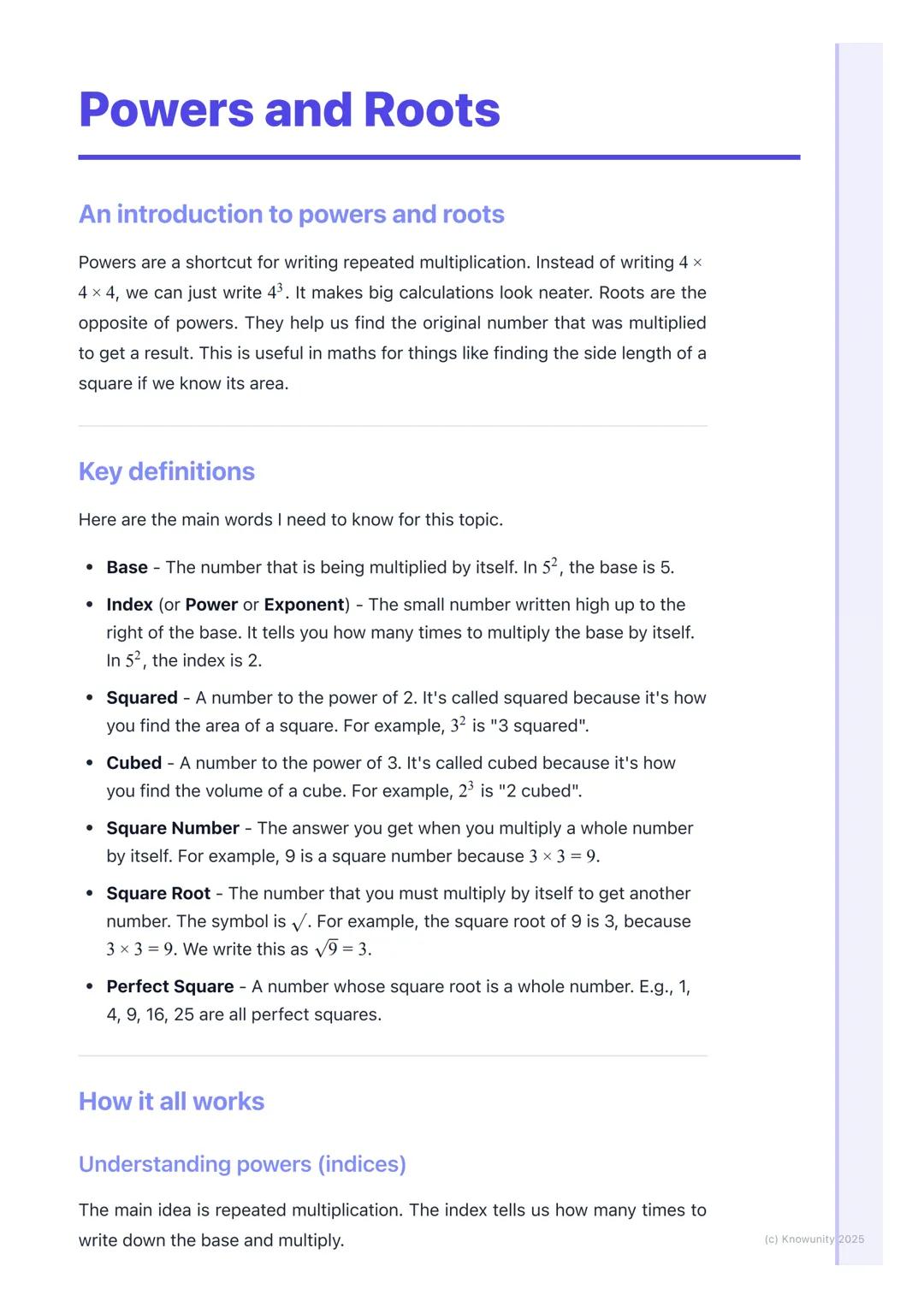
Getting Started with Powers and Roots
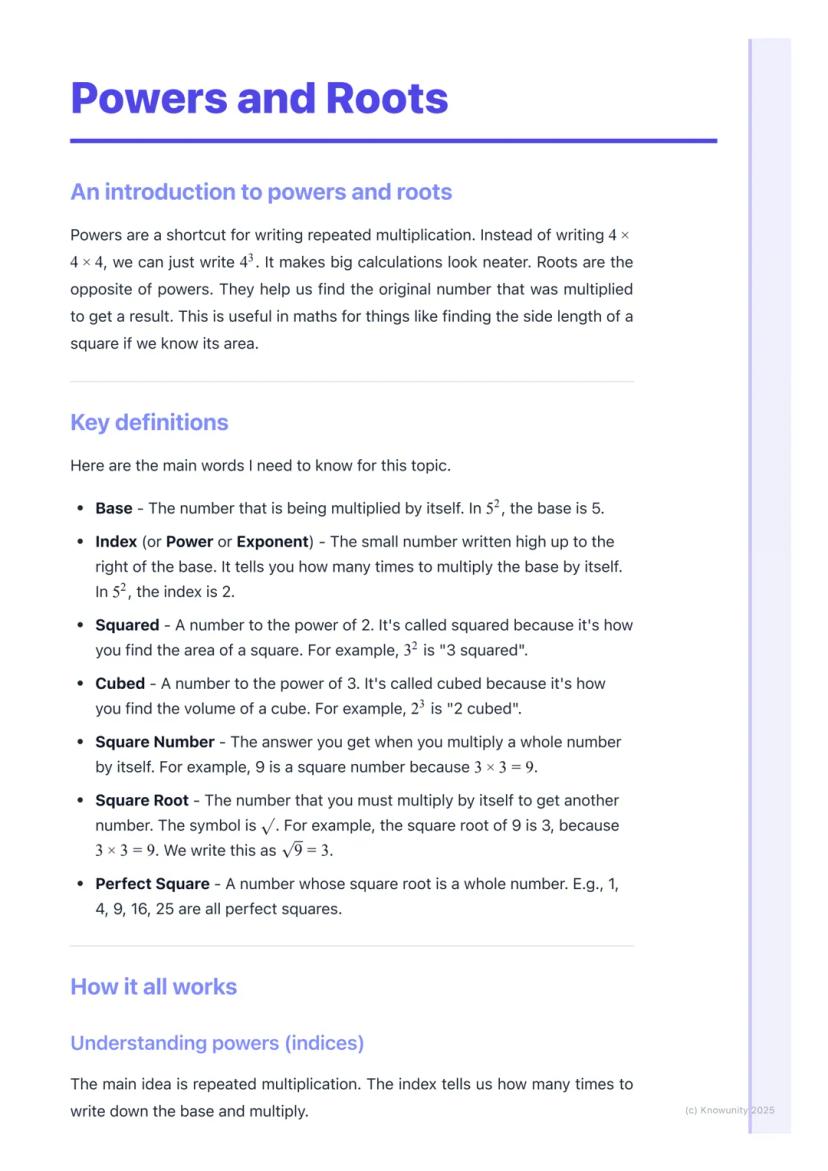
Ever wondered why we write 4³ instead of 4 × 4 × 4? Powers are basically a clever shortcut for repeated multiplication, making your maths look much tidier. The base is the number being multiplied (like the 4), and the index (also called power or exponent) is that small number up top telling you how many times to multiply.
When a number has a power of 2, we call it squared - like 3² is "3 squared". This name comes from finding the area of a square! Similarly, a power of 3 is called cubed because it's how you calculate a cube's volume.
Square numbers are what you get when you multiply any whole number by itself. For example, 9 is a square number because 3 × 3 = 9. These will pop up everywhere in your exams, so they're worth remembering!
Quick Tip: Memorising the first 12 square numbers will make your exam much faster and easier.
2
of 5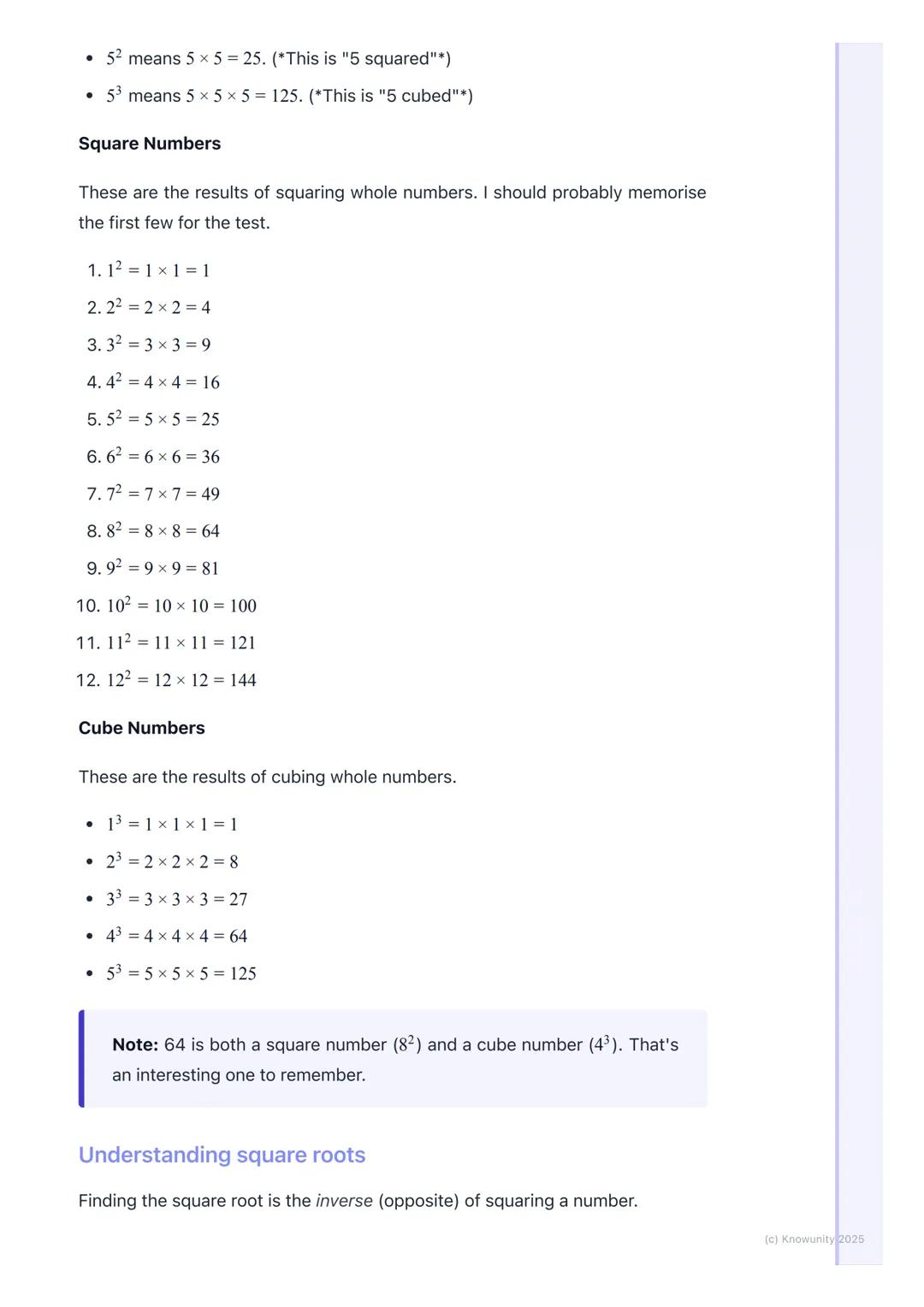
Working with Square Numbers and Cubes
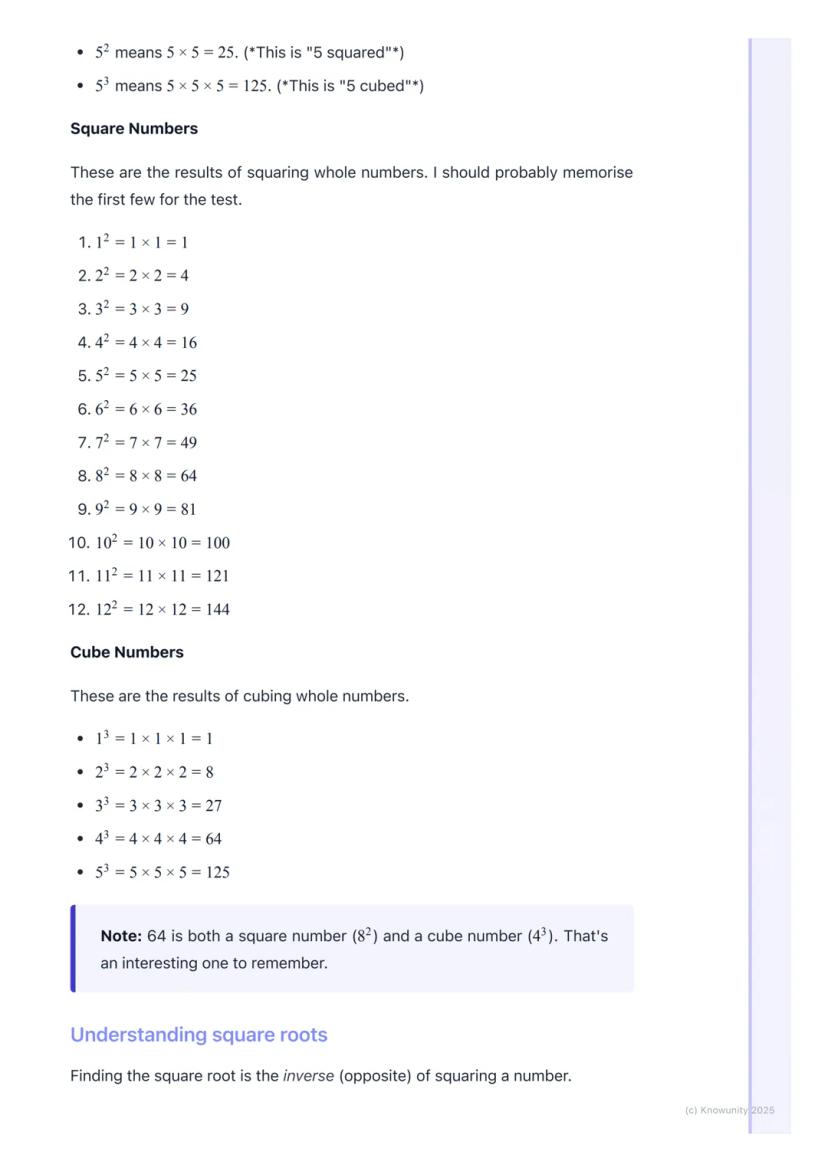
You'll definitely want to memorise these square numbers for tests: 1² = 1, 2² = 4, 3² = 9, 4² = 16, 5² = 25, 6² = 36, 7² = 49, 8² = 64, 9² = 81, 10² = 100, 11² = 121, and 12² = 144. Trust me, knowing these off by heart will save you loads of time.
Cube numbers work similarly but with three multiplications instead of two. The first few are: 1³ = 1, 2³ = 8, 3³ = 27, 4³ = 64, and 5³ = 125.
Here's something interesting - 64 is both a square number (8²) and a cube number (4³). That's definitely worth remembering for trick questions!
Remember: Don't confuse 6² with 6 × 2! The first equals 36, the second equals 12 - completely different answers.
3
of 5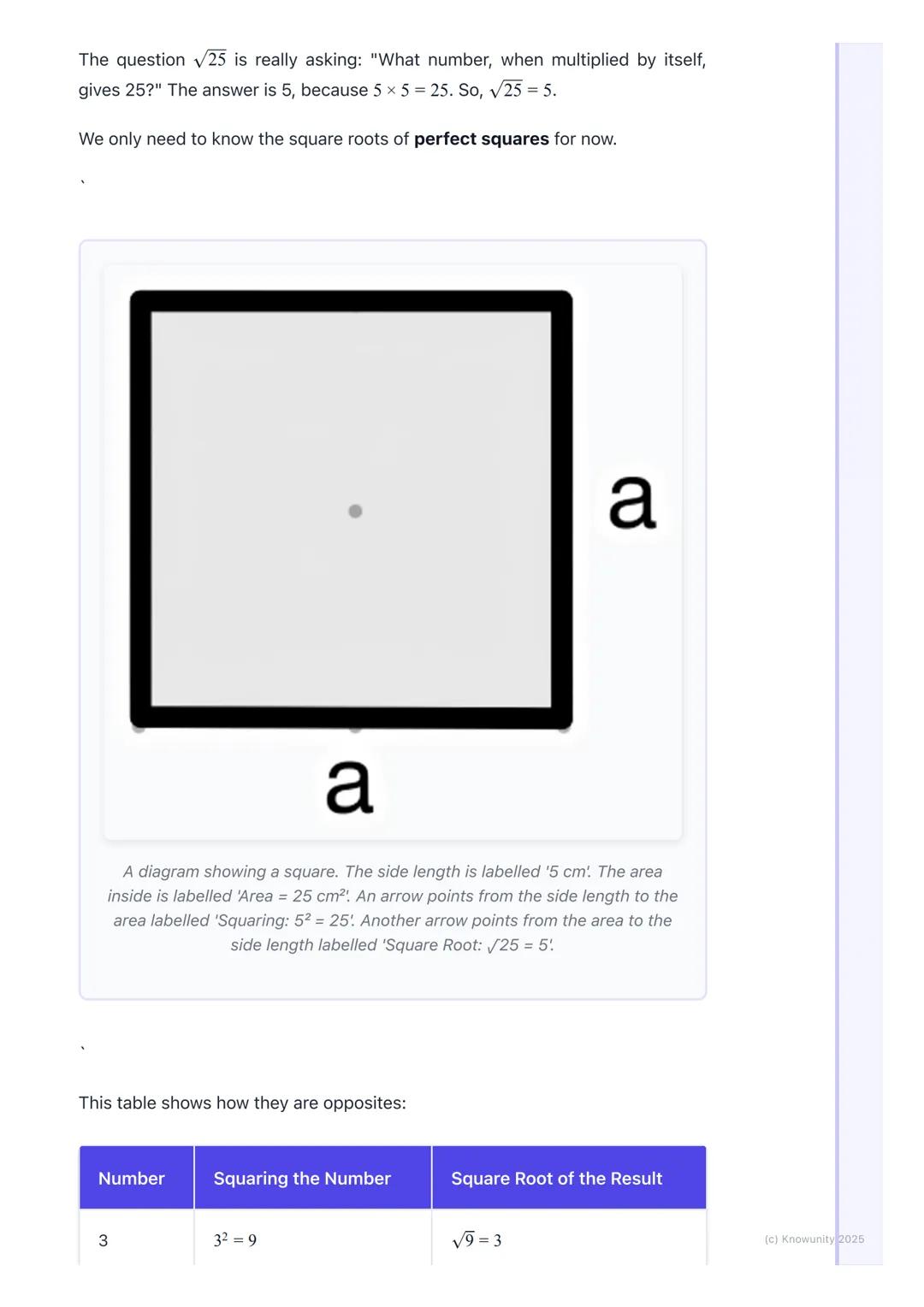
Understanding Square Roots
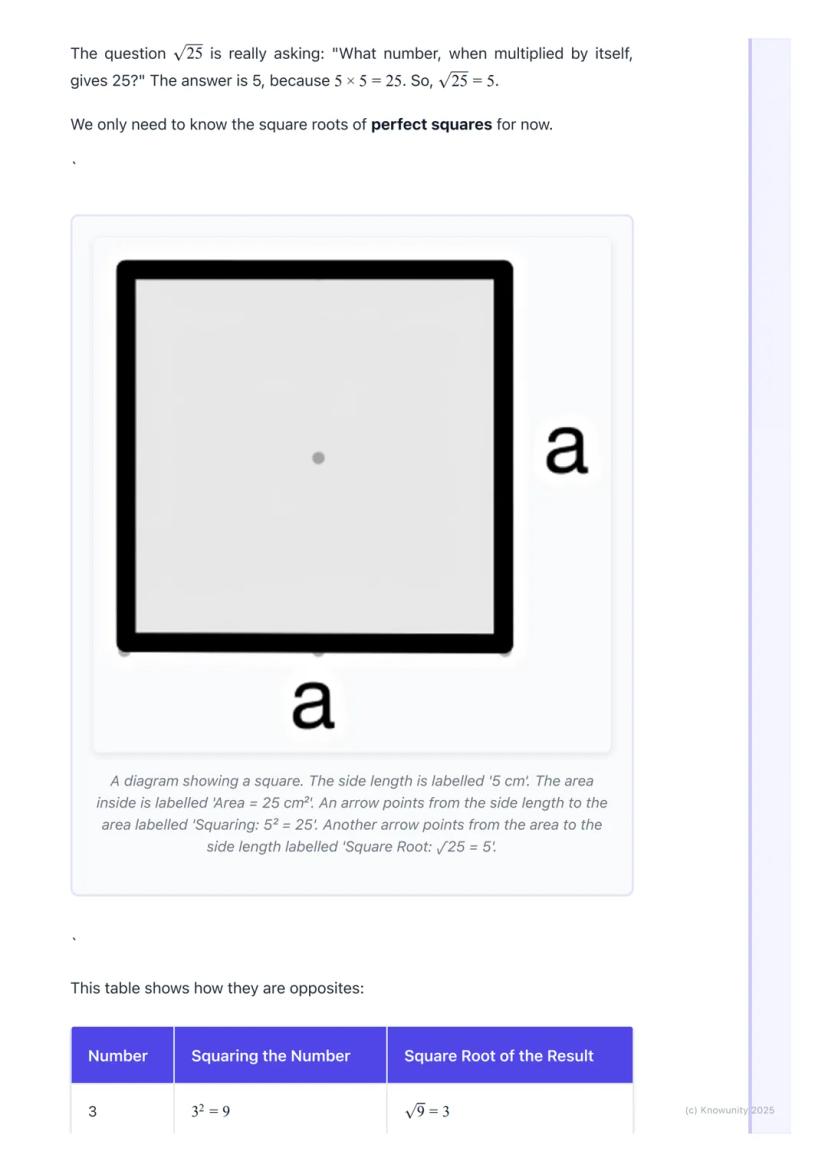
Square roots are the complete opposite of squaring - they're like mathematical detective work. When you see √25, it's asking "what number multiplied by itself gives 25?" The answer is 5, because 5 × 5 = 25.
Think of it like this: if you know a square has an area of 25 cm², the square root helps you find that each side is 5 cm long. That's why we use the square root symbol √.
Perfect squares are numbers whose square roots are whole numbers, like 1, 4, 9, 16, and 25. These are the easiest ones to work with because there's no messy decimals involved.
Visual Tip: Imagine a square with area 25 cm² - the square root finds the length of each side (5 cm).
4
of 5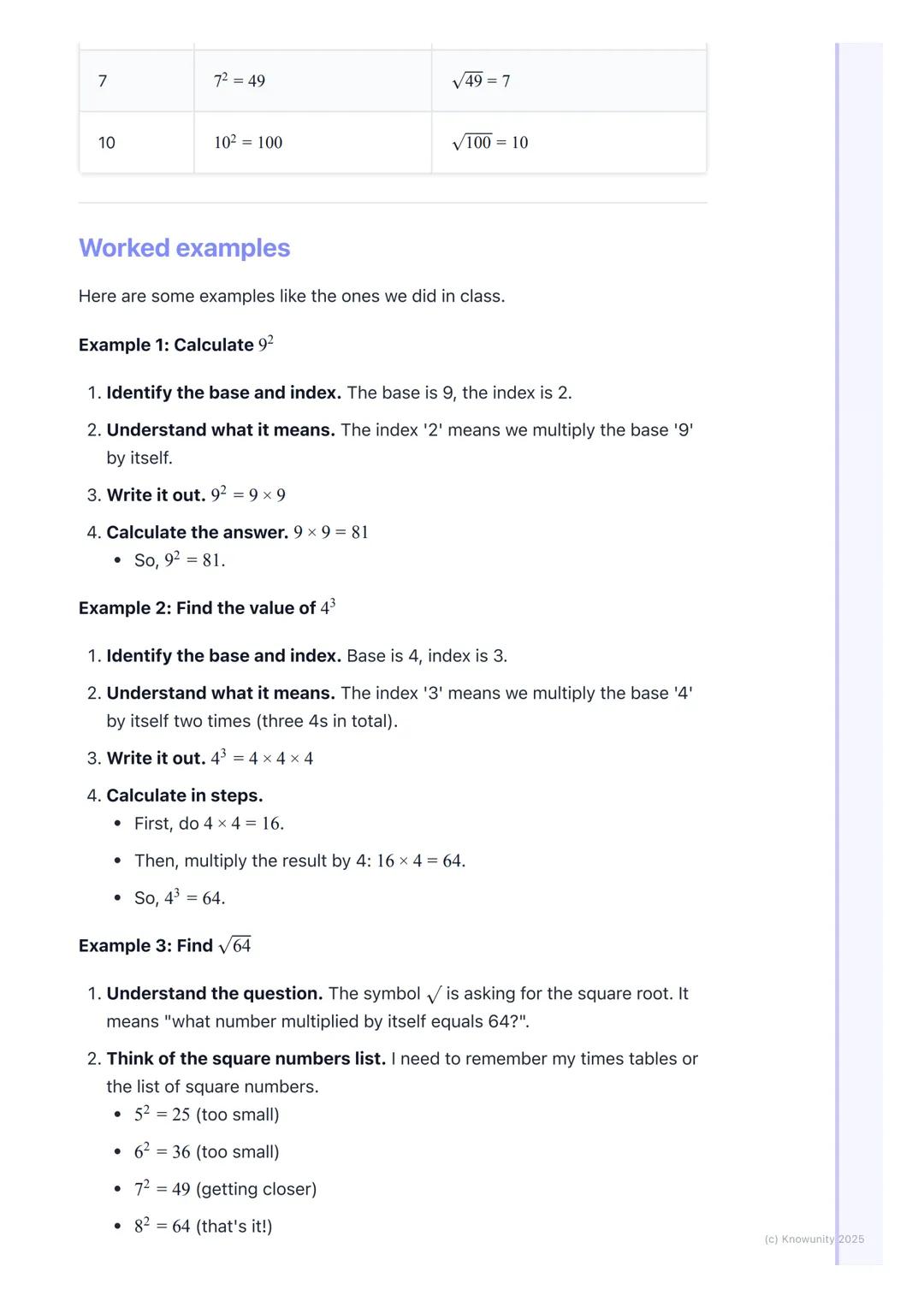
Worked Examples You Can Master
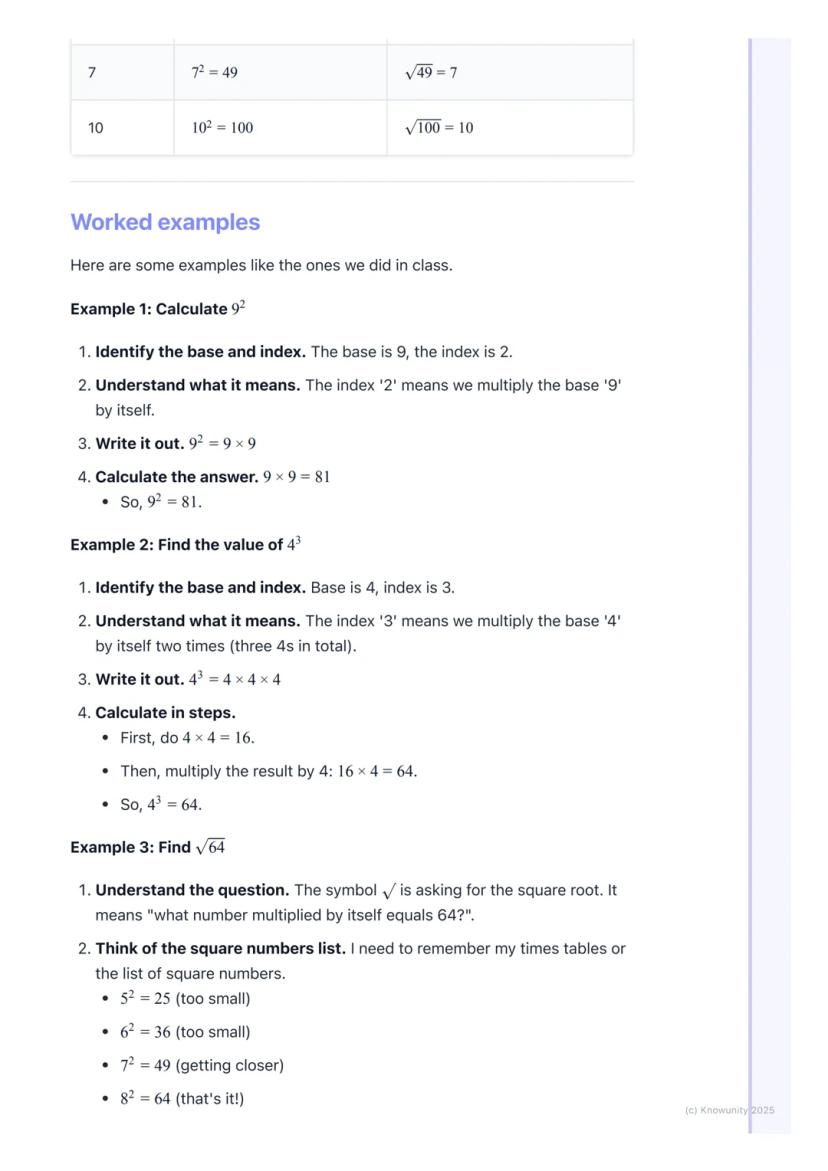
Let's tackle 9²: The base is 9, the index is 2, so we multiply 9 by itself once. That's 9 × 9 = 81. See how straightforward that is?
For 4³, we've got base 4 and index 3, meaning three 4s multiplied together: 4 × 4 × 4. First do 4 × 4 = 16, then 16 × 4 = 64. Breaking it into steps makes it much easier.
Finding √64 means asking "what number times itself equals 64?" Work through your square numbers: 6² = 36 (too small), 7² = 49 (getting closer), 8² = 64 (perfect!). So √64 = 8.
Exam Strategy: Show your working step by step - even if you use a calculator to check, you need to demonstrate your method.
5
of 5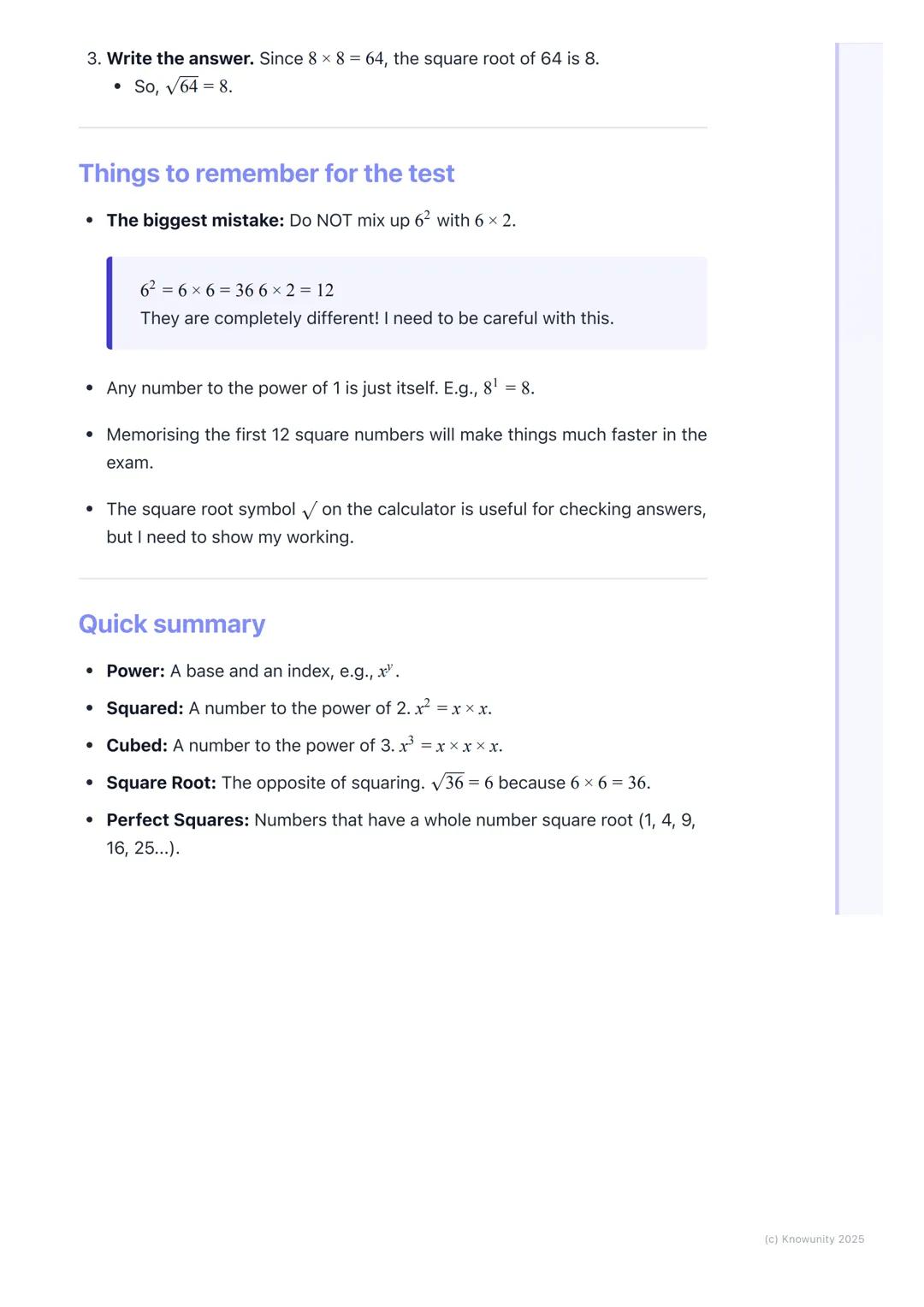
Essential Tips for Test Success
Any number to the power of 1 is just itself - so 8¹ = 8. This might seem obvious, but it catches people out in exams when they overthink it.
The calculator's √ button is handy for checking answers, but always show your working. Examiners want to see that you understand the process, not just that you can press buttons.
Your key takeaways: powers use a base and index (like 5²), squared means power of 2, cubed means power of 3, and square roots reverse the squaring process. Master these basics and you'll smash any powers and roots question.
Final Reminder: Perfect squares (1, 4, 9, 16, 25...) are your best friends - they have nice, neat whole number square roots.
Pensamos que nunca lo preguntarías...
¿Qué es Knowunity AI companion?
Nuestro compañero de IA está específicamente adaptado a las necesidades de los estudiantes. Basándonos en los millones de contenidos que tenemos en la plataforma, podemos dar a los estudiantes respuestas realmente significativas y relevantes. Pero no se trata solo de respuestas, el compañero también guía a los estudiantes a través de sus retos de aprendizaje diarios, con planes de aprendizaje personalizados, cuestionarios o contenidos en el chat y una personalización del 100% basada en las habilidades y el desarrollo de los estudiantes.
¿Dónde puedo descargar la app Knowunity?
Puedes descargar la app en Google Play Store y Apple App Store.
¿Knowunity es totalmente gratuito?
¡Sí lo es! Tienes acceso totalmente gratuito a todo el contenido de la app, puedes chatear con otros alumnos y recibir ayuda inmeditamente. Puedes ganar dinero utilizando la aplicación, que te permitirá acceder a determinadas funciones.
Contenidos más populares de Mathematics
8MathematicsAlgebra
Algebra
5th Year91
MathematicsAlgebra 2
Algebra notes focusing on the factor theorem, completing the square, -b formula, graphs of polynomials
5th Year130
MathematicsSolving Equations
This section focuses on solving one-step and two-step linear equations to find the value of an unknown variable.
1st Year131
MathematicsArithmetic sequences and series
With examples
5th Year130
MathematicsIntroduction to Probability
This topic introduces basic probability concepts, including calculating the probability of simple events and understanding the difference between experimental and theoretical probability.
2nd Year91
MathematicsMaths jc algebra
Maths jc
1st Year230
MathematicsNatural Numbers and Integers
Students will learn about positive whole numbers, zero, and negative whole numbers, and how to add, subtract, multiply, and divide them correctly.
1st Year131
MathematicsDifferential Calculus
Calculus is a topic that comes up nearly everywhere on your maths LC. This is just starter notes that could be useful end of 5th year or start of 6th year
5th Year271
Contenidos más populares
9 Irish
IrishIrish oral questions and answers
Questions and answers for the leaving cert oral
5th Year4264
 English
Key Quotes : Sive
Key Quotes and explanations: Sive
6th Year2842
IrishIrish oral questions
Outline of oral questions
5th Year2055
IrishIníon- le hÁine Durkin
Aine Durkin’s poem, Iníon: Themes & summary
5th Year850
IrishIrish poetry 2027
Iníon + Dínit an Bhróin
5th Year1133
IrishLC HL notes- Iníon (poem)
Includes poem in English and Irish, theme, key words & phrases
5th Year2284
EnglishCultural Context : Shawshank Redemption : Sive : Small Things Like These
Comparative Study : Cultural Context : Shawshank Redemption, Sive and Small Things Like These
6th Year1430
IrishMo Ghrá-sa (Idir Lúibíní)
Notes on mo ghrá-sa
5th Year380
IrishAn Gaeilge Aiste
Irish Language essay
6th Year1320
¿No encuentras lo que buscas? Explora otros temas.
Mira lo que dicen nuestros usuarios. Les encantó — y a ti también te encantará.
4.6/5App Store
4.7/5Google Play
La app es muy fácil de usar y está muy bien diseñada. Hasta ahora he encontrado todo lo que estaba buscando y he podido aprender mucho de las presentaciones. Definitivamente utilizaré la aplicación para un examen de clase. Y, por supuesto, también me sirve mucho de inspiración.
Pablousuario de iOS
Esta app es realmente genial. Hay tantos apuntes de clase y ayuda [...]. Tengo problemas con matemáticas, por ejemplo, y la aplicación tiene muchas opciones de ayuda. Gracias a Knowunity, he mejorado en mates. Se la recomiendo a todo el mundo.
Elenausuaria de Android
Vaya, estoy realmente sorprendida. Acabo de probar la app porque la he visto anunciada muchas veces y me he quedado absolutamente alucinada. Esta app es LA AYUDA que quieres para el insti y, sobre todo, ofrece muchísimas cosas, como ejercicios y hojas informativas, que a mí personalmente me han sido MUY útiles.
Anausuaria de iOS
Mathematics7 visualizaciones·Actualizado Jun 7, 2026·5 páginasUnderstanding Powers, Squares, Cubes, and Roots
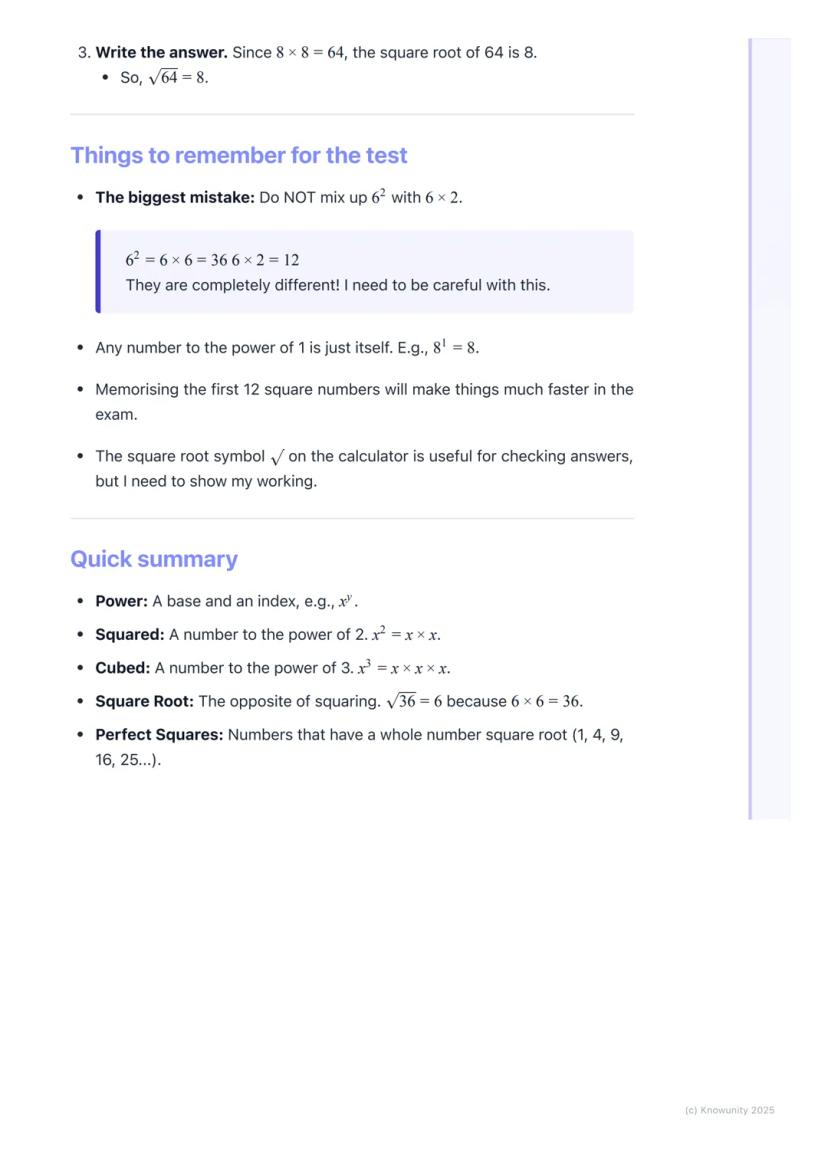
Powers and roots are mathematical shortcuts that make calculations much easier and neater. Powers let you write repeated multiplication in a compact way, whilst roots help you work backwards to find the original number that was multiplied.
1
of 5
Inscríbete para ver los apuntes. ¡Es gratis!
- Acceso a todos los documentos
- Mejora tus notas
- Únete a millones de estudiantes
Getting Started with Powers and Roots
Ever wondered why we write 4³ instead of 4 × 4 × 4? Powers are basically a clever shortcut for repeated multiplication, making your maths look much tidier. The base is the number being multiplied (like the 4), and the index (also called power or exponent) is that small number up top telling you how many times to multiply.
When a number has a power of 2, we call it squared - like 3² is "3 squared". This name comes from finding the area of a square! Similarly, a power of 3 is called cubed because it's how you calculate a cube's volume.
Square numbers are what you get when you multiply any whole number by itself. For example, 9 is a square number because 3 × 3 = 9. These will pop up everywhere in your exams, so they're worth remembering!
Quick Tip: Memorising the first 12 square numbers will make your exam much faster and easier.
2
of 5Inscríbete para ver los apuntes. ¡Es gratis!
- Acceso a todos los documentos
- Mejora tus notas
- Únete a millones de estudiantes
Working with Square Numbers and Cubes
You'll definitely want to memorise these square numbers for tests: 1² = 1, 2² = 4, 3² = 9, 4² = 16, 5² = 25, 6² = 36, 7² = 49, 8² = 64, 9² = 81, 10² = 100, 11² = 121, and 12² = 144. Trust me, knowing these off by heart will save you loads of time.
Cube numbers work similarly but with three multiplications instead of two. The first few are: 1³ = 1, 2³ = 8, 3³ = 27, 4³ = 64, and 5³ = 125.
Here's something interesting - 64 is both a square number (8²) and a cube number (4³). That's definitely worth remembering for trick questions!
Remember: Don't confuse 6² with 6 × 2! The first equals 36, the second equals 12 - completely different answers.
3
of 5Inscríbete para ver los apuntes. ¡Es gratis!
- Acceso a todos los documentos
- Mejora tus notas
- Únete a millones de estudiantes
Understanding Square Roots
Square roots are the complete opposite of squaring - they're like mathematical detective work. When you see √25, it's asking "what number multiplied by itself gives 25?" The answer is 5, because 5 × 5 = 25.
Think of it like this: if you know a square has an area of 25 cm², the square root helps you find that each side is 5 cm long. That's why we use the square root symbol √.
Perfect squares are numbers whose square roots are whole numbers, like 1, 4, 9, 16, and 25. These are the easiest ones to work with because there's no messy decimals involved.
Visual Tip: Imagine a square with area 25 cm² - the square root finds the length of each side (5 cm).
4
of 5Inscríbete para ver los apuntes. ¡Es gratis!
- Acceso a todos los documentos
- Mejora tus notas
- Únete a millones de estudiantes
Worked Examples You Can Master
Let's tackle 9²: The base is 9, the index is 2, so we multiply 9 by itself once. That's 9 × 9 = 81. See how straightforward that is?
For 4³, we've got base 4 and index 3, meaning three 4s multiplied together: 4 × 4 × 4. First do 4 × 4 = 16, then 16 × 4 = 64. Breaking it into steps makes it much easier.
Finding √64 means asking "what number times itself equals 64?" Work through your square numbers: 6² = 36 (too small), 7² = 49 (getting closer), 8² = 64 (perfect!). So √64 = 8.
Exam Strategy: Show your working step by step - even if you use a calculator to check, you need to demonstrate your method.
5
of 5Inscríbete para ver los apuntes. ¡Es gratis!
- Acceso a todos los documentos
- Mejora tus notas
- Únete a millones de estudiantes
Essential Tips for Test Success
Any number to the power of 1 is just itself - so 8¹ = 8. This might seem obvious, but it catches people out in exams when they overthink it.
The calculator's √ button is handy for checking answers, but always show your working. Examiners want to see that you understand the process, not just that you can press buttons.
Your key takeaways: powers use a base and index (like 5²), squared means power of 2, cubed means power of 3, and square roots reverse the squaring process. Master these basics and you'll smash any powers and roots question.
Final Reminder: Perfect squares (1, 4, 9, 16, 25...) are your best friends - they have nice, neat whole number square roots.
Pensamos que nunca lo preguntarías...
¿Qué es Knowunity AI companion?
Nuestro compañero de IA está específicamente adaptado a las necesidades de los estudiantes. Basándonos en los millones de contenidos que tenemos en la plataforma, podemos dar a los estudiantes respuestas realmente significativas y relevantes. Pero no se trata solo de respuestas, el compañero también guía a los estudiantes a través de sus retos de aprendizaje diarios, con planes de aprendizaje personalizados, cuestionarios o contenidos en el chat y una personalización del 100% basada en las habilidades y el desarrollo de los estudiantes.
¿Dónde puedo descargar la app Knowunity?
Puedes descargar la app en Google Play Store y Apple App Store.
¿Knowunity es totalmente gratuito?
¡Sí lo es! Tienes acceso totalmente gratuito a todo el contenido de la app, puedes chatear con otros alumnos y recibir ayuda inmeditamente. Puedes ganar dinero utilizando la aplicación, que te permitirá acceder a determinadas funciones.
Contenidos más populares de Mathematics
8MathematicsAlgebra
Algebra
5th Year91
MathematicsAlgebra 2
Algebra notes focusing on the factor theorem, completing the square, -b formula, graphs of polynomials
5th Year130
MathematicsSolving Equations
This section focuses on solving one-step and two-step linear equations to find the value of an unknown variable.
1st Year131
MathematicsArithmetic sequences and series
With examples
5th Year130
MathematicsIntroduction to Probability
This topic introduces basic probability concepts, including calculating the probability of simple events and understanding the difference between experimental and theoretical probability.
2nd Year91
MathematicsMaths jc algebra
Maths jc
1st Year230
MathematicsNatural Numbers and Integers
Students will learn about positive whole numbers, zero, and negative whole numbers, and how to add, subtract, multiply, and divide them correctly.
1st Year131
MathematicsDifferential Calculus
Calculus is a topic that comes up nearly everywhere on your maths LC. This is just starter notes that could be useful end of 5th year or start of 6th year
5th Year271
Contenidos más populares
9IrishIrish oral questions and answers
Questions and answers for the leaving cert oral
5th Year4264
EnglishKey Quotes : Sive
Key Quotes and explanations: Sive
6th Year2842
IrishIrish oral questions
Outline of oral questions
5th Year2055
IrishIníon- le hÁine Durkin
Aine Durkin’s poem, Iníon: Themes & summary
5th Year850
IrishIrish poetry 2027
Iníon + Dínit an Bhróin
5th Year1133
IrishLC HL notes- Iníon (poem)
Includes poem in English and Irish, theme, key words & phrases
5th Year2284
EnglishCultural Context : Shawshank Redemption : Sive : Small Things Like These
Comparative Study : Cultural Context : Shawshank Redemption, Sive and Small Things Like These
6th Year1430
IrishMo Ghrá-sa (Idir Lúibíní)
Notes on mo ghrá-sa
5th Year380
IrishAn Gaeilge Aiste
Irish Language essay
6th Year1320
¿No encuentras lo que buscas? Explora otros temas.
Mira lo que dicen nuestros usuarios. Les encantó — y a ti también te encantará.
4.6/5App Store
4.7/5Google Play
La app es muy fácil de usar y está muy bien diseñada. Hasta ahora he encontrado todo lo que estaba buscando y he podido aprender mucho de las presentaciones. Definitivamente utilizaré la aplicación para un examen de clase. Y, por supuesto, también me sirve mucho de inspiración.
Pablousuario de iOS
Esta app es realmente genial. Hay tantos apuntes de clase y ayuda [...]. Tengo problemas con matemáticas, por ejemplo, y la aplicación tiene muchas opciones de ayuda. Gracias a Knowunity, he mejorado en mates. Se la recomiendo a todo el mundo.
Elenausuaria de Android
Vaya, estoy realmente sorprendida. Acabo de probar la app porque la he visto anunciada muchas veces y me he quedado absolutamente alucinada. Esta app es LA AYUDA que quieres para el insti y, sobre todo, ofrece muchísimas cosas, como ejercicios y hojas informativas, que a mí personalmente me han sido MUY útiles.
Anausuaria de iOS