
Ever wondered why your bank balance can go negative or... Mostrar más
 Mathematics13 visualizaciones·Actualizado May 27, 2026·5 páginas
Understanding Natural Numbers and Integers
1 / 5
1
of 5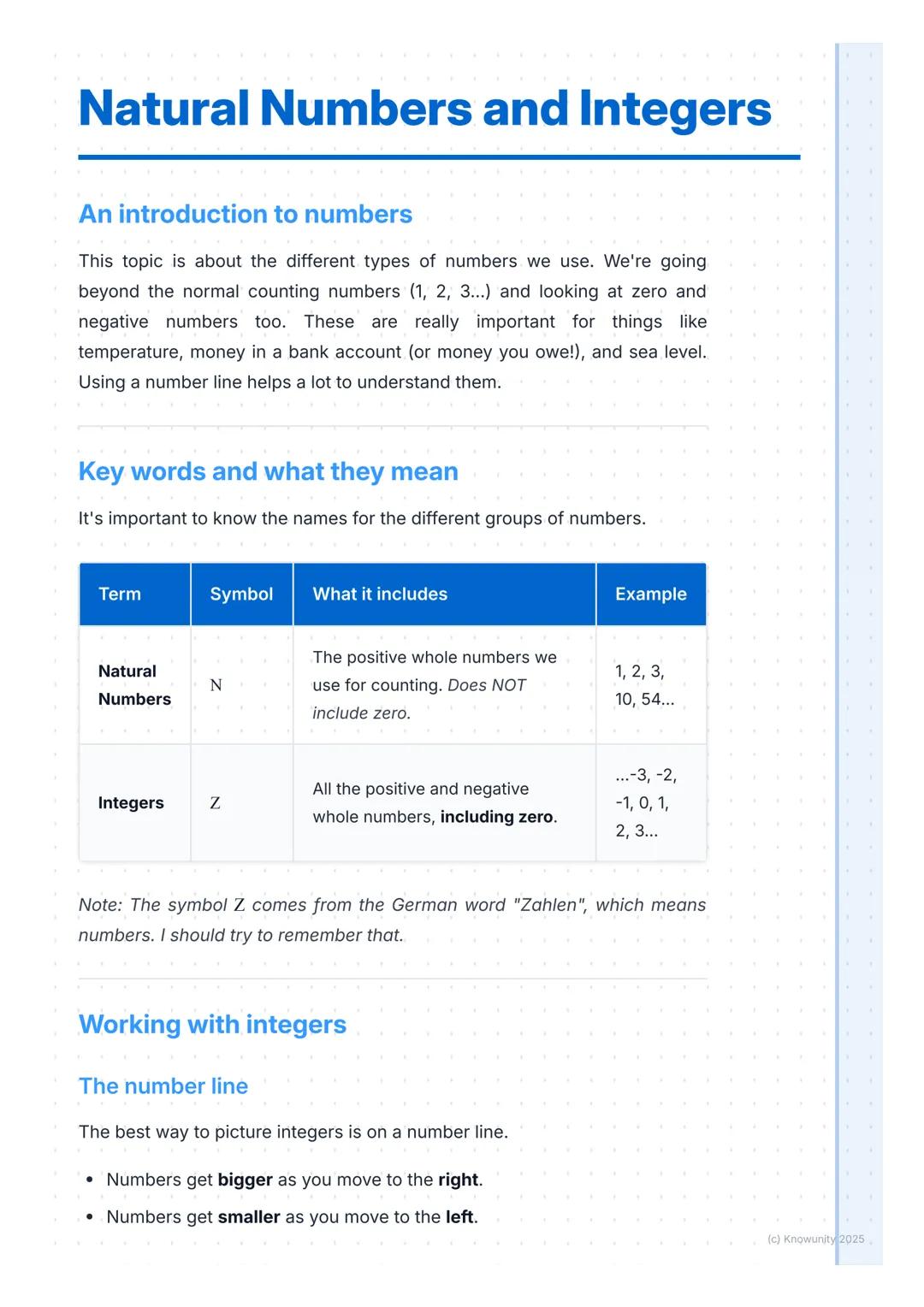
Natural Numbers and Integers - The Basics
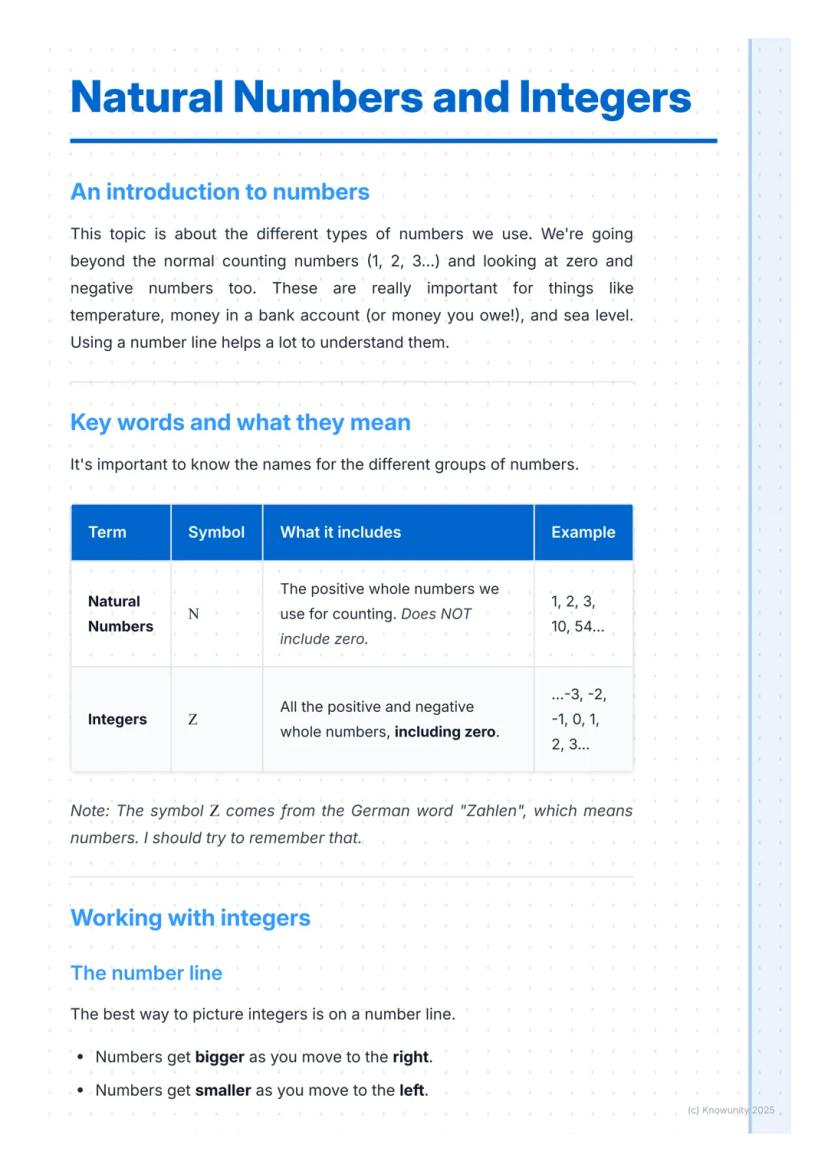
You've been using natural numbers your whole life without realising it! These are simply the counting numbers: 1, 2, 3, 4, and so on. They're called "natural" because they feel natural to use when counting objects.
Integers take things a step further by including zero and all the negative numbers too. Think of them as the complete family: ...-3, -2, -1, 0, 1, 2, 3... The symbol for integers is Z, which comes from the German word "Zahlen" meaning numbers.
Quick Tip: Remember that natural numbers don't include zero, but integers do! This catches lots of students out in tests.
The number line is your best friend here. Numbers get bigger as you move right and smaller as you move left. So -1 is actually bigger than -5 because it's further to the right!
2
of 5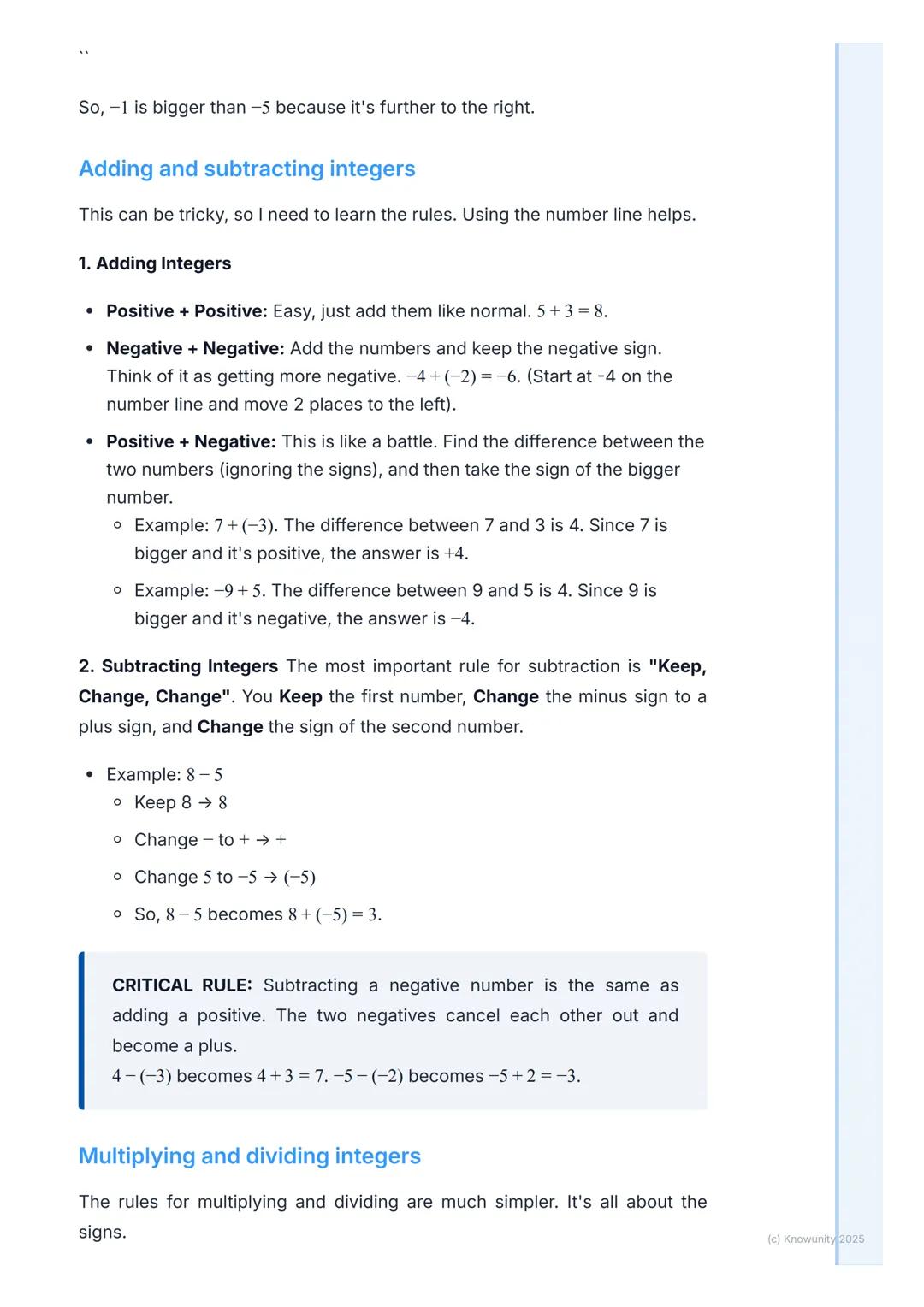
Adding and Subtracting Integers
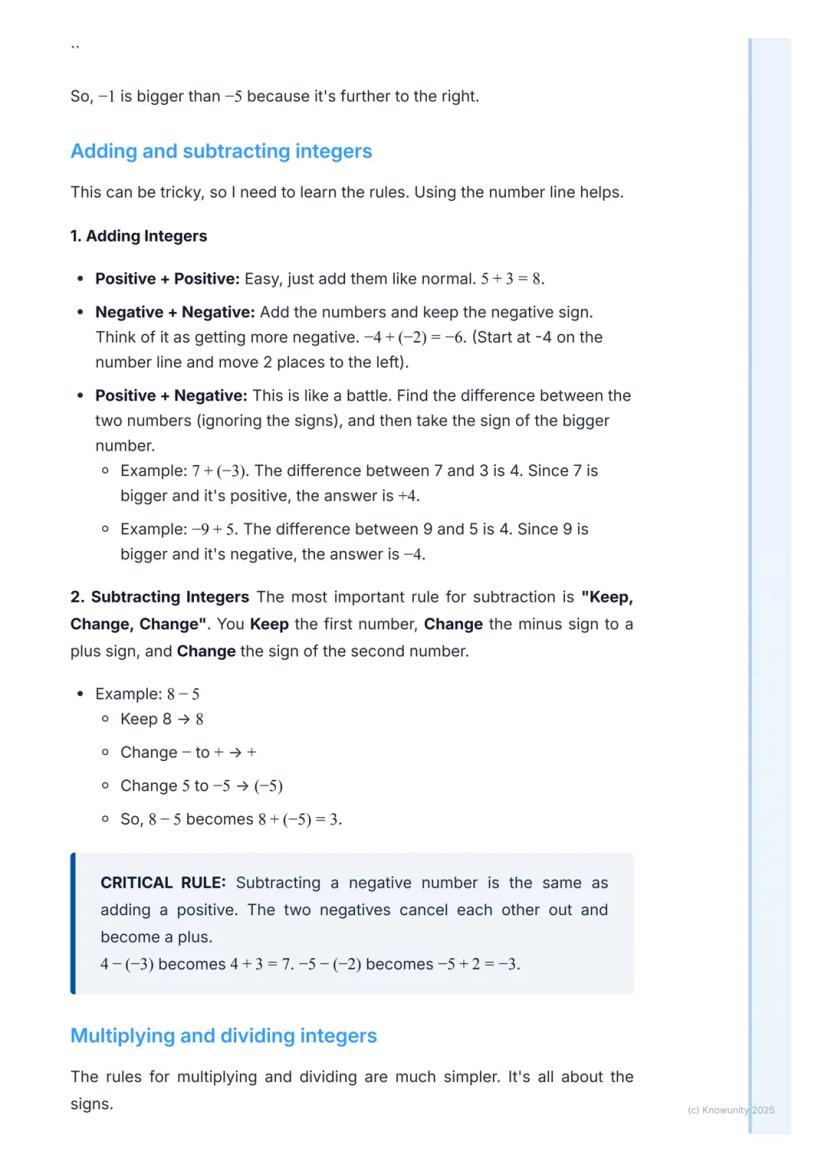
Adding integers might seem tricky at first, but there are simple patterns to follow. When you're adding two positive numbers, it's just normal addition. When adding two negative numbers, add them up and keep the negative sign - think of it as getting "more negative".
The interesting bit happens when you mix positive and negative numbers. Picture it like a battle between the numbers! Find the difference between them (ignore the signs), then use the sign of the bigger number. So 7 + (-3) = 4 because 7 is bigger and positive.
For subtraction, use the "Keep, Change, Change" rule. Keep the first number, change the minus to a plus, and change the sign of the second number. So 8 - 5 becomes 8 + (-5) = 3.
Remember: Subtracting a negative is the same as adding a positive! The two negatives cancel out: 4 - (-3) = 4 + 3 = 7.
3
of 5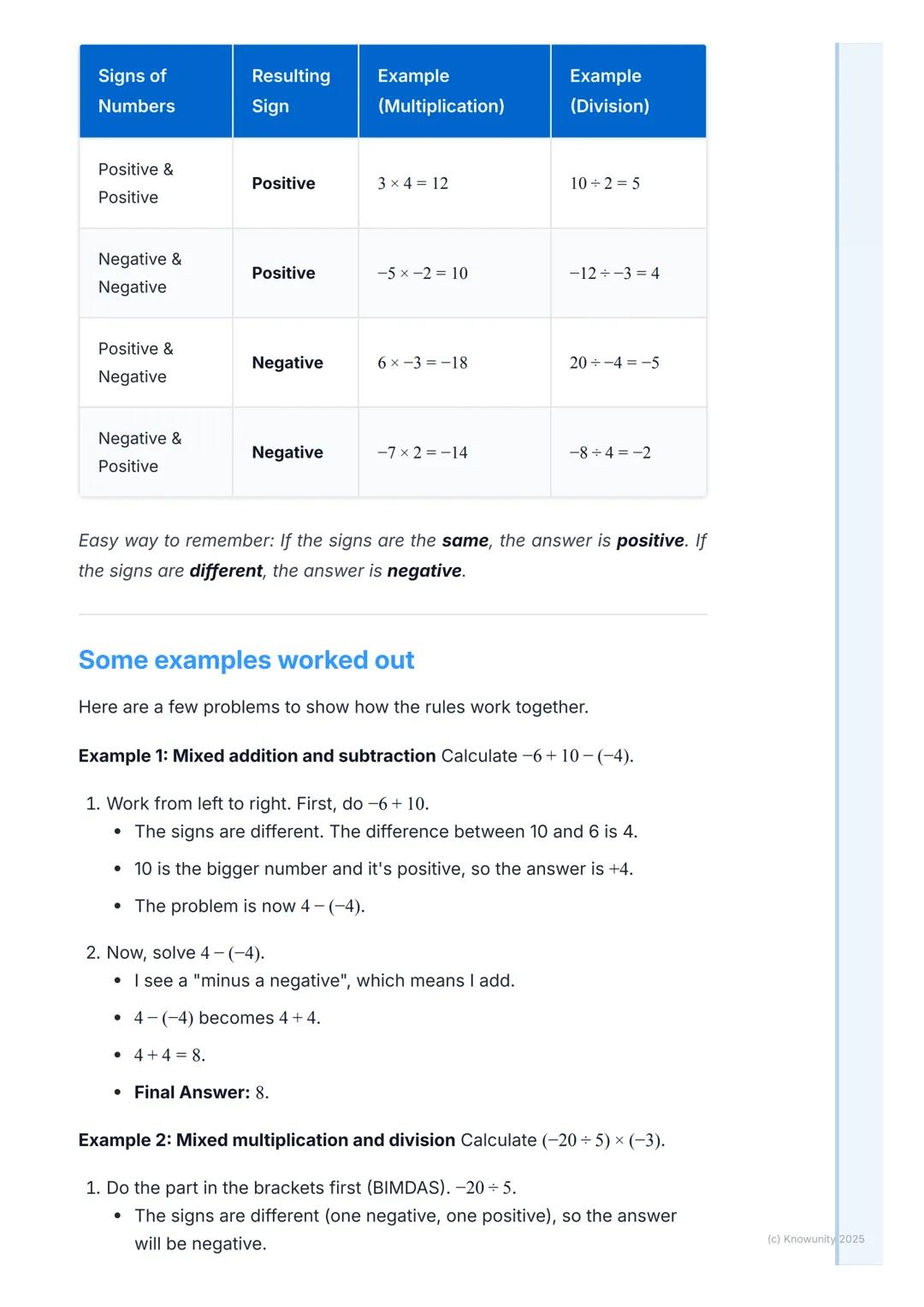
Multiplying and Dividing Integers
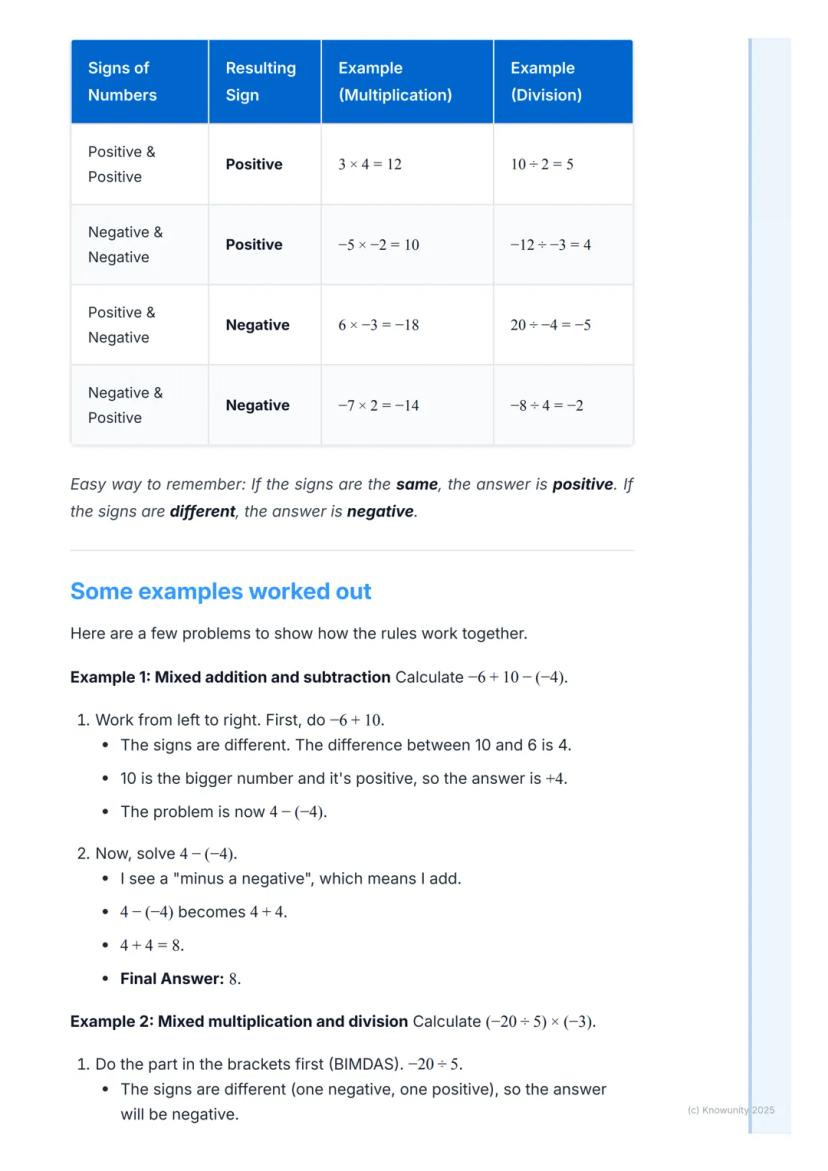
Good news - multiplying and dividing integers is much simpler than adding and subtracting! It's all about the signs, and there's just one rule to remember.
If the signs are the same (both positive or both negative), your answer is positive. If the signs are different (one positive, one negative), your answer is negative. So -5 × -2 = 10 , but 6 × -3 = -18 .
This works exactly the same for division. -12 ÷ -3 = 4 because both numbers are negative (same signs), while 20 ÷ -4 = -5 because the signs are different.
Memory Trick: Think "same = smiley face = positive" and "different = frowny face = negative"!
4
of 5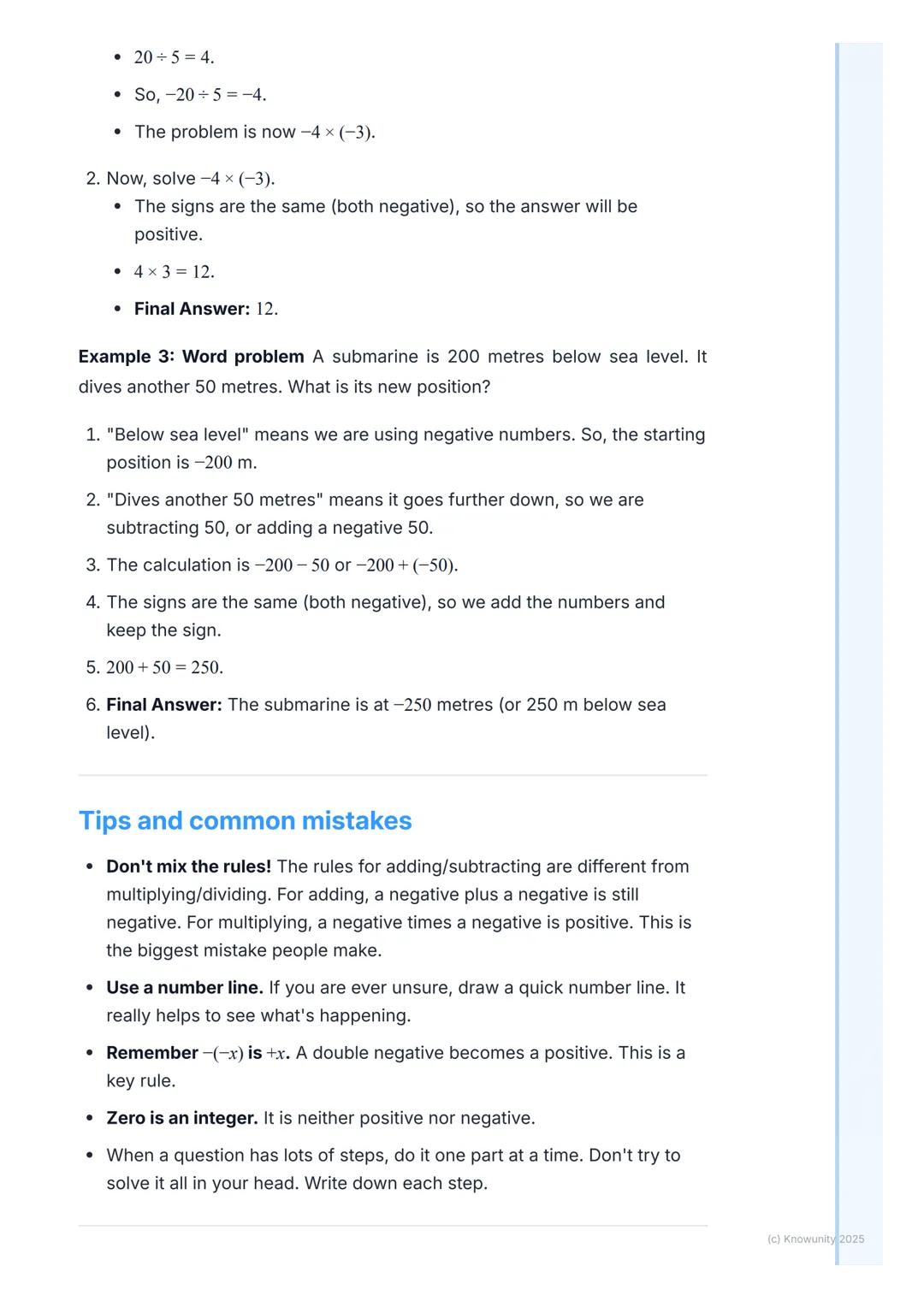
Working Through Examples
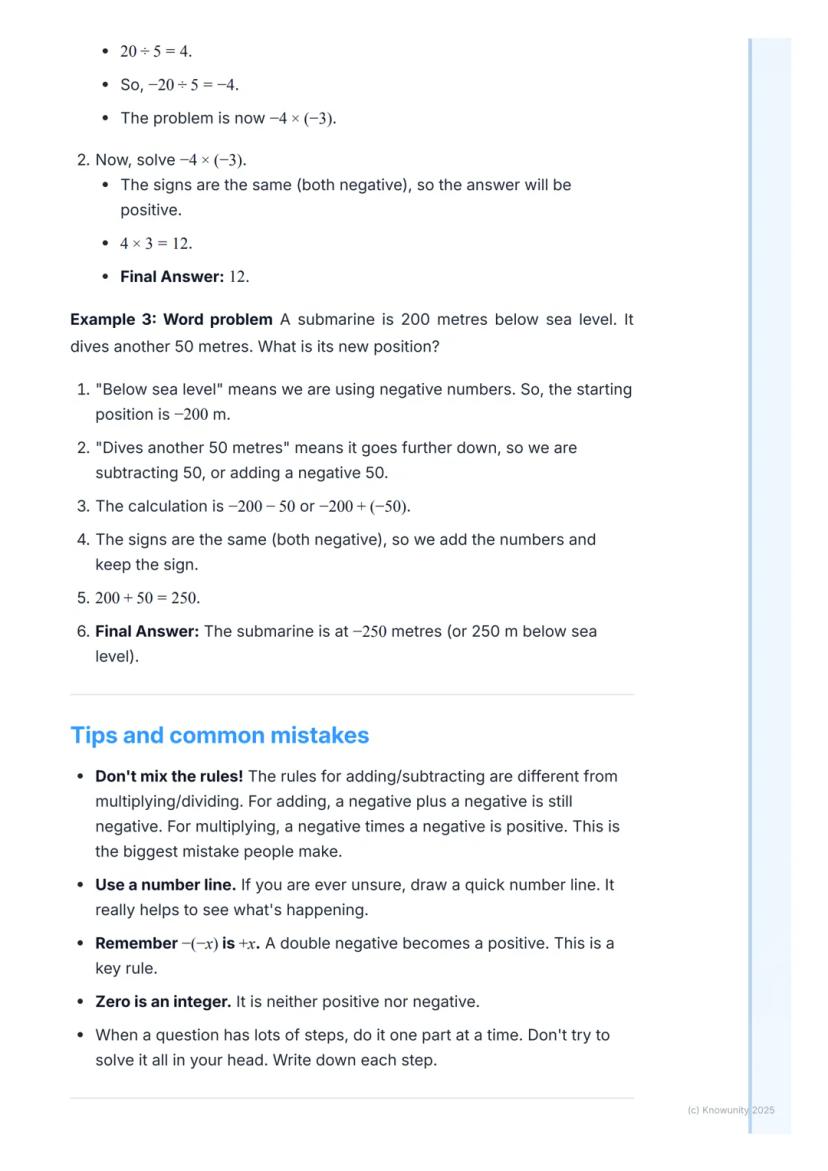
Let's tackle some real problems step by step. For -6 + 10 - (-4), work from left to right. First, -6 + 10 gives us 4 (different signs, so take the bigger number's sign). Then 4 - (-4) becomes 4 + 4 = 8.
Here's a practical example: A submarine starts 200 metres below sea level and dives another 50 metres. Since "below sea level" means negative, we calculate -200 + (-50) = -250m.
When you see brackets, always solve those first! For (-20 ÷ 5) × (-3), first work out -20 ÷ 5 = -4 . Then -4 × (-3) = 12 .
Pro Tip: Don't try to do everything in your head - write down each step. This prevents silly mistakes that cost marks!
5
of 5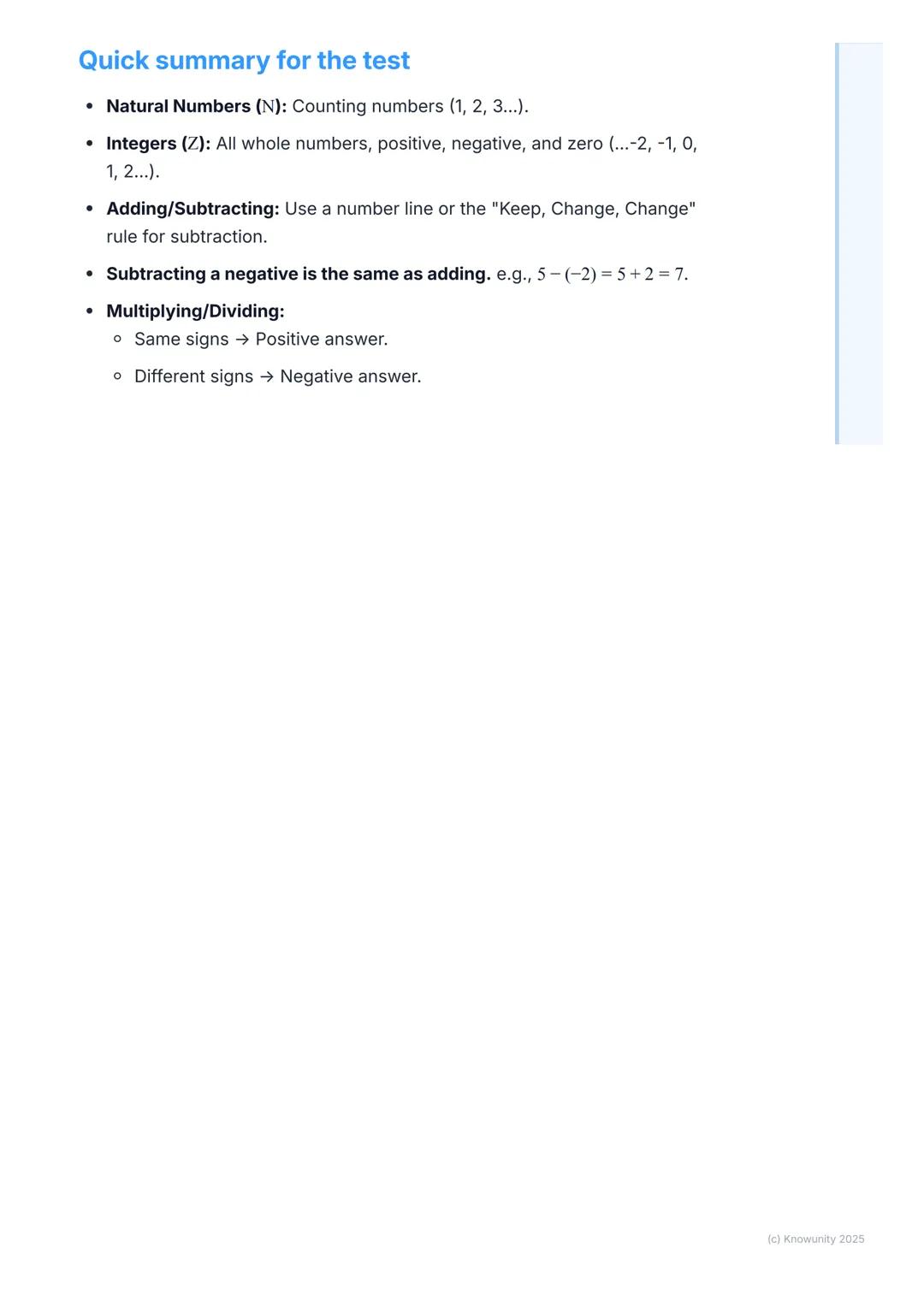
Quick Test Revision
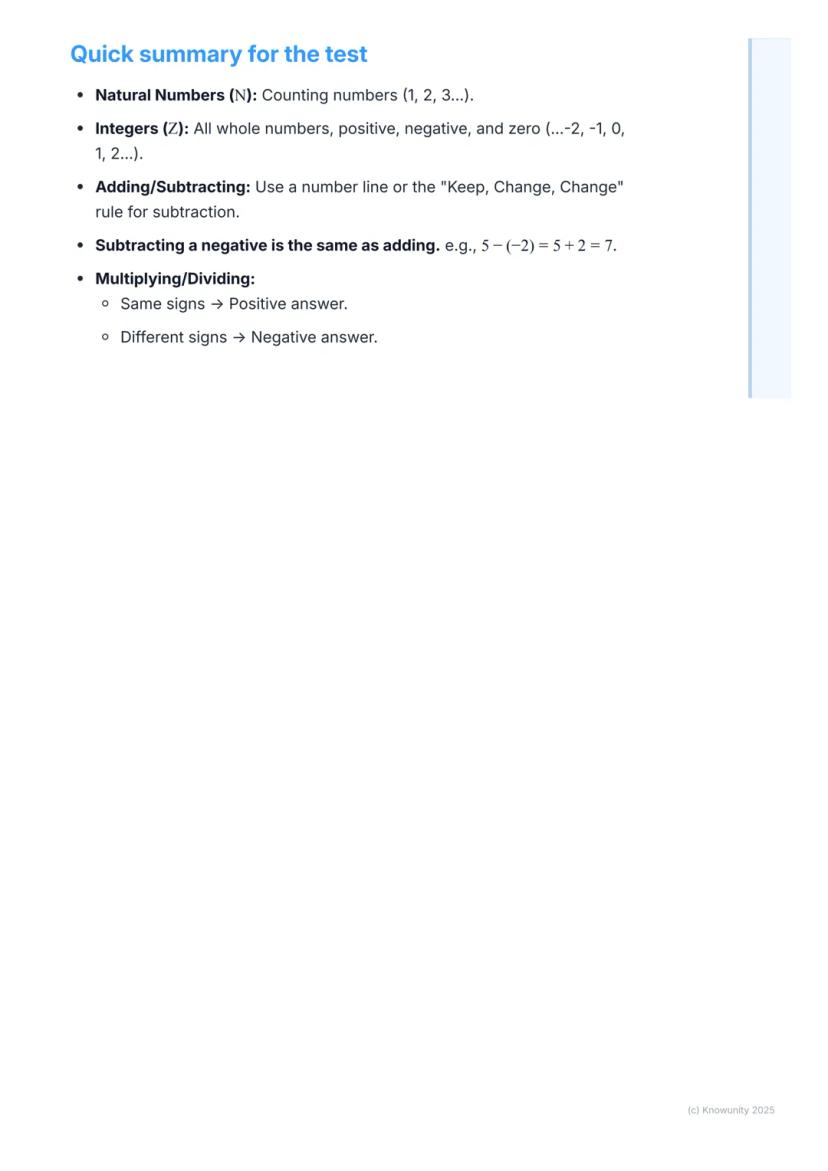
Here's everything you need for your test! Natural numbers are your basic counting numbers (1, 2, 3...), while integers include zero and all negative numbers too (...-2, -1, 0, 1, 2...).
For adding and subtracting, use the number line or remember that subtracting a negative equals adding a positive. The "Keep, Change, Change" rule is your friend for subtraction problems.
Multiplication and division follow one simple rule: same signs give positive answers, different signs give negative answers. Zero is an integer but it's neither positive nor negative.
Final Reminder: The biggest mistake students make is mixing up the rules for different operations. Adding two negatives stays negative, but multiplying two negatives becomes positive!
Pensamos que nunca lo preguntarías...
¿Qué es Knowunity AI companion?
Nuestro compañero de IA está específicamente adaptado a las necesidades de los estudiantes. Basándonos en los millones de contenidos que tenemos en la plataforma, podemos dar a los estudiantes respuestas realmente significativas y relevantes. Pero no se trata solo de respuestas, el compañero también guía a los estudiantes a través de sus retos de aprendizaje diarios, con planes de aprendizaje personalizados, cuestionarios o contenidos en el chat y una personalización del 100% basada en las habilidades y el desarrollo de los estudiantes.
¿Dónde puedo descargar la app Knowunity?
Puedes descargar la app en Google Play Store y Apple App Store.
¿Knowunity es totalmente gratuito?
¡Sí lo es! Tienes acceso totalmente gratuito a todo el contenido de la app, puedes chatear con otros alumnos y recibir ayuda inmeditamente. Puedes ganar dinero utilizando la aplicación, que te permitirá acceder a determinadas funciones.
Contenidos más populares de Mathematics
7Contenidos más populares
9¿No encuentras lo que buscas? Explora otros temas.
Mira lo que dicen nuestros usuarios. Les encantó — y a ti también te encantará.
4.6/5App Store
4.7/5Google Play
La app es muy fácil de usar y está muy bien diseñada. Hasta ahora he encontrado todo lo que estaba buscando y he podido aprender mucho de las presentaciones. Definitivamente utilizaré la aplicación para un examen de clase. Y, por supuesto, también me sirve mucho de inspiración.
Pablousuario de iOS
Esta app es realmente genial. Hay tantos apuntes de clase y ayuda [...]. Tengo problemas con matemáticas, por ejemplo, y la aplicación tiene muchas opciones de ayuda. Gracias a Knowunity, he mejorado en mates. Se la recomiendo a todo el mundo.
Elenausuaria de Android
Vaya, estoy realmente sorprendida. Acabo de probar la app porque la he visto anunciada muchas veces y me he quedado absolutamente alucinada. Esta app es LA AYUDA que quieres para el insti y, sobre todo, ofrece muchísimas cosas, como ejercicios y hojas informativas, que a mí personalmente me han sido MUY útiles.
Anausuaria de iOS
Mathematics13 visualizaciones·Actualizado May 27, 2026·5 páginasUnderstanding Natural Numbers and Integers
Ever wondered why your bank balance can go negative or how we measure temperatures below zero? Understanding natural numbers and integers is the key to making sense of these everyday situations. These number systems help us work with everything from... Mostrar más
1
of 5Inscríbete para ver los apuntes. ¡Es gratis!
- Acceso a todos los documentos
- Mejora tus notas
- Únete a millones de estudiantes
Natural Numbers and Integers - The Basics
You've been using natural numbers your whole life without realising it! These are simply the counting numbers: 1, 2, 3, 4, and so on. They're called "natural" because they feel natural to use when counting objects.
Integers take things a step further by including zero and all the negative numbers too. Think of them as the complete family: ...-3, -2, -1, 0, 1, 2, 3... The symbol for integers is Z, which comes from the German word "Zahlen" meaning numbers.
Quick Tip: Remember that natural numbers don't include zero, but integers do! This catches lots of students out in tests.
The number line is your best friend here. Numbers get bigger as you move right and smaller as you move left. So -1 is actually bigger than -5 because it's further to the right!
2
of 5Inscríbete para ver los apuntes. ¡Es gratis!
- Acceso a todos los documentos
- Mejora tus notas
- Únete a millones de estudiantes
Adding and Subtracting Integers
Adding integers might seem tricky at first, but there are simple patterns to follow. When you're adding two positive numbers, it's just normal addition. When adding two negative numbers, add them up and keep the negative sign - think of it as getting "more negative".
The interesting bit happens when you mix positive and negative numbers. Picture it like a battle between the numbers! Find the difference between them (ignore the signs), then use the sign of the bigger number. So 7 + (-3) = 4 because 7 is bigger and positive.
For subtraction, use the "Keep, Change, Change" rule. Keep the first number, change the minus to a plus, and change the sign of the second number. So 8 - 5 becomes 8 + (-5) = 3.
Remember: Subtracting a negative is the same as adding a positive! The two negatives cancel out: 4 - (-3) = 4 + 3 = 7.
3
of 5Inscríbete para ver los apuntes. ¡Es gratis!
- Acceso a todos los documentos
- Mejora tus notas
- Únete a millones de estudiantes
Multiplying and Dividing Integers
Good news - multiplying and dividing integers is much simpler than adding and subtracting! It's all about the signs, and there's just one rule to remember.
If the signs are the same (both positive or both negative), your answer is positive. If the signs are different (one positive, one negative), your answer is negative. So -5 × -2 = 10 , but 6 × -3 = -18 .
This works exactly the same for division. -12 ÷ -3 = 4 because both numbers are negative (same signs), while 20 ÷ -4 = -5 because the signs are different.
Memory Trick: Think "same = smiley face = positive" and "different = frowny face = negative"!
4
of 5Inscríbete para ver los apuntes. ¡Es gratis!
- Acceso a todos los documentos
- Mejora tus notas
- Únete a millones de estudiantes
Working Through Examples
Let's tackle some real problems step by step. For -6 + 10 - (-4), work from left to right. First, -6 + 10 gives us 4 (different signs, so take the bigger number's sign). Then 4 - (-4) becomes 4 + 4 = 8.
Here's a practical example: A submarine starts 200 metres below sea level and dives another 50 metres. Since "below sea level" means negative, we calculate -200 + (-50) = -250m.
When you see brackets, always solve those first! For (-20 ÷ 5) × (-3), first work out -20 ÷ 5 = -4 . Then -4 × (-3) = 12 .
Pro Tip: Don't try to do everything in your head - write down each step. This prevents silly mistakes that cost marks!
5
of 5Inscríbete para ver los apuntes. ¡Es gratis!
- Acceso a todos los documentos
- Mejora tus notas
- Únete a millones de estudiantes
Quick Test Revision
Here's everything you need for your test! Natural numbers are your basic counting numbers (1, 2, 3...), while integers include zero and all negative numbers too (...-2, -1, 0, 1, 2...).
For adding and subtracting, use the number line or remember that subtracting a negative equals adding a positive. The "Keep, Change, Change" rule is your friend for subtraction problems.
Multiplication and division follow one simple rule: same signs give positive answers, different signs give negative answers. Zero is an integer but it's neither positive nor negative.
Final Reminder: The biggest mistake students make is mixing up the rules for different operations. Adding two negatives stays negative, but multiplying two negatives becomes positive!
Pensamos que nunca lo preguntarías...
¿Qué es Knowunity AI companion?
Nuestro compañero de IA está específicamente adaptado a las necesidades de los estudiantes. Basándonos en los millones de contenidos que tenemos en la plataforma, podemos dar a los estudiantes respuestas realmente significativas y relevantes. Pero no se trata solo de respuestas, el compañero también guía a los estudiantes a través de sus retos de aprendizaje diarios, con planes de aprendizaje personalizados, cuestionarios o contenidos en el chat y una personalización del 100% basada en las habilidades y el desarrollo de los estudiantes.
¿Dónde puedo descargar la app Knowunity?
Puedes descargar la app en Google Play Store y Apple App Store.
¿Knowunity es totalmente gratuito?
¡Sí lo es! Tienes acceso totalmente gratuito a todo el contenido de la app, puedes chatear con otros alumnos y recibir ayuda inmeditamente. Puedes ganar dinero utilizando la aplicación, que te permitirá acceder a determinadas funciones.
Contenidos más populares de Mathematics
7Contenidos más populares
9¿No encuentras lo que buscas? Explora otros temas.
Mira lo que dicen nuestros usuarios. Les encantó — y a ti también te encantará.
4.6/5App Store
4.7/5Google Play
La app es muy fácil de usar y está muy bien diseñada. Hasta ahora he encontrado todo lo que estaba buscando y he podido aprender mucho de las presentaciones. Definitivamente utilizaré la aplicación para un examen de clase. Y, por supuesto, también me sirve mucho de inspiración.
Pablousuario de iOS
Esta app es realmente genial. Hay tantos apuntes de clase y ayuda [...]. Tengo problemas con matemáticas, por ejemplo, y la aplicación tiene muchas opciones de ayuda. Gracias a Knowunity, he mejorado en mates. Se la recomiendo a todo el mundo.
Elenausuaria de Android
Vaya, estoy realmente sorprendida. Acabo de probar la app porque la he visto anunciada muchas veces y me he quedado absolutamente alucinada. Esta app es LA AYUDA que quieres para el insti y, sobre todo, ofrece muchísimas cosas, como ejercicios y hojas informativas, que a mí personalmente me han sido MUY útiles.
Anausuaria de iOS