
Ever wondered how builders work out roof angles or how...
 Mathematics5 visualizaciones·Actualizado Jun 11, 2026·7 páginas
Understanding Key Trigonometric Ratios: Sine, Cosine, and Tangent

1 / 7
1
of 7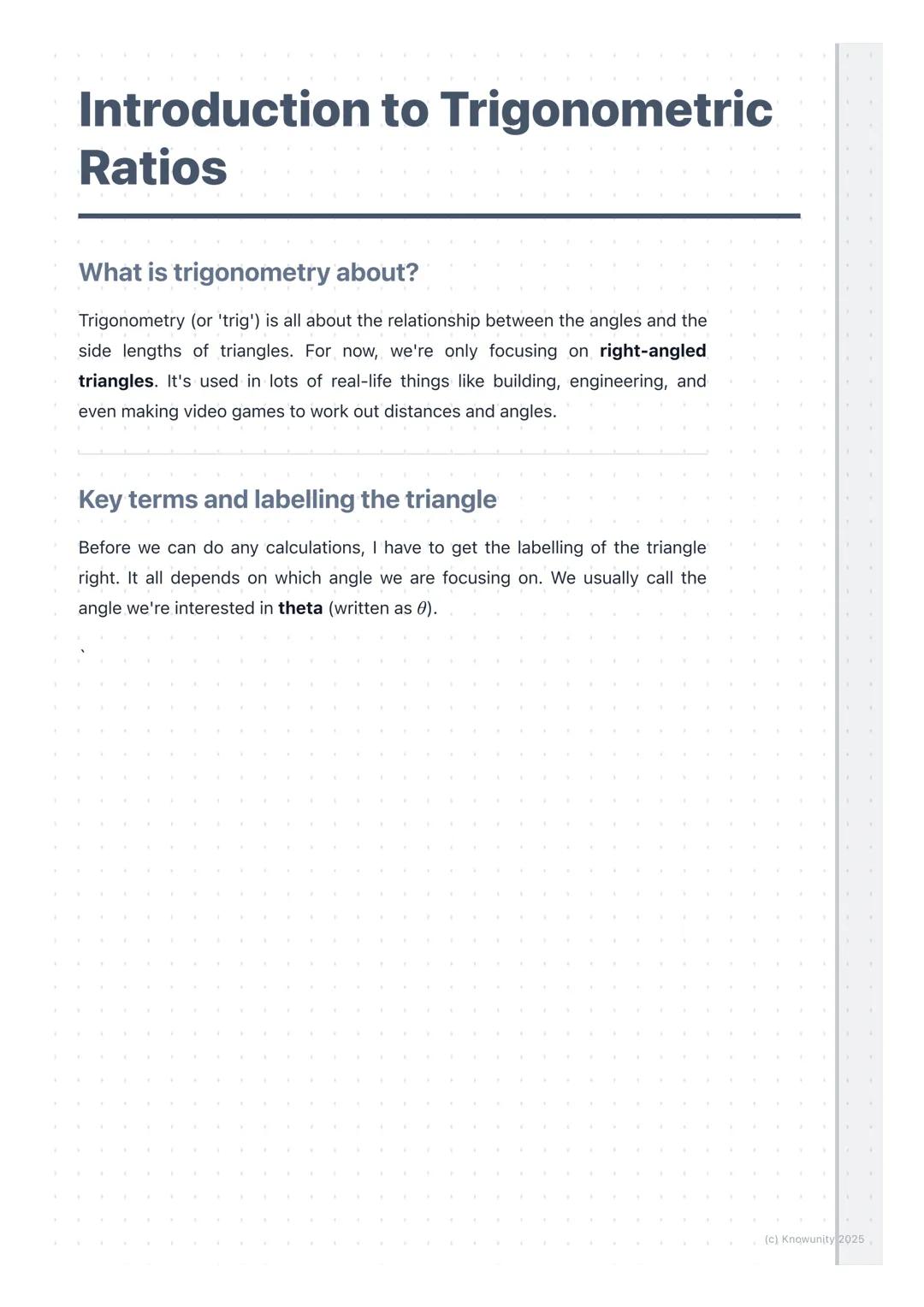
Introduction to Trigonometric Ratios
Trigonometry (or just 'trig') is everywhere around us. Engineers use it to design bridges, architects calculate roof slopes, and game developers work out character movements. The brilliant thing is, it all starts with simple right-angled triangles.
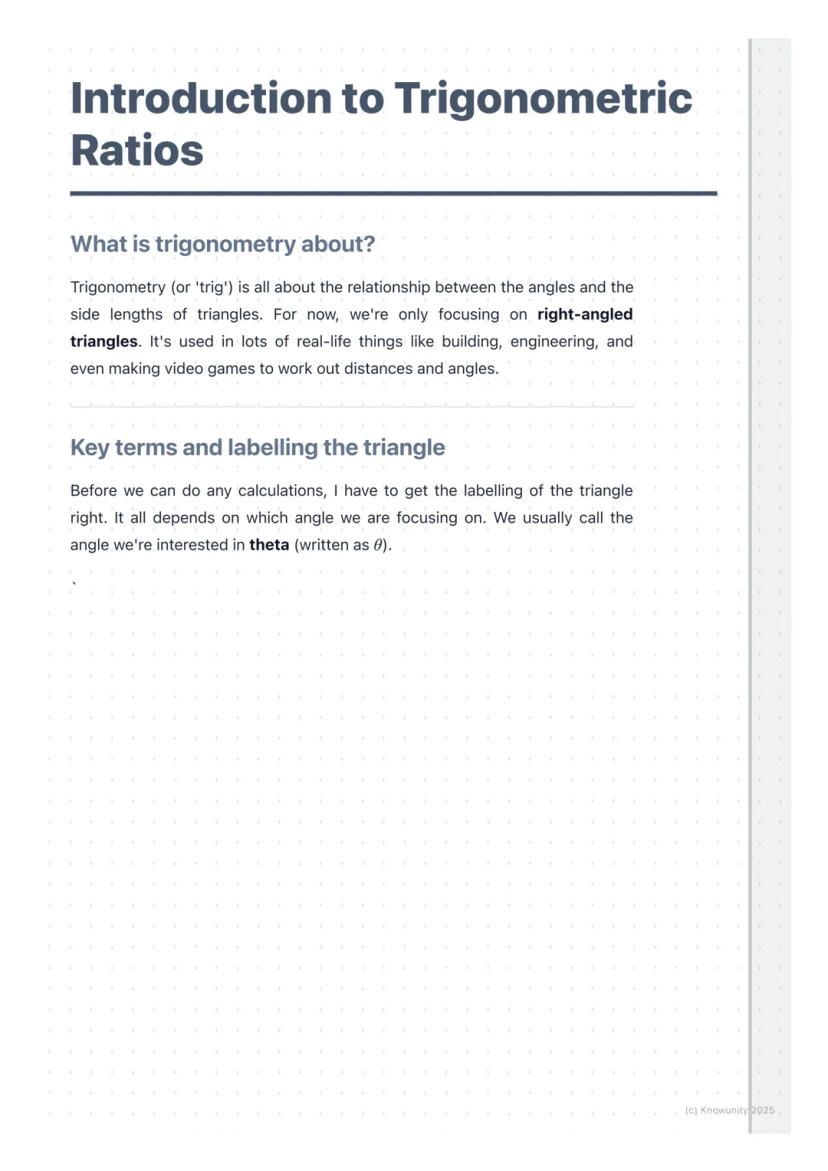
Before jumping into calculations, you've got to nail the labelling. Everything depends on which angle you're focusing on - we call this angle theta (written as θ). Get this wrong and everything else falls apart!
Quick Tip: Always identify your angle first, then label everything else relative to that angle.
The key is understanding that trigonometry only works with right-angled triangles - those with a perfect 90° corner.
2
of 7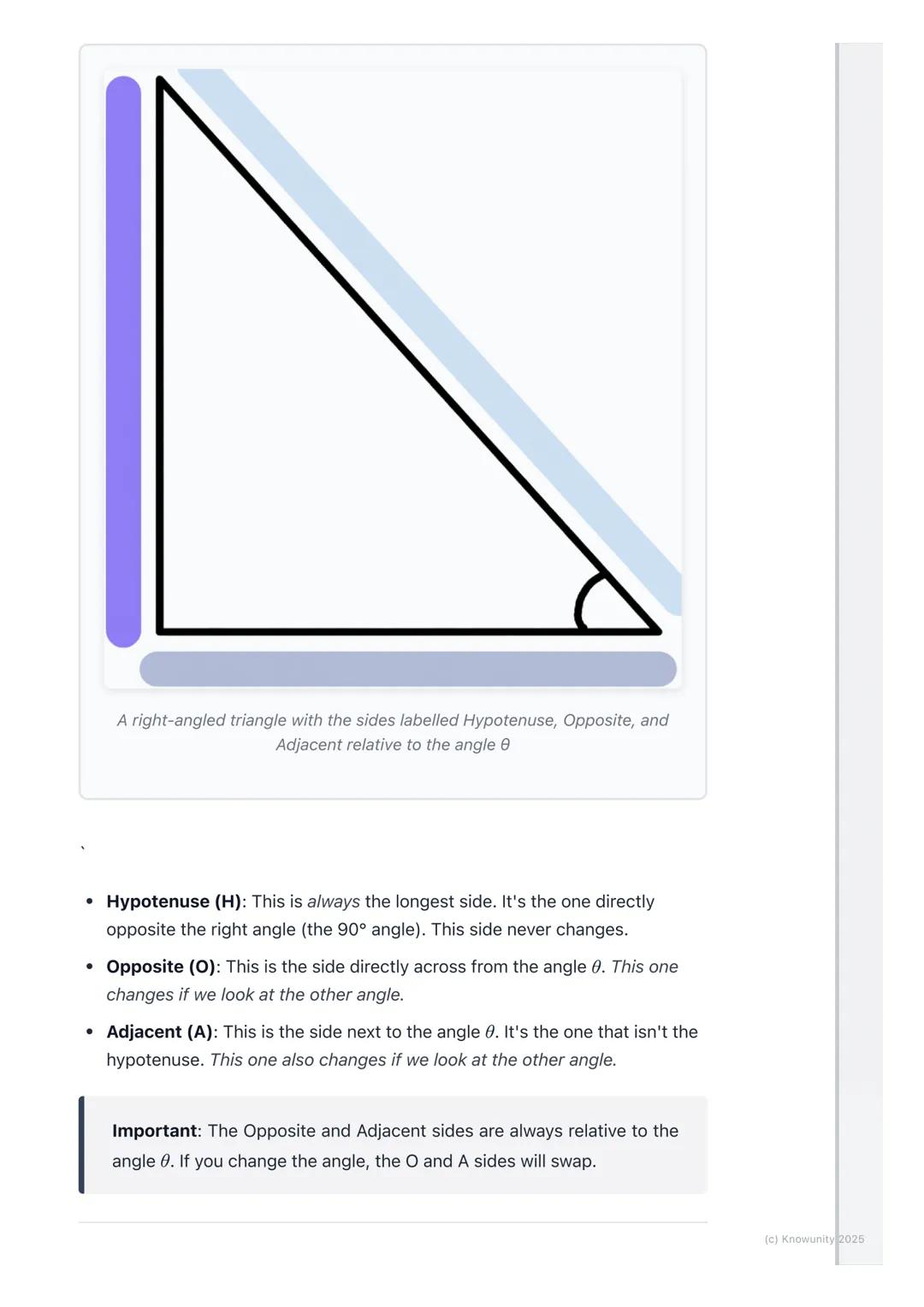
Labelling Triangle Sides
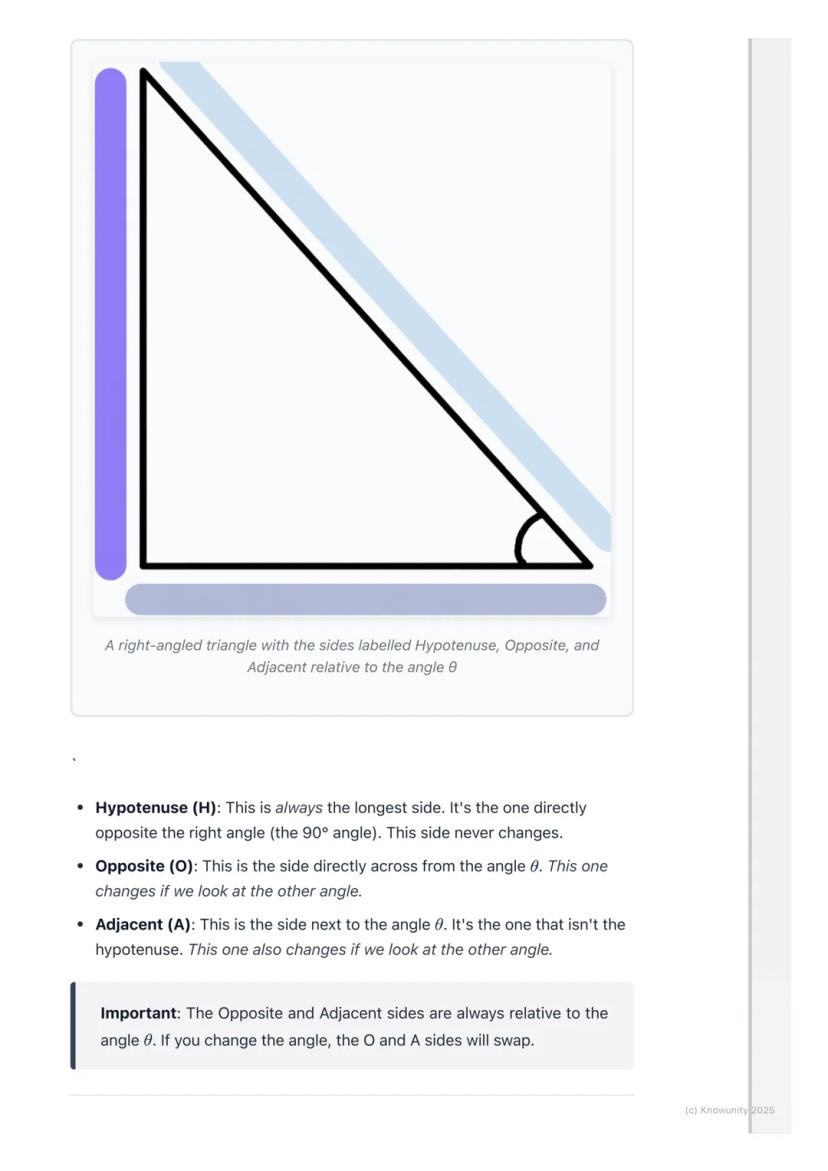
Here's where students often trip up, but it's actually dead simple once you get it. You need to identify three sides relative to your chosen angle θ.
The Hypotenuse (H) is always the longest side - it's opposite the right angle and never changes. Easy to spot because it's the diagonal one.
The Opposite (O) side sits directly across from your angle θ. This one changes if you switch to looking at a different angle in the triangle.
The Adjacent (A) side is next to your angle θ (but it's not the hypotenuse). Like the opposite, this changes depending on which angle you're examining.
Remember: Opposite and Adjacent sides are always relative to your chosen angle. Switch angles, and they swap places!
3
of 7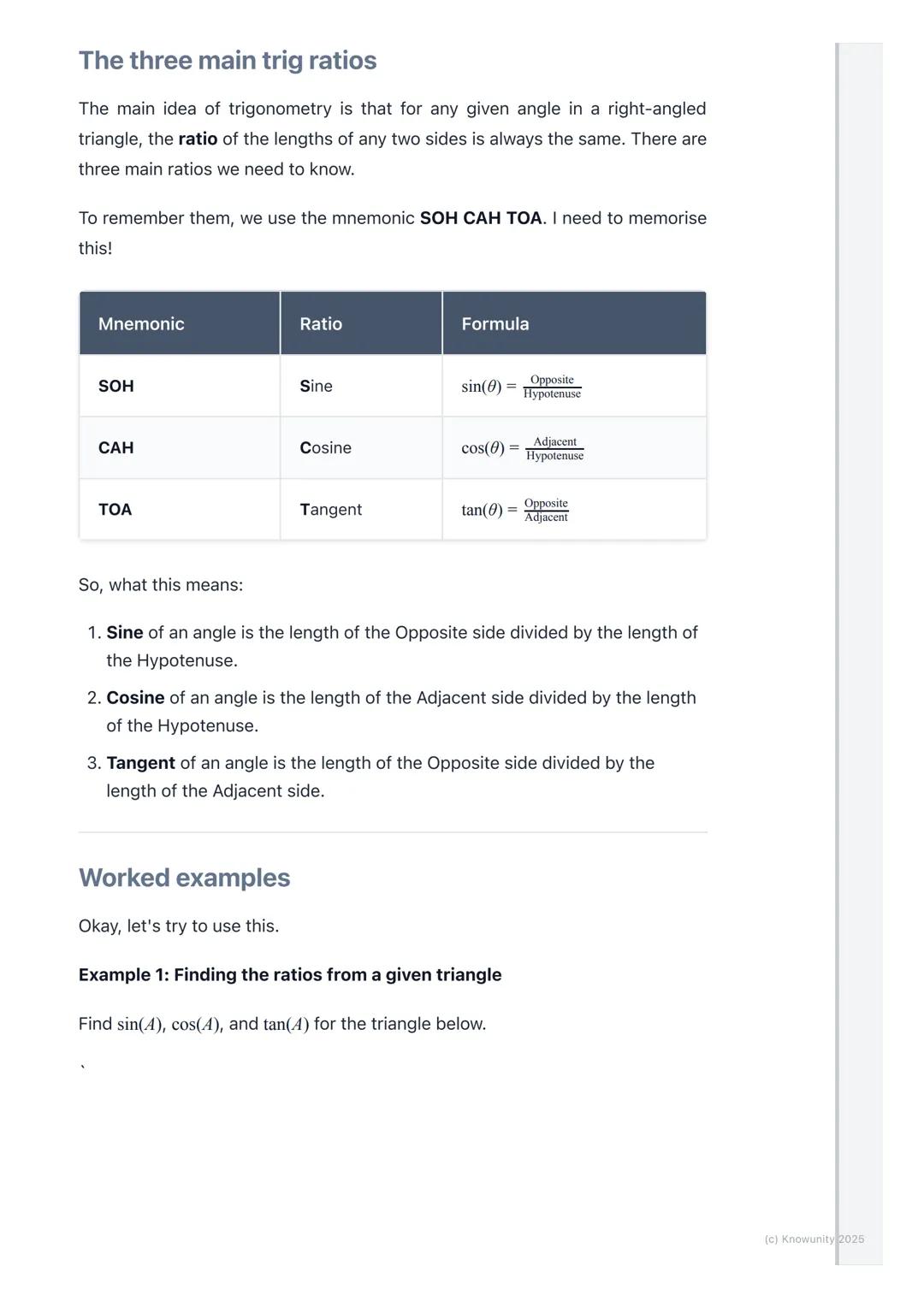
The Three Main Trig Ratios
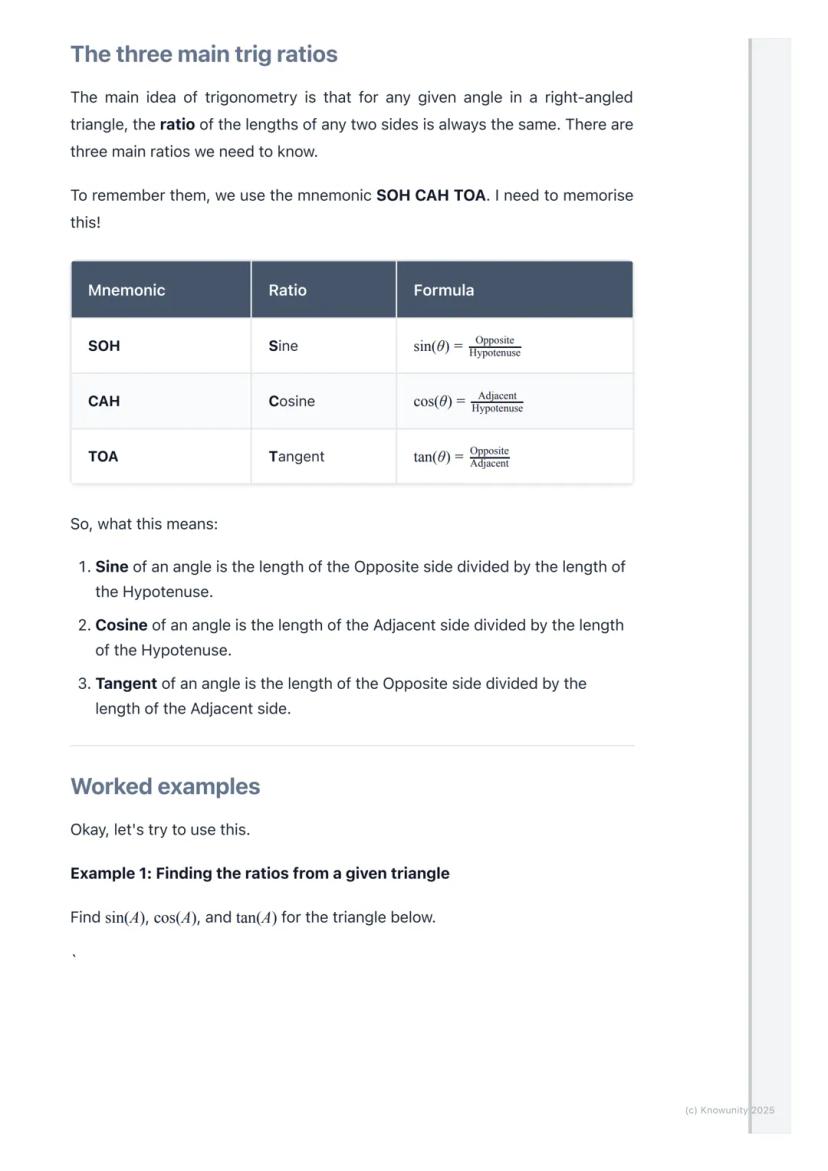
This is the heart of trigonometry - three simple ratios that connect angles to side lengths. The magic is that for any given angle, these ratios stay constant no matter how big or small your triangle is.
SOH CAH TOA is your best mate here - memorise it! It stands for:
- SOH: Sine = Opposite ÷ Hypotenuse
- CAH: Cosine = Adjacent ÷ Hypotenuse
- TOA: Tangent = Opposite ÷ Adjacent
These trigonometric ratios are the foundation of everything. Sine connects opposite and hypotenuse, cosine links adjacent and hypotenuse, whilst tangent relates opposite and adjacent.
Exam Tip: Write "SOH CAH TOA" at the top of your exam paper - it'll save you time and stress during questions!
4
of 7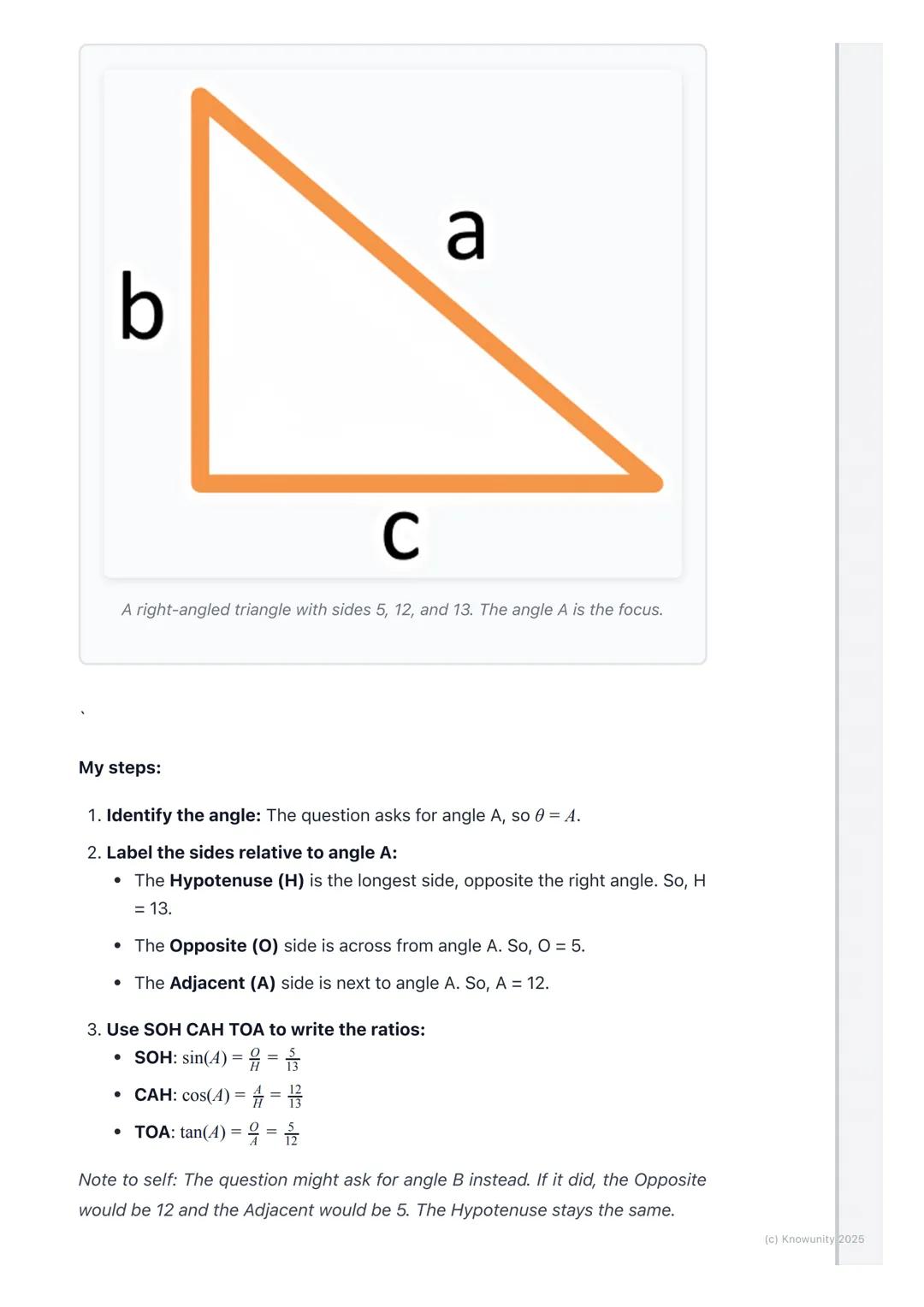
Working with Given Triangles
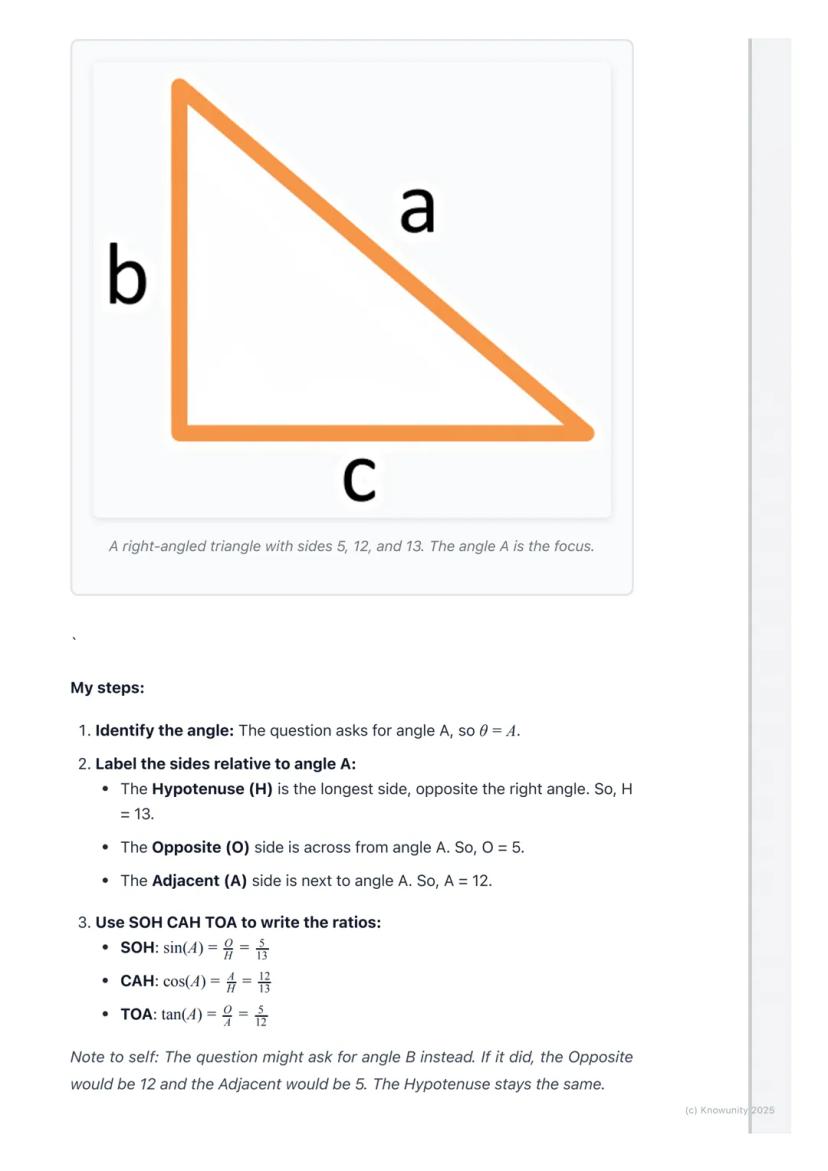
Let's see SOH CAH TOA in action with a triangle that has sides of 5, 12, and 13, focusing on angle A.
First, identify your angle - we want angle A, so θ = A. Then label the sides: hypotenuse is 13 (longest side), opposite to A is 5, and adjacent to A is 12.
Now apply the ratios:
- sin(A) = 5/13 (opposite over hypotenuse)
- cos(A) = 12/13 (adjacent over hypotenuse)
- tan(A) = 5/12 (opposite over adjacent)
The brilliant thing is that these ratios would be exactly the same for any right-angled triangle with a matching angle, regardless of size.
Watch Out: If the question asked for angle B instead, your opposite and adjacent would swap, but the hypotenuse stays the same!
5
of 7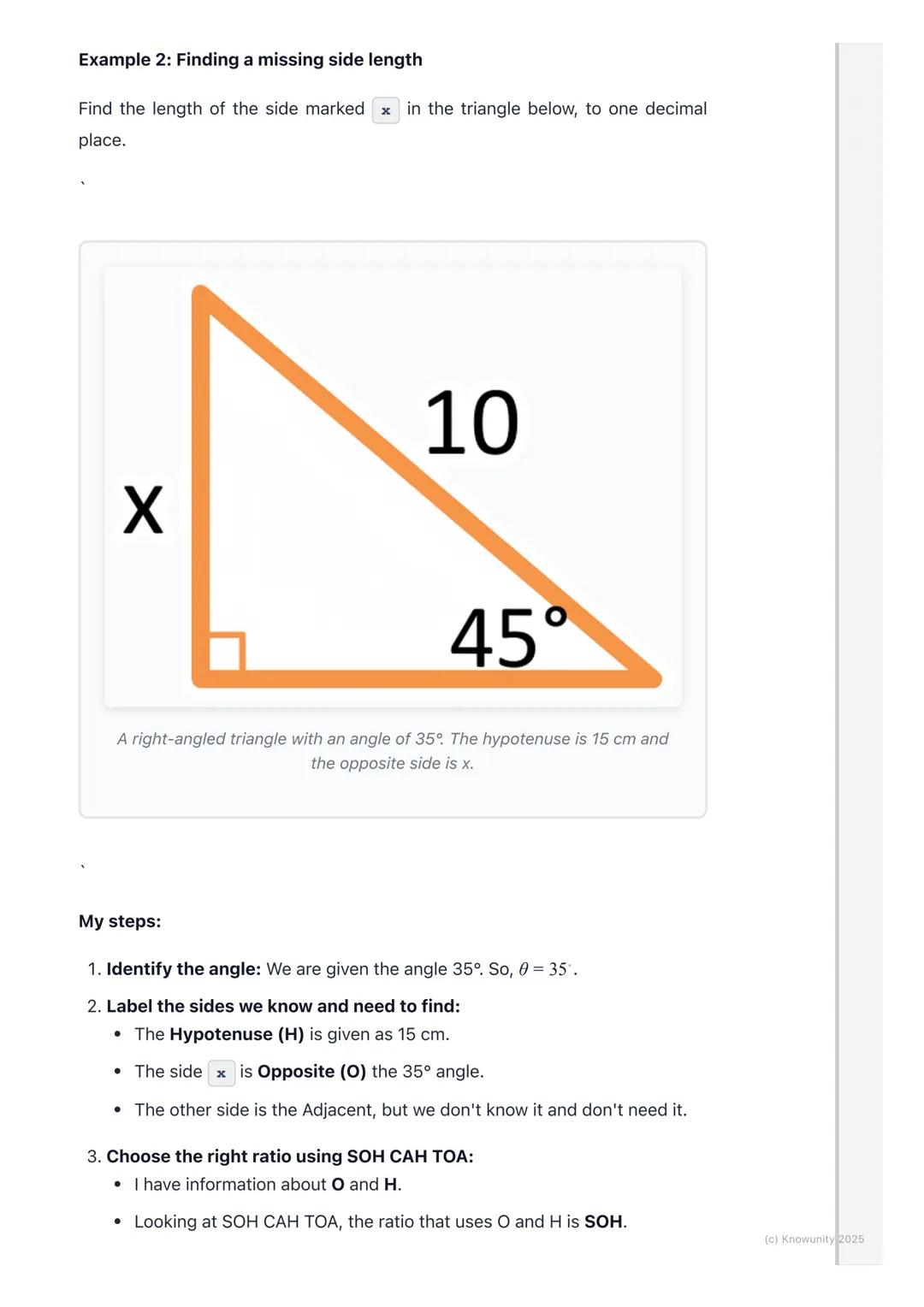
Finding Missing Side Lengths
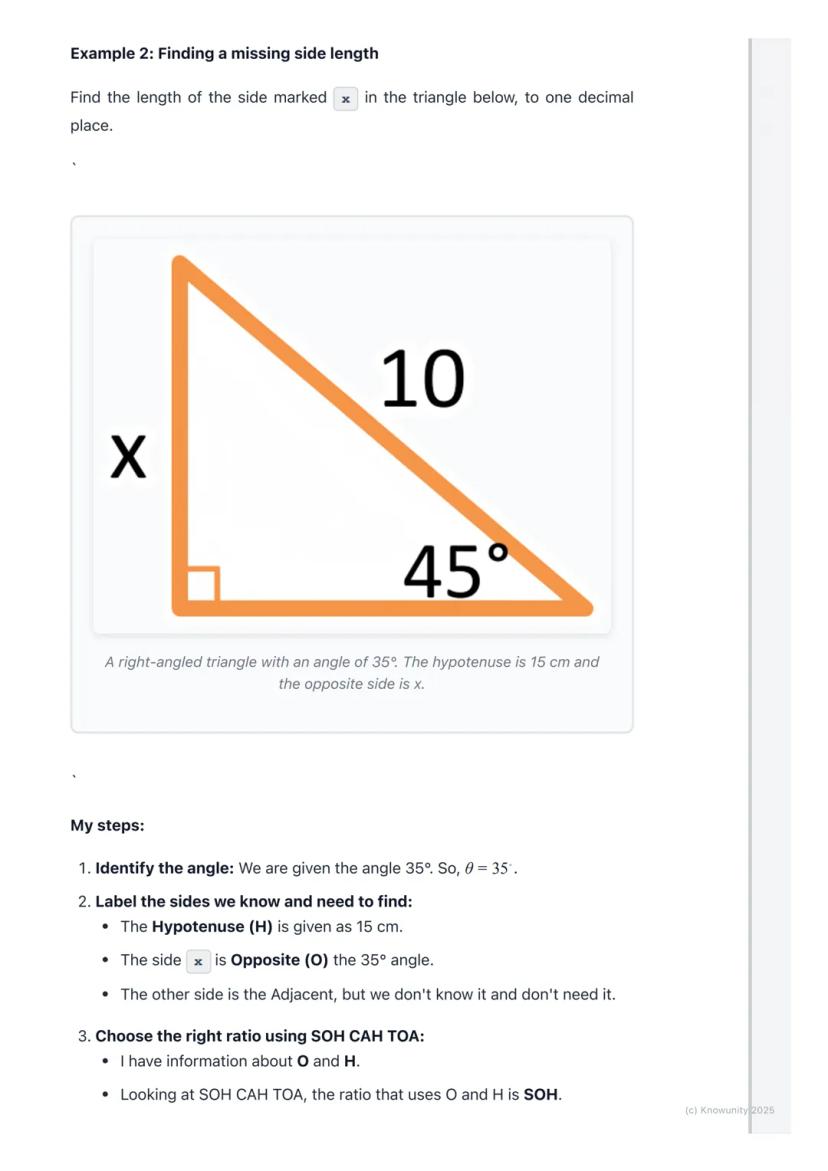
Now for the really useful stuff - finding unknown sides using trigonometry. Say you've got a triangle with a 35° angle, hypotenuse of 15 cm, and you need to find the opposite side.
Start by identifying what you know: angle = 35°, hypotenuse = 15 cm, opposite = x (unknown). You don't need the adjacent for this problem.
Choose your ratio from SOH CAH TOA. You've got opposite and hypotenuse, so that's SOH - you need sine.
Set up your equation: sin(35°) = x/15. To find x, multiply both sides by 15: x = 15 × sin(35°).
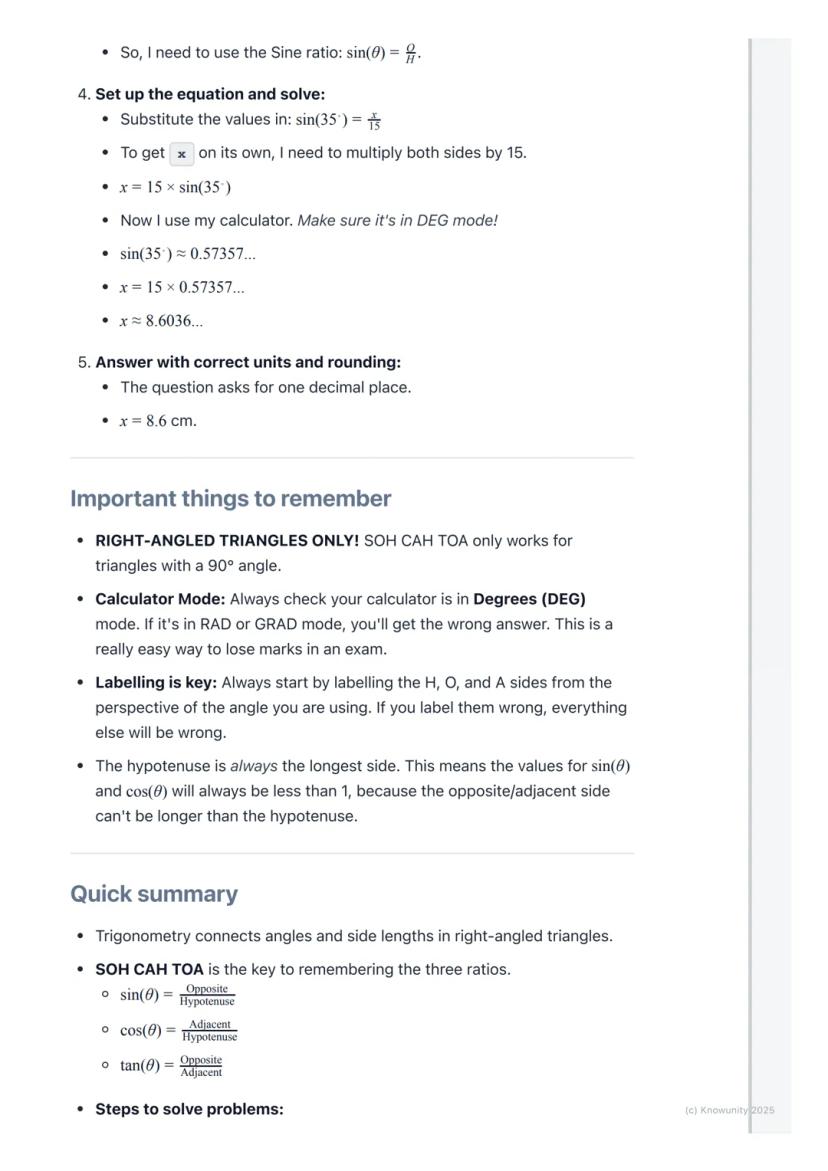
Calculator Alert: Make sure your calculator is in DEG (degrees) mode, not RAD or GRAD - this catches loads of students out!
6
of 7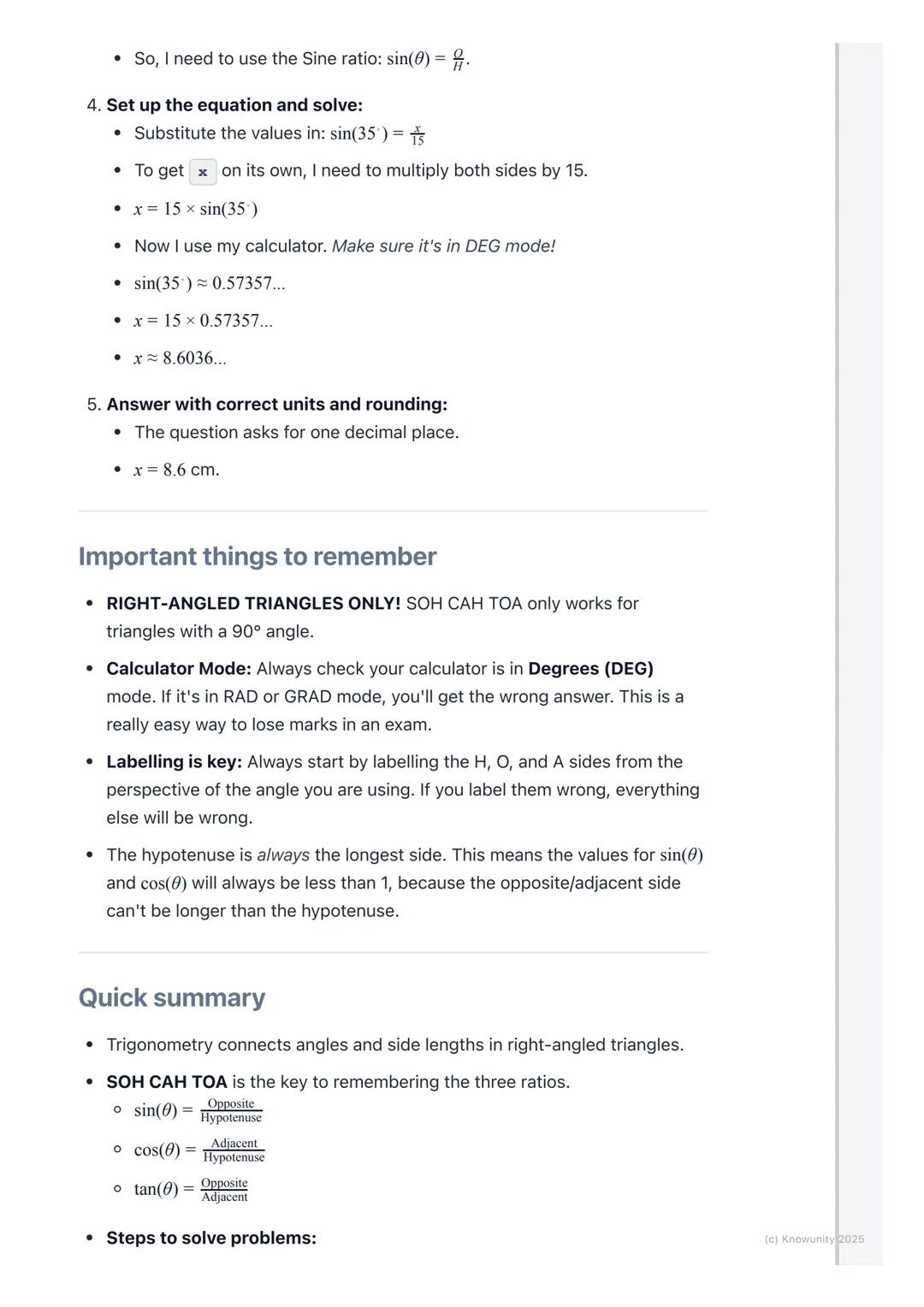
Solving and Key Points
Finishing the calculation: sin(35°) ≈ 0.57357, so x = 15 × 0.57357 ≈ 8.6 cm (to one decimal place).
Critical reminders that'll save your grades: SOH CAH TOA only works for right-angled triangles - no exceptions! Always check your calculator is in degrees mode before starting.
Labelling is everything - get your H, O, and A wrong and your whole answer goes wrong. The hypotenuse is always the longest side, which means sin and cos values are always less than 1.
Your problem-solving steps: label sides based on your angle, choose the right ratio, substitute values, solve for the unknown, and double-check that calculator mode!
Quick Check: If your sin or cos answer is greater than 1, something's gone wrong - probably your calculator mode or labelling!
7
of 7
Pensamos que nunca lo preguntarías...
¿Qué es Knowunity AI companion?
Nuestro compañero de IA está específicamente adaptado a las necesidades de los estudiantes. Basándonos en los millones de contenidos que tenemos en la plataforma, podemos dar a los estudiantes respuestas realmente significativas y relevantes. Pero no se trata solo de respuestas, el compañero también guía a los estudiantes a través de sus retos de aprendizaje diarios, con planes de aprendizaje personalizados, cuestionarios o contenidos en el chat y una personalización del 100% basada en las habilidades y el desarrollo de los estudiantes.
¿Dónde puedo descargar la app Knowunity?
Puedes descargar la app en Google Play Store y Apple App Store.
¿Knowunity es totalmente gratuito?
¡Sí lo es! Tienes acceso totalmente gratuito a todo el contenido de la app, puedes chatear con otros alumnos y recibir ayuda inmeditamente. Puedes ganar dinero utilizando la aplicación, que te permitirá acceder a determinadas funciones.
Contenidos más populares de Mathematics
8MathematicsAlgebra
Algebra
5th Year91
MathematicsAlgebra 2
Algebra notes focusing on the factor theorem, completing the square, -b formula, graphs of polynomials
5th Year130
MathematicsSolving Equations
This section focuses on solving one-step and two-step linear equations to find the value of an unknown variable.
1st Year131
MathematicsArithmetic sequences and series
With examples
5th Year130
MathematicsIntroduction to Probability
This topic introduces basic probability concepts, including calculating the probability of simple events and understanding the difference between experimental and theoretical probability.
2nd Year91
MathematicsMaths jc algebra
Maths jc
1st Year230
MathematicsNatural Numbers and Integers
Students will learn about positive whole numbers, zero, and negative whole numbers, and how to add, subtract, multiply, and divide them correctly.
1st Year131
MathematicsDifferential Calculus
Calculus is a topic that comes up nearly everywhere on your maths LC. This is just starter notes that could be useful end of 5th year or start of 6th year
5th Year271
Contenidos más populares
9 Irish
IrishIrish oral questions and answers
Questions and answers for the leaving cert oral
5th Year4264
 English
Key Quotes : Sive
Key Quotes and explanations: Sive
6th Year2842
IrishIrish oral questions
Outline of oral questions
5th Year2055
IrishIníon- le hÁine Durkin
Aine Durkin’s poem, Iníon: Themes & summary
5th Year850
IrishIrish poetry 2027
Iníon + Dínit an Bhróin
5th Year1133
IrishLC HL notes- Iníon (poem)
Includes poem in English and Irish, theme, key words & phrases
5th Year2284
EnglishCultural Context : Shawshank Redemption : Sive : Small Things Like These
Comparative Study : Cultural Context : Shawshank Redemption, Sive and Small Things Like These
6th Year1430
IrishMo Ghrá-sa (Idir Lúibíní)
Notes on mo ghrá-sa
5th Year380
IrishAn Gaeilge Aiste
Irish Language essay
6th Year1320
¿No encuentras lo que buscas? Explora otros temas.
Mira lo que dicen nuestros usuarios. Les encantó — y a ti también te encantará.
4.6/5App Store
4.7/5Google Play
La app es muy fácil de usar y está muy bien diseñada. Hasta ahora he encontrado todo lo que estaba buscando y he podido aprender mucho de las presentaciones. Definitivamente utilizaré la aplicación para un examen de clase. Y, por supuesto, también me sirve mucho de inspiración.
Pablousuario de iOS
Esta app es realmente genial. Hay tantos apuntes de clase y ayuda [...]. Tengo problemas con matemáticas, por ejemplo, y la aplicación tiene muchas opciones de ayuda. Gracias a Knowunity, he mejorado en mates. Se la recomiendo a todo el mundo.
Elenausuaria de Android
Vaya, estoy realmente sorprendida. Acabo de probar la app porque la he visto anunciada muchas veces y me he quedado absolutamente alucinada. Esta app es LA AYUDA que quieres para el insti y, sobre todo, ofrece muchísimas cosas, como ejercicios y hojas informativas, que a mí personalmente me han sido MUY útiles.
Anausuaria de iOS
Mathematics5 visualizaciones·Actualizado Jun 11, 2026·7 páginasUnderstanding Key Trigonometric Ratios: Sine, Cosine, and Tangent
Ever wondered how builders work out roof angles or how video games calculate distances? That's all trigonometry! It's basically about understanding the relationships between angles and side lengths in right-angled triangles.
1
of 7
Inscríbete para ver los apuntes. ¡Es gratis!
- Acceso a todos los documentos
- Mejora tus notas
- Únete a millones de estudiantes
Introduction to Trigonometric Ratios
Trigonometry (or just 'trig') is everywhere around us. Engineers use it to design bridges, architects calculate roof slopes, and game developers work out character movements. The brilliant thing is, it all starts with simple right-angled triangles.
Before jumping into calculations, you've got to nail the labelling. Everything depends on which angle you're focusing on - we call this angle theta (written as θ). Get this wrong and everything else falls apart!
Quick Tip: Always identify your angle first, then label everything else relative to that angle.
The key is understanding that trigonometry only works with right-angled triangles - those with a perfect 90° corner.
2
of 7Inscríbete para ver los apuntes. ¡Es gratis!
- Acceso a todos los documentos
- Mejora tus notas
- Únete a millones de estudiantes
Labelling Triangle Sides
Here's where students often trip up, but it's actually dead simple once you get it. You need to identify three sides relative to your chosen angle θ.
The Hypotenuse (H) is always the longest side - it's opposite the right angle and never changes. Easy to spot because it's the diagonal one.
The Opposite (O) side sits directly across from your angle θ. This one changes if you switch to looking at a different angle in the triangle.
The Adjacent (A) side is next to your angle θ (but it's not the hypotenuse). Like the opposite, this changes depending on which angle you're examining.
Remember: Opposite and Adjacent sides are always relative to your chosen angle. Switch angles, and they swap places!
3
of 7Inscríbete para ver los apuntes. ¡Es gratis!
- Acceso a todos los documentos
- Mejora tus notas
- Únete a millones de estudiantes
The Three Main Trig Ratios
This is the heart of trigonometry - three simple ratios that connect angles to side lengths. The magic is that for any given angle, these ratios stay constant no matter how big or small your triangle is.
SOH CAH TOA is your best mate here - memorise it! It stands for:
- SOH: Sine = Opposite ÷ Hypotenuse
- CAH: Cosine = Adjacent ÷ Hypotenuse
- TOA: Tangent = Opposite ÷ Adjacent
These trigonometric ratios are the foundation of everything. Sine connects opposite and hypotenuse, cosine links adjacent and hypotenuse, whilst tangent relates opposite and adjacent.
Exam Tip: Write "SOH CAH TOA" at the top of your exam paper - it'll save you time and stress during questions!
4
of 7Inscríbete para ver los apuntes. ¡Es gratis!
- Acceso a todos los documentos
- Mejora tus notas
- Únete a millones de estudiantes
Working with Given Triangles
Let's see SOH CAH TOA in action with a triangle that has sides of 5, 12, and 13, focusing on angle A.
First, identify your angle - we want angle A, so θ = A. Then label the sides: hypotenuse is 13 (longest side), opposite to A is 5, and adjacent to A is 12.
Now apply the ratios:
- sin(A) = 5/13 (opposite over hypotenuse)
- cos(A) = 12/13 (adjacent over hypotenuse)
- tan(A) = 5/12 (opposite over adjacent)
The brilliant thing is that these ratios would be exactly the same for any right-angled triangle with a matching angle, regardless of size.
Watch Out: If the question asked for angle B instead, your opposite and adjacent would swap, but the hypotenuse stays the same!
5
of 7Inscríbete para ver los apuntes. ¡Es gratis!
- Acceso a todos los documentos
- Mejora tus notas
- Únete a millones de estudiantes
Finding Missing Side Lengths
Now for the really useful stuff - finding unknown sides using trigonometry. Say you've got a triangle with a 35° angle, hypotenuse of 15 cm, and you need to find the opposite side.
Start by identifying what you know: angle = 35°, hypotenuse = 15 cm, opposite = x (unknown). You don't need the adjacent for this problem.
Choose your ratio from SOH CAH TOA. You've got opposite and hypotenuse, so that's SOH - you need sine.
Set up your equation: sin(35°) = x/15. To find x, multiply both sides by 15: x = 15 × sin(35°).
Calculator Alert: Make sure your calculator is in DEG (degrees) mode, not RAD or GRAD - this catches loads of students out!
6
of 7Inscríbete para ver los apuntes. ¡Es gratis!
- Acceso a todos los documentos
- Mejora tus notas
- Únete a millones de estudiantes
Solving and Key Points
Finishing the calculation: sin(35°) ≈ 0.57357, so x = 15 × 0.57357 ≈ 8.6 cm (to one decimal place).
Critical reminders that'll save your grades: SOH CAH TOA only works for right-angled triangles - no exceptions! Always check your calculator is in degrees mode before starting.
Labelling is everything - get your H, O, and A wrong and your whole answer goes wrong. The hypotenuse is always the longest side, which means sin and cos values are always less than 1.
Your problem-solving steps: label sides based on your angle, choose the right ratio, substitute values, solve for the unknown, and double-check that calculator mode!
Quick Check: If your sin or cos answer is greater than 1, something's gone wrong - probably your calculator mode or labelling!
7
of 7Inscríbete para ver los apuntes. ¡Es gratis!
- Acceso a todos los documentos
- Mejora tus notas
- Únete a millones de estudiantes
Pensamos que nunca lo preguntarías...
¿Qué es Knowunity AI companion?
Nuestro compañero de IA está específicamente adaptado a las necesidades de los estudiantes. Basándonos en los millones de contenidos que tenemos en la plataforma, podemos dar a los estudiantes respuestas realmente significativas y relevantes. Pero no se trata solo de respuestas, el compañero también guía a los estudiantes a través de sus retos de aprendizaje diarios, con planes de aprendizaje personalizados, cuestionarios o contenidos en el chat y una personalización del 100% basada en las habilidades y el desarrollo de los estudiantes.
¿Dónde puedo descargar la app Knowunity?
Puedes descargar la app en Google Play Store y Apple App Store.
¿Knowunity es totalmente gratuito?
¡Sí lo es! Tienes acceso totalmente gratuito a todo el contenido de la app, puedes chatear con otros alumnos y recibir ayuda inmeditamente. Puedes ganar dinero utilizando la aplicación, que te permitirá acceder a determinadas funciones.
Contenidos más populares de Mathematics
8MathematicsAlgebra
Algebra
5th Year91
MathematicsAlgebra 2
Algebra notes focusing on the factor theorem, completing the square, -b formula, graphs of polynomials
5th Year130
MathematicsSolving Equations
This section focuses on solving one-step and two-step linear equations to find the value of an unknown variable.
1st Year131
MathematicsArithmetic sequences and series
With examples
5th Year130
MathematicsIntroduction to Probability
This topic introduces basic probability concepts, including calculating the probability of simple events and understanding the difference between experimental and theoretical probability.
2nd Year91
MathematicsMaths jc algebra
Maths jc
1st Year230
MathematicsNatural Numbers and Integers
Students will learn about positive whole numbers, zero, and negative whole numbers, and how to add, subtract, multiply, and divide them correctly.
1st Year131
MathematicsDifferential Calculus
Calculus is a topic that comes up nearly everywhere on your maths LC. This is just starter notes that could be useful end of 5th year or start of 6th year
5th Year271
Contenidos más populares
9IrishIrish oral questions and answers
Questions and answers for the leaving cert oral
5th Year4264
EnglishKey Quotes : Sive
Key Quotes and explanations: Sive
6th Year2842
IrishIrish oral questions
Outline of oral questions
5th Year2055
IrishIníon- le hÁine Durkin
Aine Durkin’s poem, Iníon: Themes & summary
5th Year850
IrishIrish poetry 2027
Iníon + Dínit an Bhróin
5th Year1133
IrishLC HL notes- Iníon (poem)
Includes poem in English and Irish, theme, key words & phrases
5th Year2284
EnglishCultural Context : Shawshank Redemption : Sive : Small Things Like These
Comparative Study : Cultural Context : Shawshank Redemption, Sive and Small Things Like These
6th Year1430
IrishMo Ghrá-sa (Idir Lúibíní)
Notes on mo ghrá-sa
5th Year380
IrishAn Gaeilge Aiste
Irish Language essay
6th Year1320
¿No encuentras lo que buscas? Explora otros temas.
Mira lo que dicen nuestros usuarios. Les encantó — y a ti también te encantará.
4.6/5App Store
4.7/5Google Play
La app es muy fácil de usar y está muy bien diseñada. Hasta ahora he encontrado todo lo que estaba buscando y he podido aprender mucho de las presentaciones. Definitivamente utilizaré la aplicación para un examen de clase. Y, por supuesto, también me sirve mucho de inspiración.
Pablousuario de iOS
Esta app es realmente genial. Hay tantos apuntes de clase y ayuda [...]. Tengo problemas con matemáticas, por ejemplo, y la aplicación tiene muchas opciones de ayuda. Gracias a Knowunity, he mejorado en mates. Se la recomiendo a todo el mundo.
Elenausuaria de Android
Vaya, estoy realmente sorprendida. Acabo de probar la app porque la he visto anunciada muchas veces y me he quedado absolutamente alucinada. Esta app es LA AYUDA que quieres para el insti y, sobre todo, ofrece muchísimas cosas, como ejercicios y hojas informativas, que a mí personalmente me han sido MUY útiles.
Anausuaria de iOS