
The Irish future tense (an aimsir fháistineach) is your tool...
 Irish5 visualizaciones·Actualizado Jun 13, 2026·5 páginas
Learn About An Aimsir Fháistineach: Forming Future Tense in Irish
1 / 5
1
of 5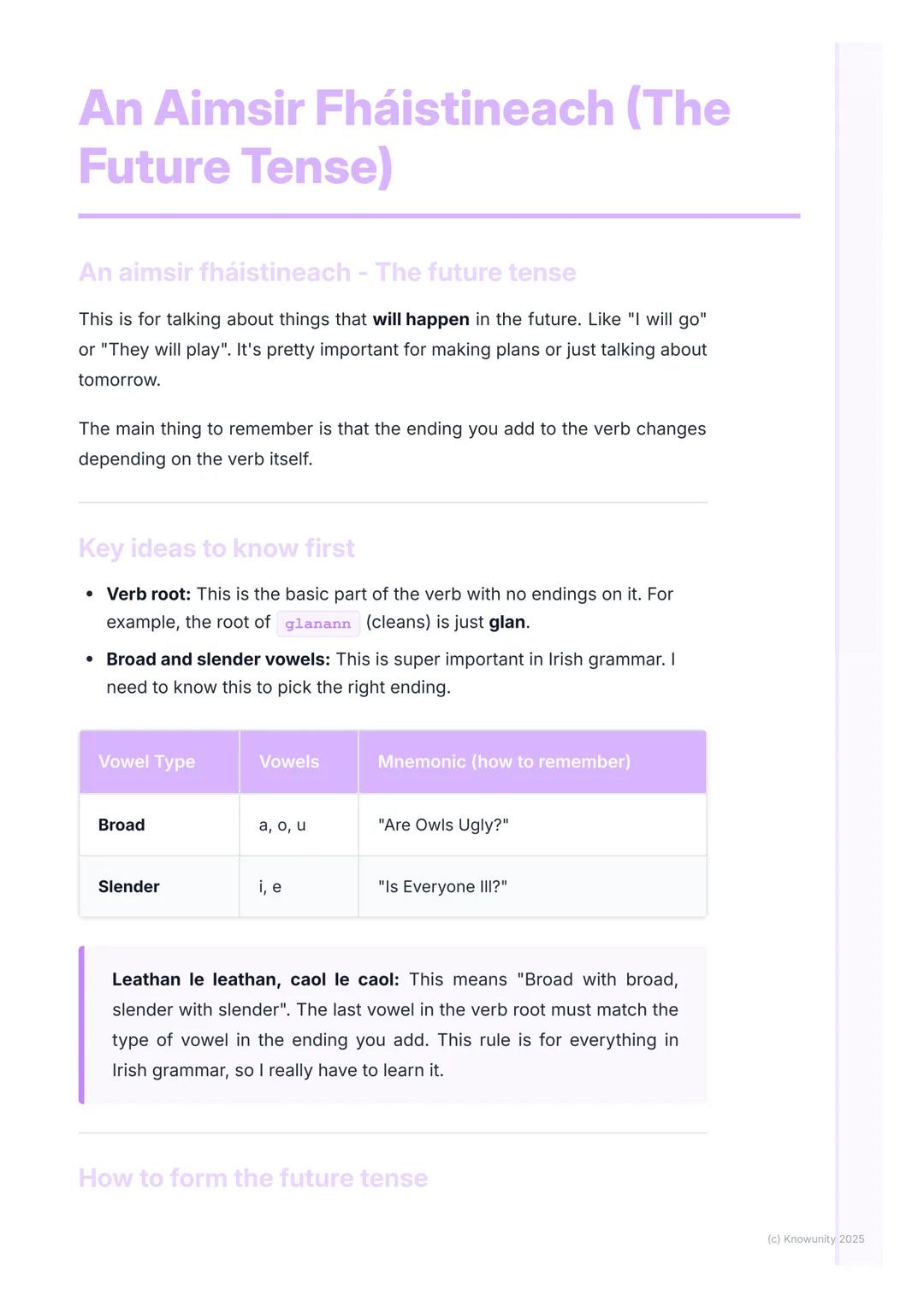
An Aimsir Fháistineach - Getting Started
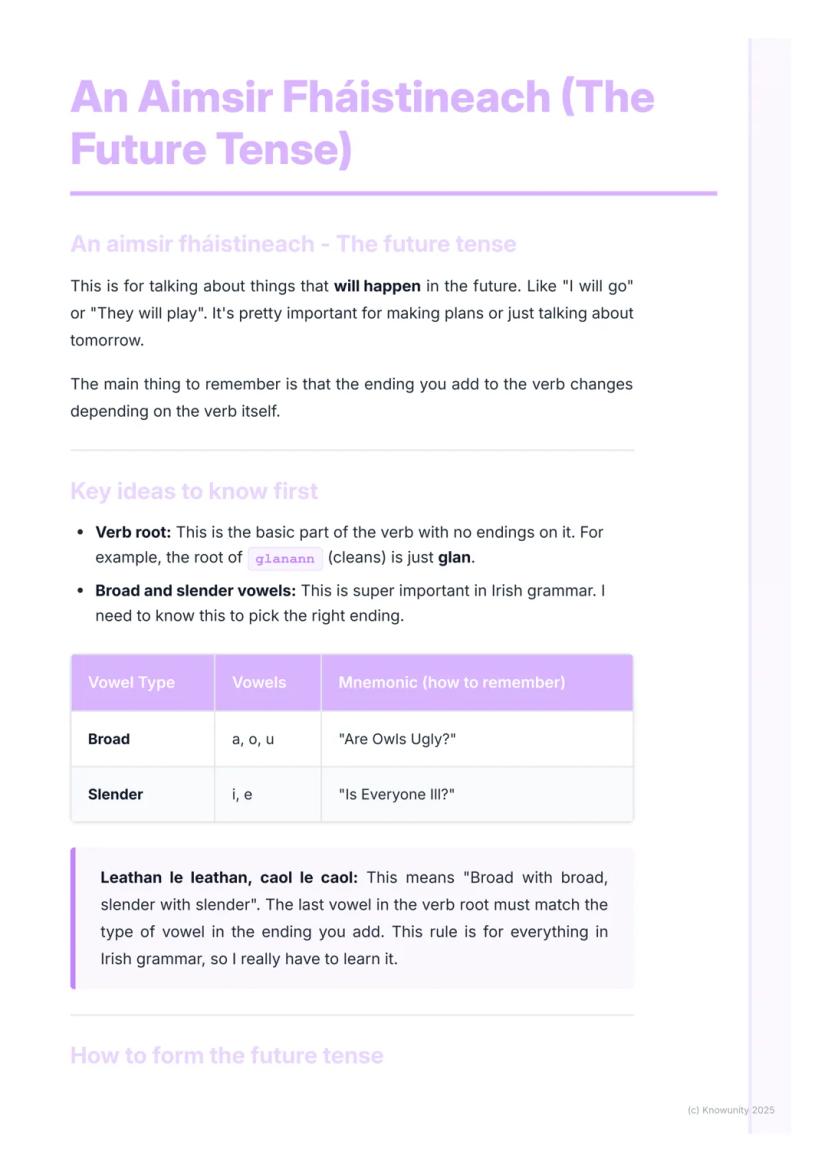
Think of the future tense as your planning language - it's how you say "I will go" or "they will play" in Irish. The trick is knowing which ending to stick on your verb, and that depends on the vowels inside it.
Before diving in, you need to master broad and slender vowels. Broad vowels are a, o, u (remember: "Are Owls Ugly?") and slender vowels are i, e ("Is Everyone Ill?"). This matters because of the golden rule: leathan le leathan, caol le caol - broad with broad, slender with slender.
The verb root is your starting point - it's the basic form without any endings. For example, glanann (cleans) has the root glan. Once you've got your root, check its last vowel to decide which ending fits.
Quick tip: Master the vowel types first - they're used throughout Irish grammar, not just the future tense!
2
of 5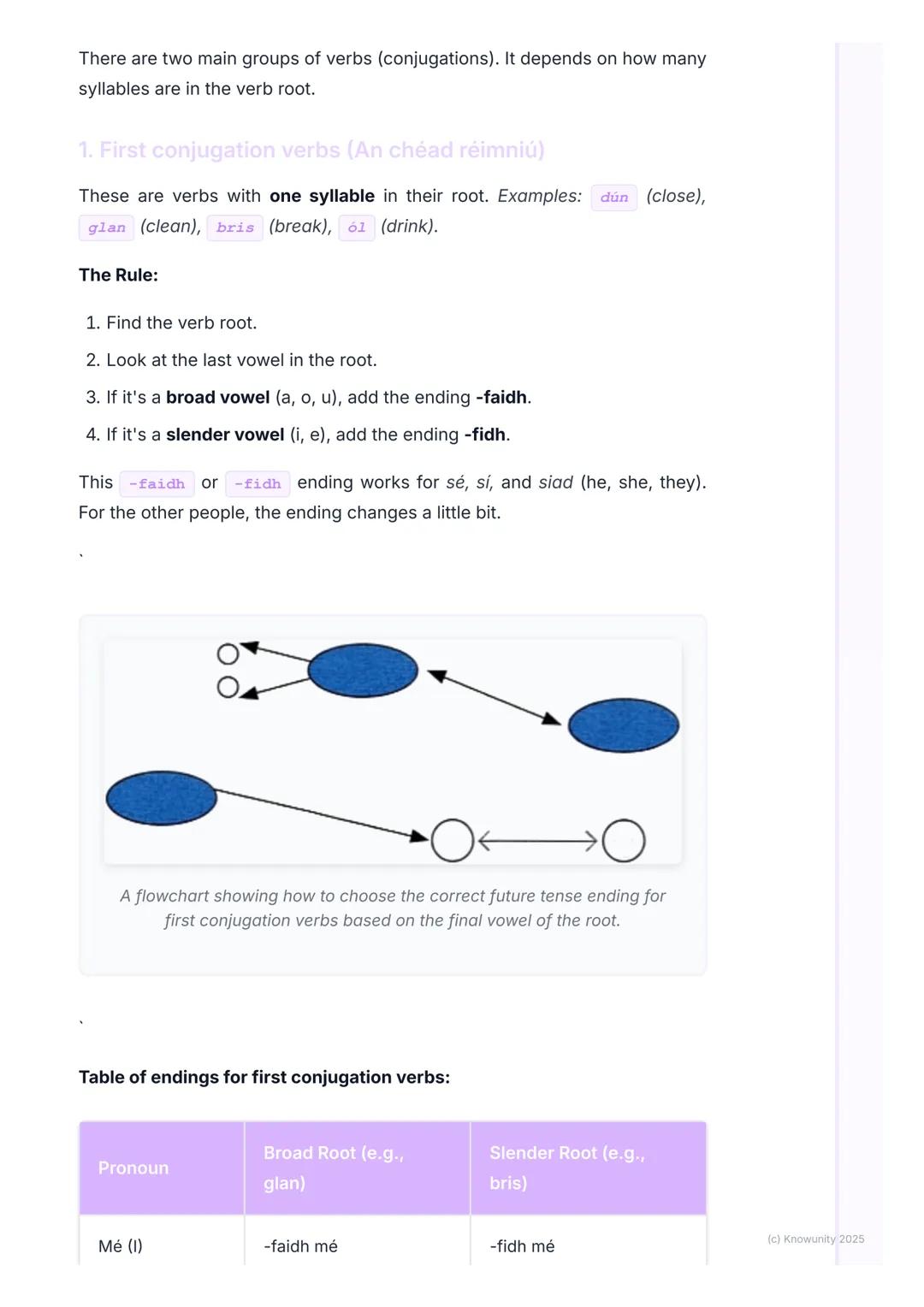
First Conjugation Verbs - The One-Syllable Gang
First conjugation verbs have just one syllable in their root - words like dún (close), glan (clean), bris (break), and ól (drink). These are actually the easiest once you get the pattern.
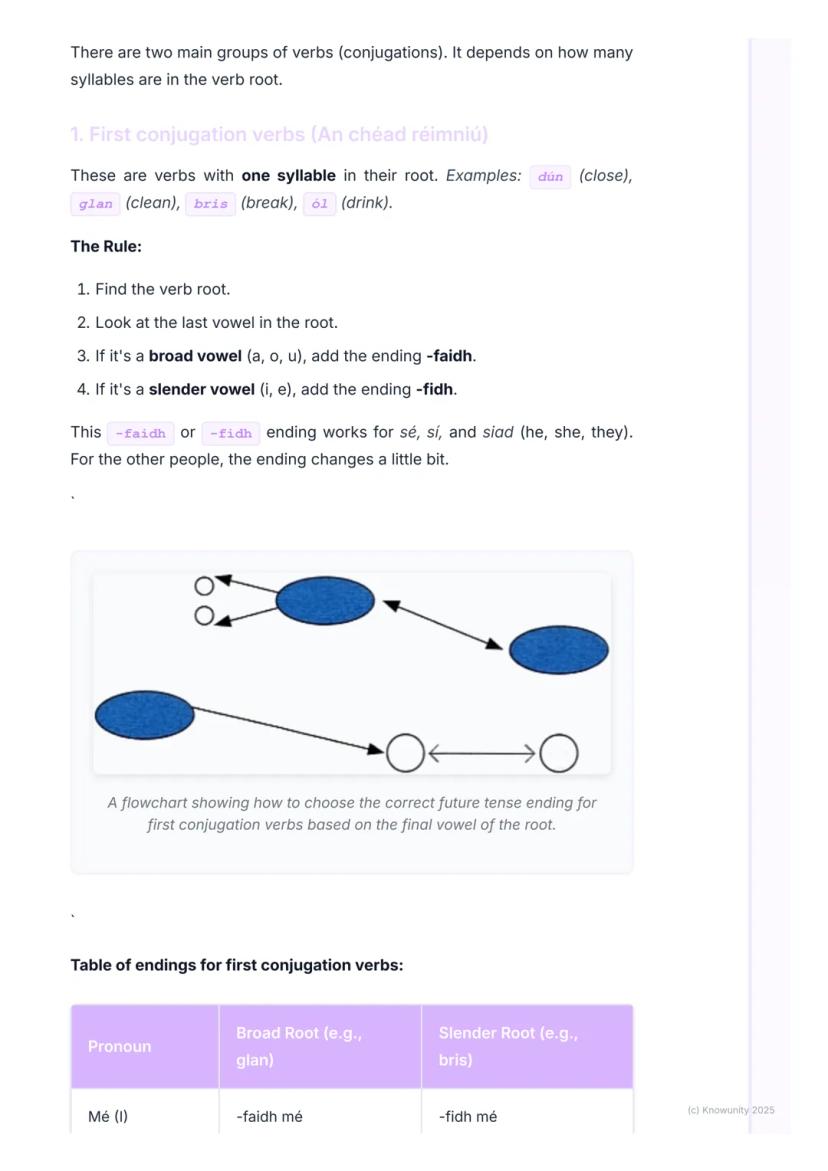
Here's the system: if your verb root ends with a broad vowel (a, o, u), you add -faidh. If it ends with a slender vowel (i, e), you add -fidh. So glan becomes glanfaidh and bris becomes brisfidh.
The endings work perfectly for sé, sí, and siad (he, she, they). For other pronouns like mé and tú, you just add the pronoun after: glanfaidh mé, glanfaidh tú. The only special case is sinn (we) - it gets its own endings: -faimid for broad roots and -fimid for slender ones.
Remember: The broad/slender rule applies to every single verb - there are no exceptions here!
3
of 5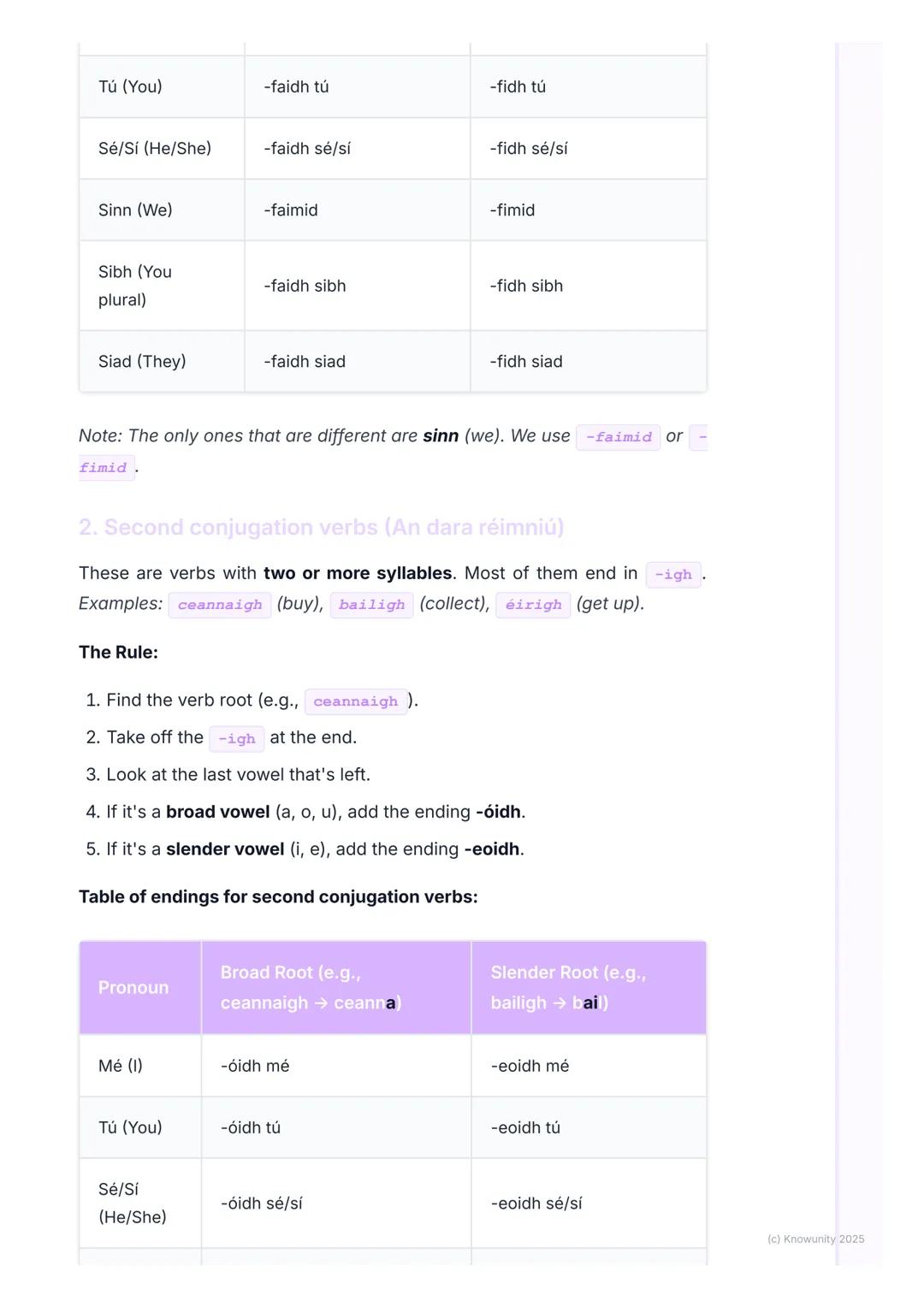
Second Conjugation Verbs - The Multi-Syllable Squad
Second conjugation verbs have two or more syllables and usually end in -igh. Think ceannaigh (buy), bailigh (collect), or éirigh (get up) - they're longer words that need a different approach.
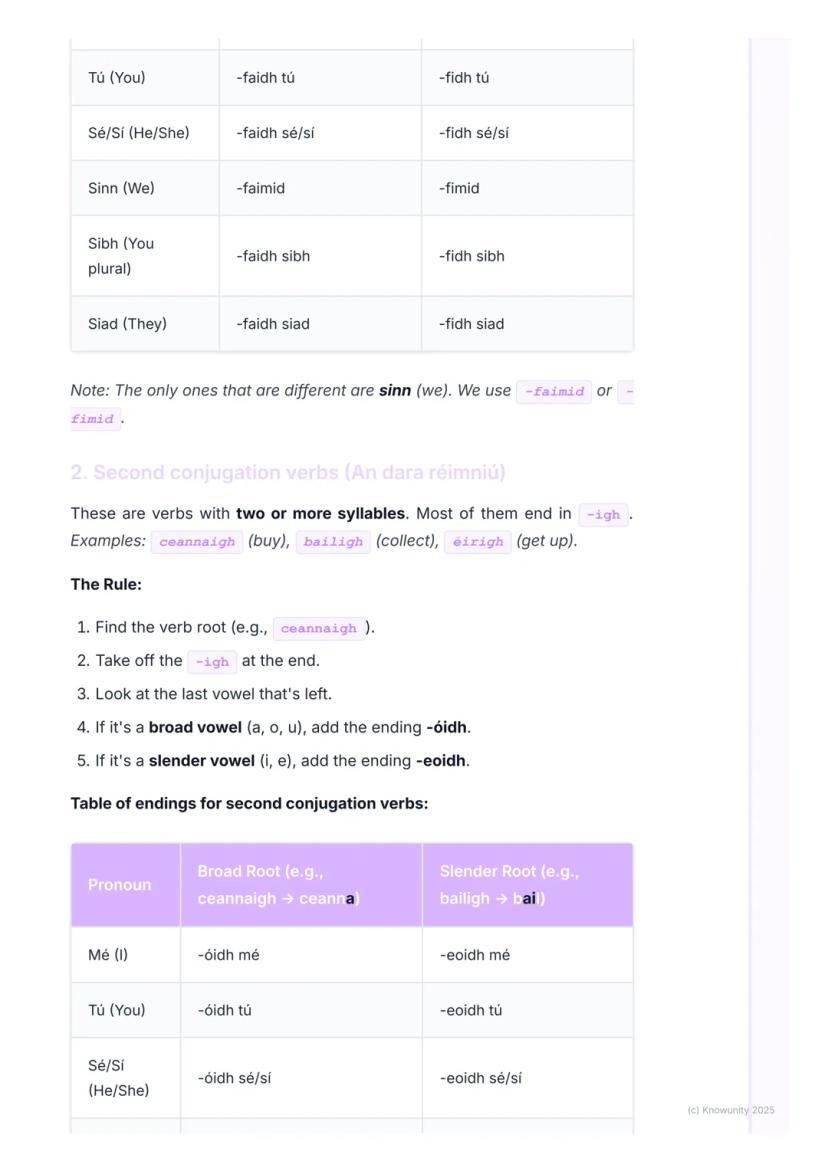
The process is straightforward: chop off the -igh ending first. Then check what vowel you're left with at the end. If it's broad (a, o, u), add -óidh. If it's slender (i, e), add -eoidh.
So ceannaigh loses its -igh to become ceanna (ending in broad 'a'), then gets -óidh to make ceannóidh. Bailigh becomes bail (ending in slender 'i'), then gets -eoidh to make baileoidh.
Just like first conjugation, sinn (we) is special again. It uses -óimid for broad roots and -eoimid for slender ones instead of the regular endings.
Pro tip: Most verbs you'll meet ending in -igh follow this pattern - it's more common than you might think!
4
of 5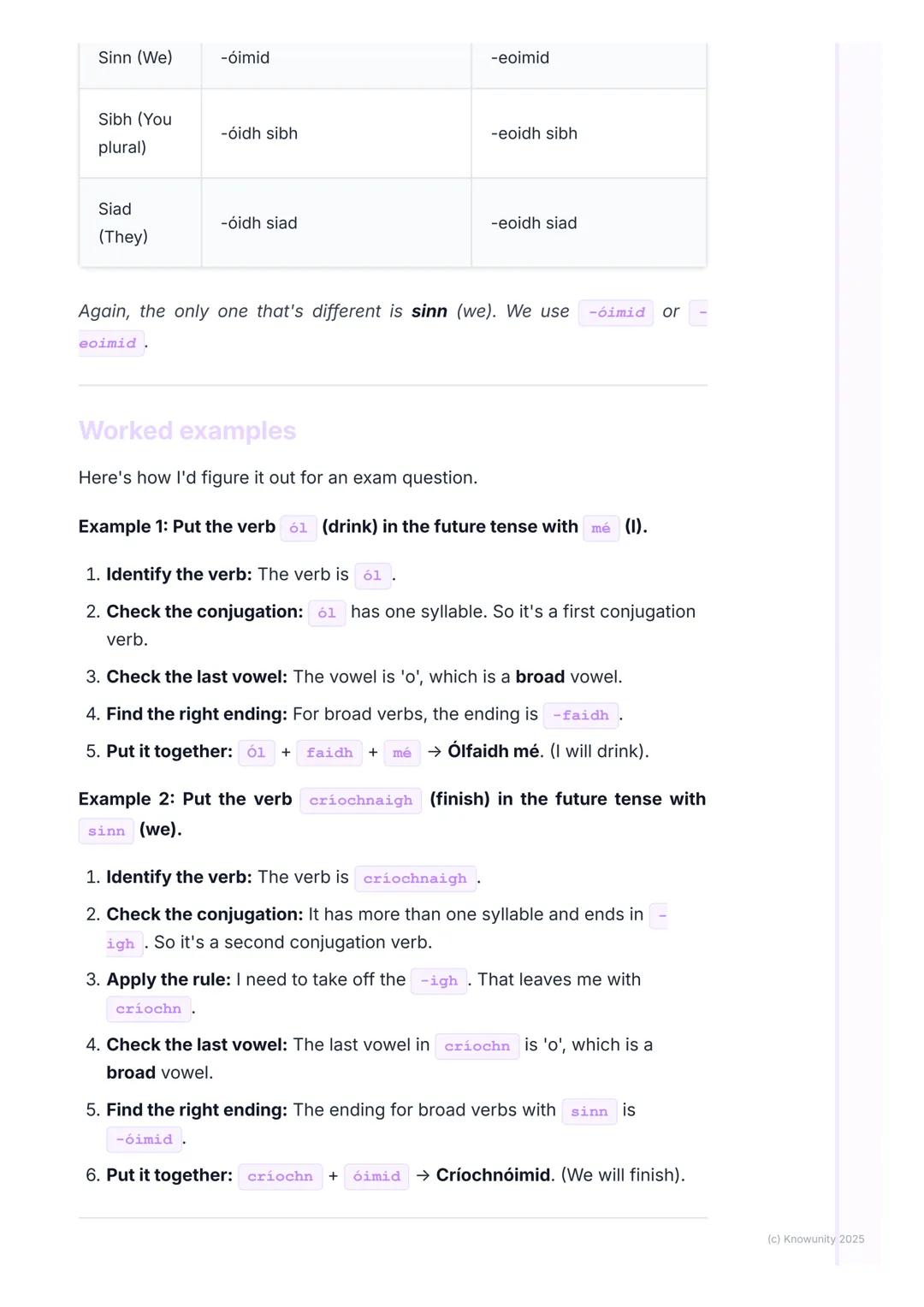
Working Through Examples
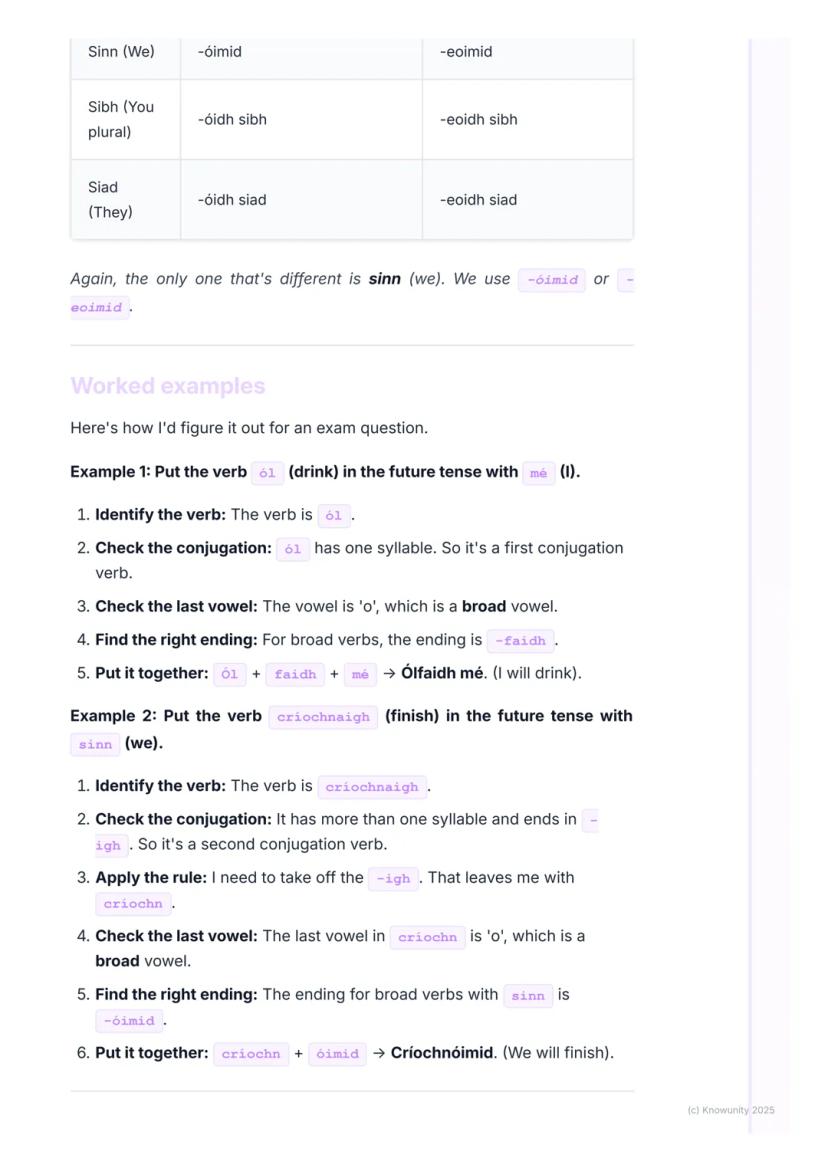
Let's tackle some exam-style questions to see how this works in practice. Take ól (drink) with mé (I) - it's one syllable, so it's first conjugation. The 'o' is broad, so we add -faidh: ólfaidh mé (I will drink).
For something trickier, try críochnaigh (finish) with sinn (we). It's multi-syllable and ends in -igh, so it's second conjugation. Drop the -igh to get críochn, which ends in broad 'o'. Since it's sinn, we use -óimid: críochnóimid (we will finish).
The key is taking it step by step: identify the conjugation type, find the root, check the vowel type, pick the right ending. Once you've done a few, the pattern becomes automatic.
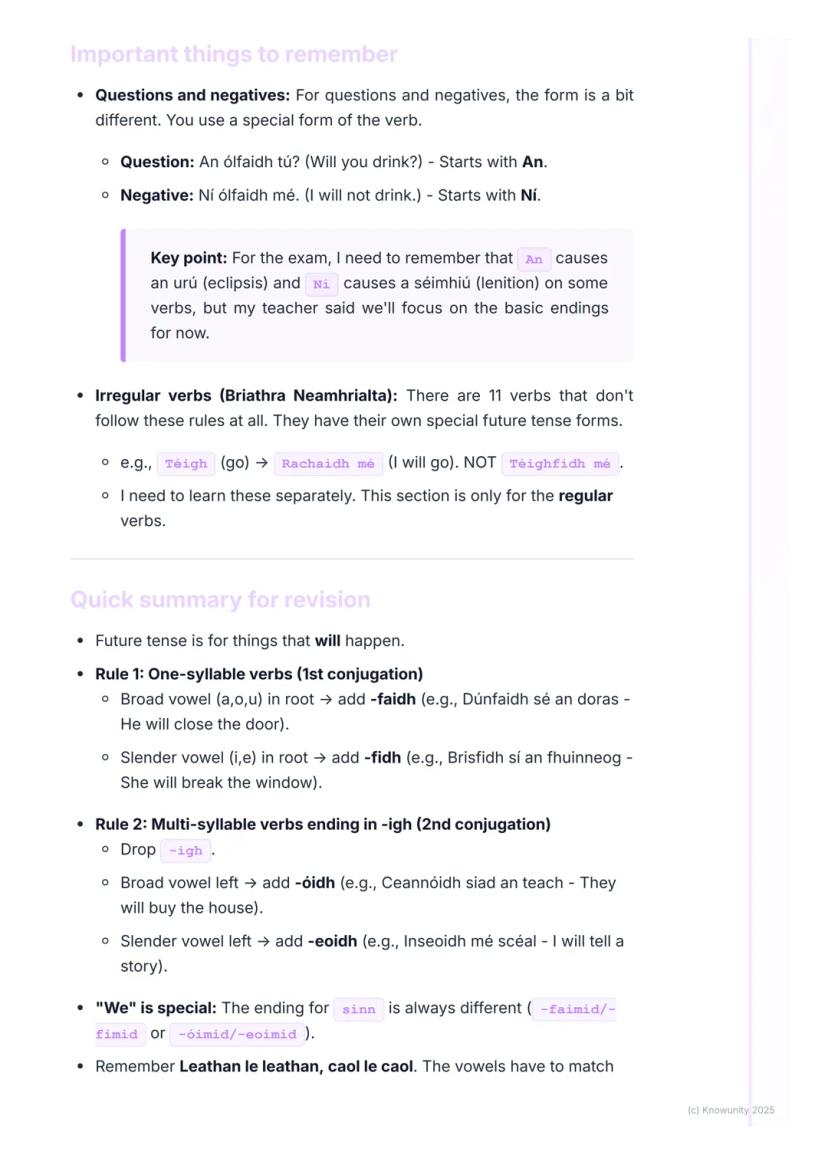
Questions and negatives change things slightly - they start with An (will...?) or Ní (will not...), but the verb endings stay the same. An ólfaidh tú? (Will you drink?) and Ní ólfaidh mé (I will not drink).
Exam hack: Always identify conjugation type first - it saves you from mixing up the ending patterns!
5
of 5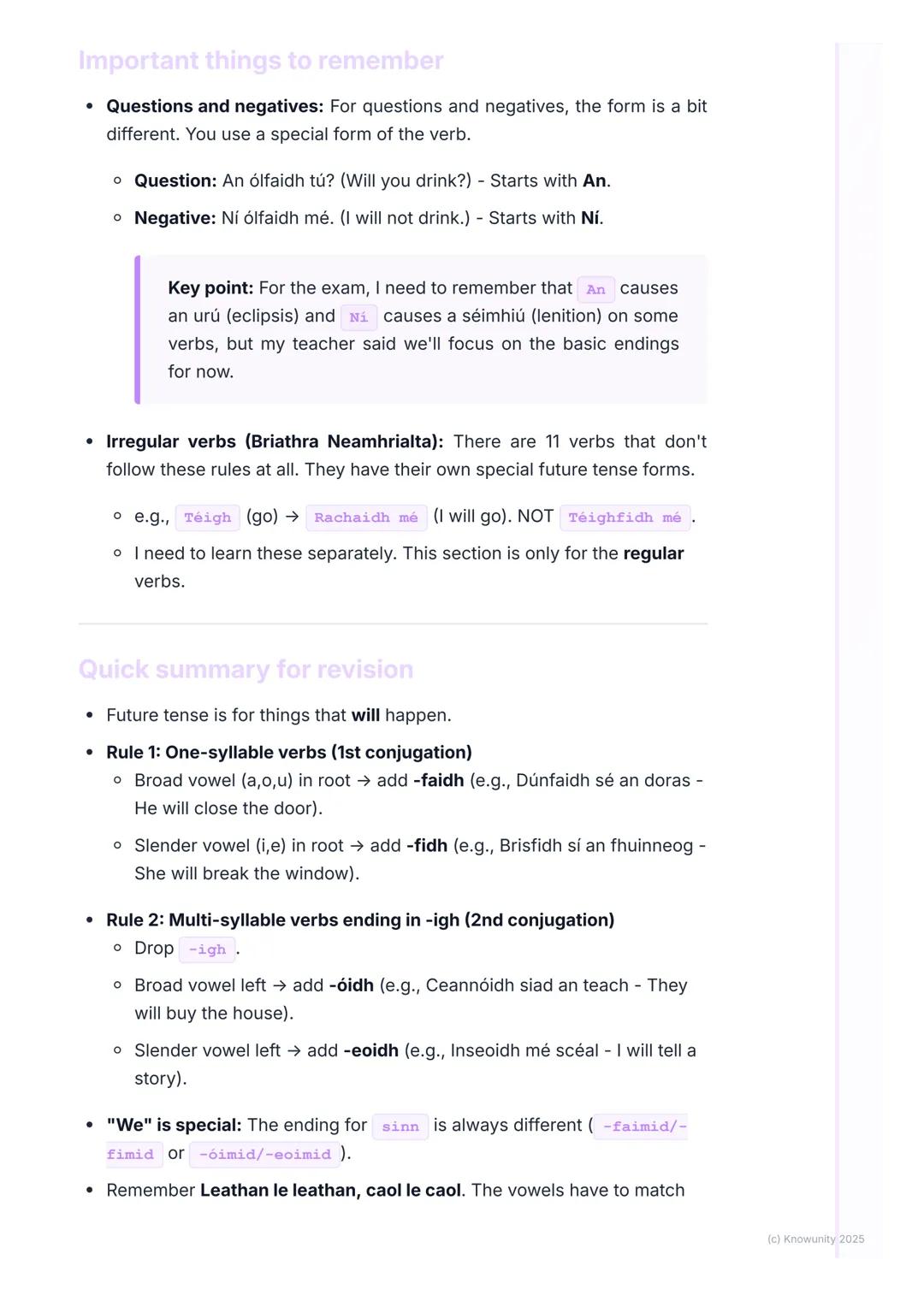
Quick Revision Summary
You've got two main patterns to remember. First conjugation : broad vowel gets -faidh, slender vowel gets -fidh. Second conjugation : drop the -igh, then broad gets -óidh, slender gets -eoidh.
The pronoun sinn (we) always gets special treatment with its own endings: -faimid/-fimid for first conjugation, -óimid/-eoimid for second conjugation. Every other pronoun just tags along after the main verb form.
Remember that irregular verbs like téigh (go) completely ignore these rules - téigh becomes rachaidh mé (I will go), not téighfidh mé. You'll need to learn those 11 irregular verbs separately.
The leathan le leathan, caol le caol rule is your safety net - if your vowels don't match up, you've made a mistake somewhere. This future tense system works for the vast majority of Irish verbs once you've mastered the basics.
Final reminder: Practice with regular verbs first - once these patterns are automatic, irregular verbs become much easier to handle!
Pensamos que nunca lo preguntarías...
¿Qué es Knowunity AI companion?
Nuestro compañero de IA está específicamente adaptado a las necesidades de los estudiantes. Basándonos en los millones de contenidos que tenemos en la plataforma, podemos dar a los estudiantes respuestas realmente significativas y relevantes. Pero no se trata solo de respuestas, el compañero también guía a los estudiantes a través de sus retos de aprendizaje diarios, con planes de aprendizaje personalizados, cuestionarios o contenidos en el chat y una personalización del 100% basada en las habilidades y el desarrollo de los estudiantes.
¿Dónde puedo descargar la app Knowunity?
Puedes descargar la app en Google Play Store y Apple App Store.
¿Knowunity es totalmente gratuito?
¡Sí lo es! Tienes acceso totalmente gratuito a todo el contenido de la app, puedes chatear con otros alumnos y recibir ayuda inmeditamente. Puedes ganar dinero utilizando la aplicación, que te permitirá acceder a determinadas funciones.
Contenidos más populares de Irish
9IrishIrish oral questions and answers
Questions and answers for the leaving cert oral
5th Year4264
IrishIrish oral questions
Outline of oral questions
5th Year2055
IrishIrish poetry 2027
Iníon + Dínit an Bhróin
5th Year1153
IrishIníon- le hÁine Durkin
Aine Durkin’s poem, Iníon: Themes & summary
5th Year890
IrishLC HL notes- Iníon (poem)
Includes poem in English and Irish, theme, key words & phrases
5th Year2304
IrishMo Ghrá-sa (Idir Lúibíní)
Notes on mo ghrá-sa
5th Year380
IrishGaeilge Grammar Office
All the basics you need to know on Irish grammar.
6th Year1063
IrishAn Gaeilge Aiste
Irish Language essay
6th Year1320
IrishMé Féin & Mo Chlann (Myself & My Family)
Students will learn vocabulary to describe themselves, their family members, and daily routines. This helps in personal introductions and discussions.
TY291
Contenidos más populares
9IrishIrish oral questions and answers
Questions and answers for the leaving cert oral
5th Year4264
 English
Key Quotes : Sive
Key Quotes and explanations: Sive
6th Year2842
IrishIrish oral questions
Outline of oral questions
5th Year2055
IrishIníon- le hÁine Durkin
Aine Durkin’s poem, Iníon: Themes & summary
5th Year890
IrishIrish poetry 2027
Iníon + Dínit an Bhróin
5th Year1153
IrishLC HL notes- Iníon (poem)
Includes poem in English and Irish, theme, key words & phrases
5th Year2304
EnglishCultural Context : Shawshank Redemption : Sive : Small Things Like These
Comparative Study : Cultural Context : Shawshank Redemption, Sive and Small Things Like These
6th Year1430
IrishMo Ghrá-sa (Idir Lúibíní)
Notes on mo ghrá-sa
5th Year380
IrishAn Gaeilge Aiste
Irish Language essay
6th Year1320
¿No encuentras lo que buscas? Explora otros temas.
Mira lo que dicen nuestros usuarios. Les encantó — y a ti también te encantará.
4.6/5App Store
4.7/5Google Play
La app es muy fácil de usar y está muy bien diseñada. Hasta ahora he encontrado todo lo que estaba buscando y he podido aprender mucho de las presentaciones. Definitivamente utilizaré la aplicación para un examen de clase. Y, por supuesto, también me sirve mucho de inspiración.
Pablousuario de iOS
Esta app es realmente genial. Hay tantos apuntes de clase y ayuda [...]. Tengo problemas con matemáticas, por ejemplo, y la aplicación tiene muchas opciones de ayuda. Gracias a Knowunity, he mejorado en mates. Se la recomiendo a todo el mundo.
Elenausuaria de Android
Vaya, estoy realmente sorprendida. Acabo de probar la app porque la he visto anunciada muchas veces y me he quedado absolutamente alucinada. Esta app es LA AYUDA que quieres para el insti y, sobre todo, ofrece muchísimas cosas, como ejercicios y hojas informativas, que a mí personalmente me han sido MUY útiles.
Anausuaria de iOS
Irish5 visualizaciones·Actualizado Jun 13, 2026·5 páginasLearn About An Aimsir Fháistineach: Forming Future Tense in Irish
The Irish future tense (an aimsir fháistineach) is your tool for talking about things that will happen - from tomorrow's plans to next year's goals. It's built on a simple system of adding specific endings to verb roots, but you...
1
of 5
Inscríbete para ver los apuntes. ¡Es gratis!
- Acceso a todos los documentos
- Mejora tus notas
- Únete a millones de estudiantes
An Aimsir Fháistineach - Getting Started
Think of the future tense as your planning language - it's how you say "I will go" or "they will play" in Irish. The trick is knowing which ending to stick on your verb, and that depends on the vowels inside it.
Before diving in, you need to master broad and slender vowels. Broad vowels are a, o, u (remember: "Are Owls Ugly?") and slender vowels are i, e ("Is Everyone Ill?"). This matters because of the golden rule: leathan le leathan, caol le caol - broad with broad, slender with slender.
The verb root is your starting point - it's the basic form without any endings. For example, glanann (cleans) has the root glan. Once you've got your root, check its last vowel to decide which ending fits.
Quick tip: Master the vowel types first - they're used throughout Irish grammar, not just the future tense!
2
of 5Inscríbete para ver los apuntes. ¡Es gratis!
- Acceso a todos los documentos
- Mejora tus notas
- Únete a millones de estudiantes
First Conjugation Verbs - The One-Syllable Gang
First conjugation verbs have just one syllable in their root - words like dún (close), glan (clean), bris (break), and ól (drink). These are actually the easiest once you get the pattern.
Here's the system: if your verb root ends with a broad vowel (a, o, u), you add -faidh. If it ends with a slender vowel (i, e), you add -fidh. So glan becomes glanfaidh and bris becomes brisfidh.
The endings work perfectly for sé, sí, and siad (he, she, they). For other pronouns like mé and tú, you just add the pronoun after: glanfaidh mé, glanfaidh tú. The only special case is sinn (we) - it gets its own endings: -faimid for broad roots and -fimid for slender ones.
Remember: The broad/slender rule applies to every single verb - there are no exceptions here!
3
of 5Inscríbete para ver los apuntes. ¡Es gratis!
- Acceso a todos los documentos
- Mejora tus notas
- Únete a millones de estudiantes
Second Conjugation Verbs - The Multi-Syllable Squad
Second conjugation verbs have two or more syllables and usually end in -igh. Think ceannaigh (buy), bailigh (collect), or éirigh (get up) - they're longer words that need a different approach.
The process is straightforward: chop off the -igh ending first. Then check what vowel you're left with at the end. If it's broad (a, o, u), add -óidh. If it's slender (i, e), add -eoidh.
So ceannaigh loses its -igh to become ceanna (ending in broad 'a'), then gets -óidh to make ceannóidh. Bailigh becomes bail (ending in slender 'i'), then gets -eoidh to make baileoidh.
Just like first conjugation, sinn (we) is special again. It uses -óimid for broad roots and -eoimid for slender ones instead of the regular endings.
Pro tip: Most verbs you'll meet ending in -igh follow this pattern - it's more common than you might think!
4
of 5Inscríbete para ver los apuntes. ¡Es gratis!
- Acceso a todos los documentos
- Mejora tus notas
- Únete a millones de estudiantes
Working Through Examples
Let's tackle some exam-style questions to see how this works in practice. Take ól (drink) with mé (I) - it's one syllable, so it's first conjugation. The 'o' is broad, so we add -faidh: ólfaidh mé (I will drink).
For something trickier, try críochnaigh (finish) with sinn (we). It's multi-syllable and ends in -igh, so it's second conjugation. Drop the -igh to get críochn, which ends in broad 'o'. Since it's sinn, we use -óimid: críochnóimid (we will finish).
The key is taking it step by step: identify the conjugation type, find the root, check the vowel type, pick the right ending. Once you've done a few, the pattern becomes automatic.
Questions and negatives change things slightly - they start with An (will...?) or Ní (will not...), but the verb endings stay the same. An ólfaidh tú? (Will you drink?) and Ní ólfaidh mé (I will not drink).
Exam hack: Always identify conjugation type first - it saves you from mixing up the ending patterns!
5
of 5Inscríbete para ver los apuntes. ¡Es gratis!
- Acceso a todos los documentos
- Mejora tus notas
- Únete a millones de estudiantes
Quick Revision Summary
You've got two main patterns to remember. First conjugation : broad vowel gets -faidh, slender vowel gets -fidh. Second conjugation : drop the -igh, then broad gets -óidh, slender gets -eoidh.
The pronoun sinn (we) always gets special treatment with its own endings: -faimid/-fimid for first conjugation, -óimid/-eoimid for second conjugation. Every other pronoun just tags along after the main verb form.
Remember that irregular verbs like téigh (go) completely ignore these rules - téigh becomes rachaidh mé (I will go), not téighfidh mé. You'll need to learn those 11 irregular verbs separately.
The leathan le leathan, caol le caol rule is your safety net - if your vowels don't match up, you've made a mistake somewhere. This future tense system works for the vast majority of Irish verbs once you've mastered the basics.
Final reminder: Practice with regular verbs first - once these patterns are automatic, irregular verbs become much easier to handle!
Pensamos que nunca lo preguntarías...
¿Qué es Knowunity AI companion?
Nuestro compañero de IA está específicamente adaptado a las necesidades de los estudiantes. Basándonos en los millones de contenidos que tenemos en la plataforma, podemos dar a los estudiantes respuestas realmente significativas y relevantes. Pero no se trata solo de respuestas, el compañero también guía a los estudiantes a través de sus retos de aprendizaje diarios, con planes de aprendizaje personalizados, cuestionarios o contenidos en el chat y una personalización del 100% basada en las habilidades y el desarrollo de los estudiantes.
¿Dónde puedo descargar la app Knowunity?
Puedes descargar la app en Google Play Store y Apple App Store.
¿Knowunity es totalmente gratuito?
¡Sí lo es! Tienes acceso totalmente gratuito a todo el contenido de la app, puedes chatear con otros alumnos y recibir ayuda inmeditamente. Puedes ganar dinero utilizando la aplicación, que te permitirá acceder a determinadas funciones.
Contenidos más populares de Irish
9IrishIrish oral questions and answers
Questions and answers for the leaving cert oral
5th Year4264
IrishIrish oral questions
Outline of oral questions
5th Year2055
IrishIrish poetry 2027
Iníon + Dínit an Bhróin
5th Year1153
IrishIníon- le hÁine Durkin
Aine Durkin’s poem, Iníon: Themes & summary
5th Year890
IrishLC HL notes- Iníon (poem)
Includes poem in English and Irish, theme, key words & phrases
5th Year2304
IrishMo Ghrá-sa (Idir Lúibíní)
Notes on mo ghrá-sa
5th Year380
IrishGaeilge Grammar Office
All the basics you need to know on Irish grammar.
6th Year1063
IrishAn Gaeilge Aiste
Irish Language essay
6th Year1320
IrishMé Féin & Mo Chlann (Myself & My Family)
Students will learn vocabulary to describe themselves, their family members, and daily routines. This helps in personal introductions and discussions.
TY291
Contenidos más populares
9IrishIrish oral questions and answers
Questions and answers for the leaving cert oral
5th Year4264
EnglishKey Quotes : Sive
Key Quotes and explanations: Sive
6th Year2842
IrishIrish oral questions
Outline of oral questions
5th Year2055
IrishIníon- le hÁine Durkin
Aine Durkin’s poem, Iníon: Themes & summary
5th Year890
IrishIrish poetry 2027
Iníon + Dínit an Bhróin
5th Year1153
IrishLC HL notes- Iníon (poem)
Includes poem in English and Irish, theme, key words & phrases
5th Year2304
EnglishCultural Context : Shawshank Redemption : Sive : Small Things Like These
Comparative Study : Cultural Context : Shawshank Redemption, Sive and Small Things Like These
6th Year1430
IrishMo Ghrá-sa (Idir Lúibíní)
Notes on mo ghrá-sa
5th Year380
IrishAn Gaeilge Aiste
Irish Language essay
6th Year1320
¿No encuentras lo que buscas? Explora otros temas.
Mira lo que dicen nuestros usuarios. Les encantó — y a ti también te encantará.
4.6/5App Store
4.7/5Google Play
La app es muy fácil de usar y está muy bien diseñada. Hasta ahora he encontrado todo lo que estaba buscando y he podido aprender mucho de las presentaciones. Definitivamente utilizaré la aplicación para un examen de clase. Y, por supuesto, también me sirve mucho de inspiración.
Pablousuario de iOS
Esta app es realmente genial. Hay tantos apuntes de clase y ayuda [...]. Tengo problemas con matemáticas, por ejemplo, y la aplicación tiene muchas opciones de ayuda. Gracias a Knowunity, he mejorado en mates. Se la recomiendo a todo el mundo.
Elenausuaria de Android
Vaya, estoy realmente sorprendida. Acabo de probar la app porque la he visto anunciada muchas veces y me he quedado absolutamente alucinada. Esta app es LA AYUDA que quieres para el insti y, sobre todo, ofrece muchísimas cosas, como ejercicios y hojas informativas, que a mí personalmente me han sido MUY útiles.
Anausuaria de iOS