
The Great Famine (An Gorta Mór) devastated Ireland from 1845... Mostrar más
 History3 visualizaciones·Actualizado Jun 5, 2026·5 páginas
The Irish Potato Famine: Causes and Impact
1 / 5
1
of 5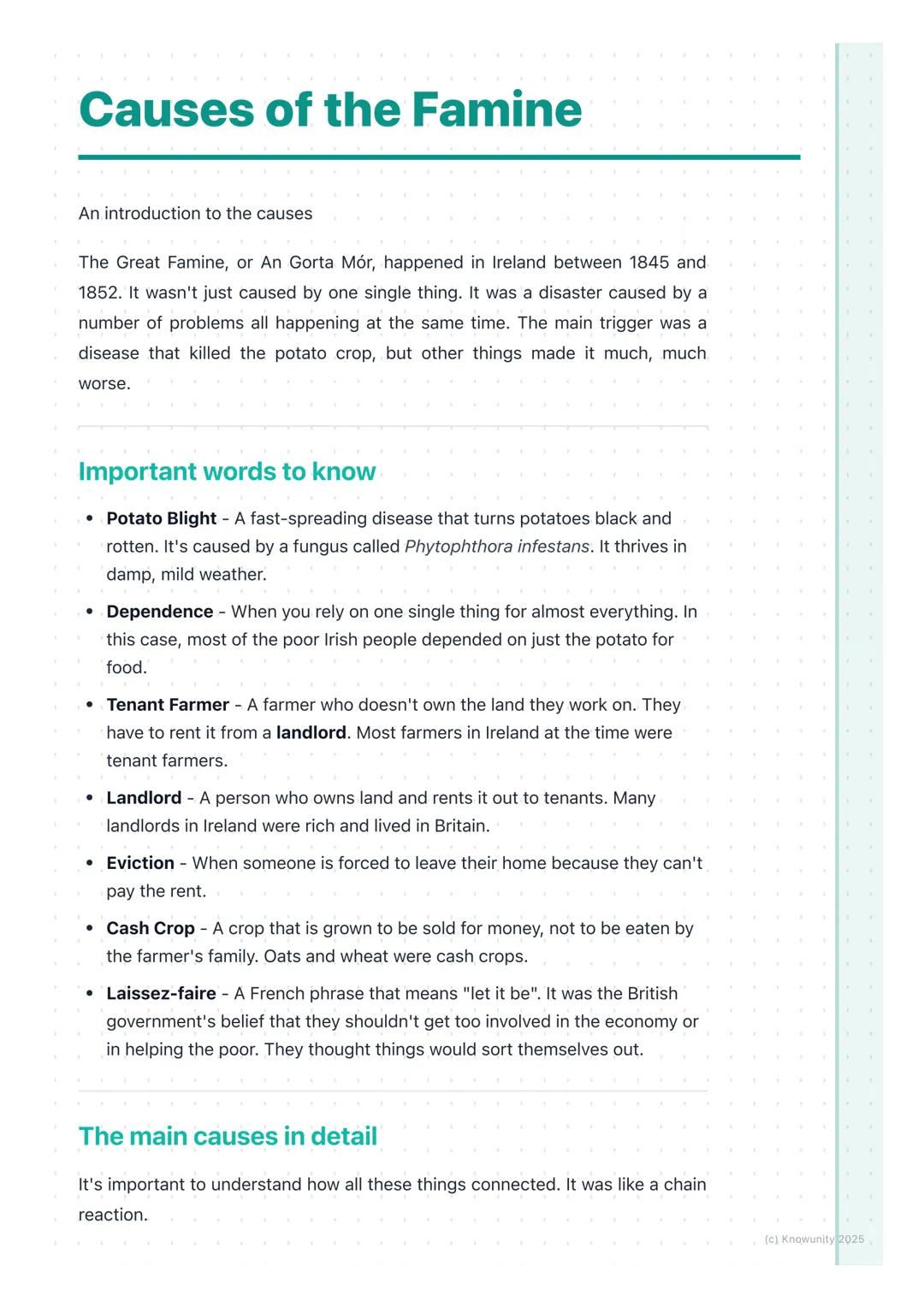
Understanding the Famine's Beginning
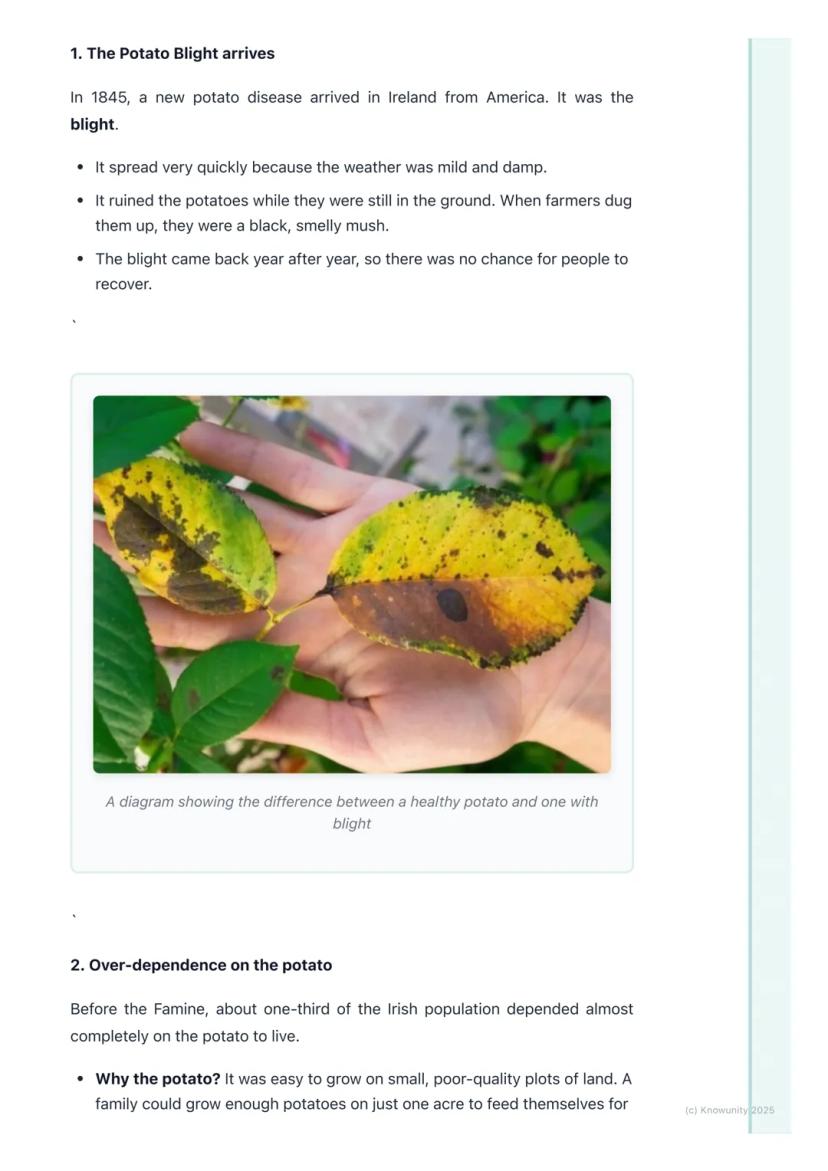
Ever wondered how a plant disease could kill a million people? The Great Famine started when a nasty fungus called potato blight arrived from America in 1845. This disease turned Ireland's main food source into black, smelly mush while it was still in the ground.
The blight spread like wildfire because Ireland's weather was perfect for it - mild and damp. What made this particularly devastating was that it kept coming back year after year, giving families no chance to recover or find alternatives.
Before the famine, about one-third of Ireland's population lived almost entirely on potatoes. This might sound mental, but potatoes were actually brilliant for poor families - you could grow enough on just one acre to feed everyone for a whole year, and they're packed with vitamins.
Did you know? A family of six could survive healthily on just potatoes and a bit of milk. But when that single food source disappeared, they had absolutely nothing left to eat.
2
of 5
The Unfair Land System
Picture this: you're a farmer, but you don't own your land. That was reality for most Irish people - they were tenant farmers who had to rent tiny plots from wealthy landlords. Most of these landlords lived comfortably in Britain and cared more about their rent money than their tenants' lives.
When the potato crop failed, tenant farmers faced an impossible choice. They had no food to eat and no crop to sell to pay their rent. The punishment for not paying? Eviction - being thrown out of your home with nowhere to go.
The land was divided into smaller and smaller plots because Ireland's population had grown massively. Families were squeezed onto tiny pieces of poor-quality land, making them completely dependent on the high-yield potato crop.
Think about it: If you couldn't pay rent today, imagine being kicked out onto the street with your entire family and having your house knocked down behind you.
3
of 5
Food Leaving While People Starved
Here's the maddest part - whilst millions of Irish people were literally starving to death, ships loaded with food were sailing out of Irish ports every single day. These ships carried oats, wheat, butter, and livestock to Britain and other countries.
This wasn't an accident or oversight. Landlords demanded their rent money, so tenant farmers had to keep growing and selling cash crops (crops grown for money, not food) to pay what they owed. The British government could have stopped these exports but chose not to.
The harsh truth is that there was actually plenty of food in Ireland during the famine. The problem wasn't shortage - it was that starving people had no money to buy the food that was there.
Remember this key fact: The famine wasn't really about lack of food in Ireland - it was about poor people having no access to the food that existed.
4
of 5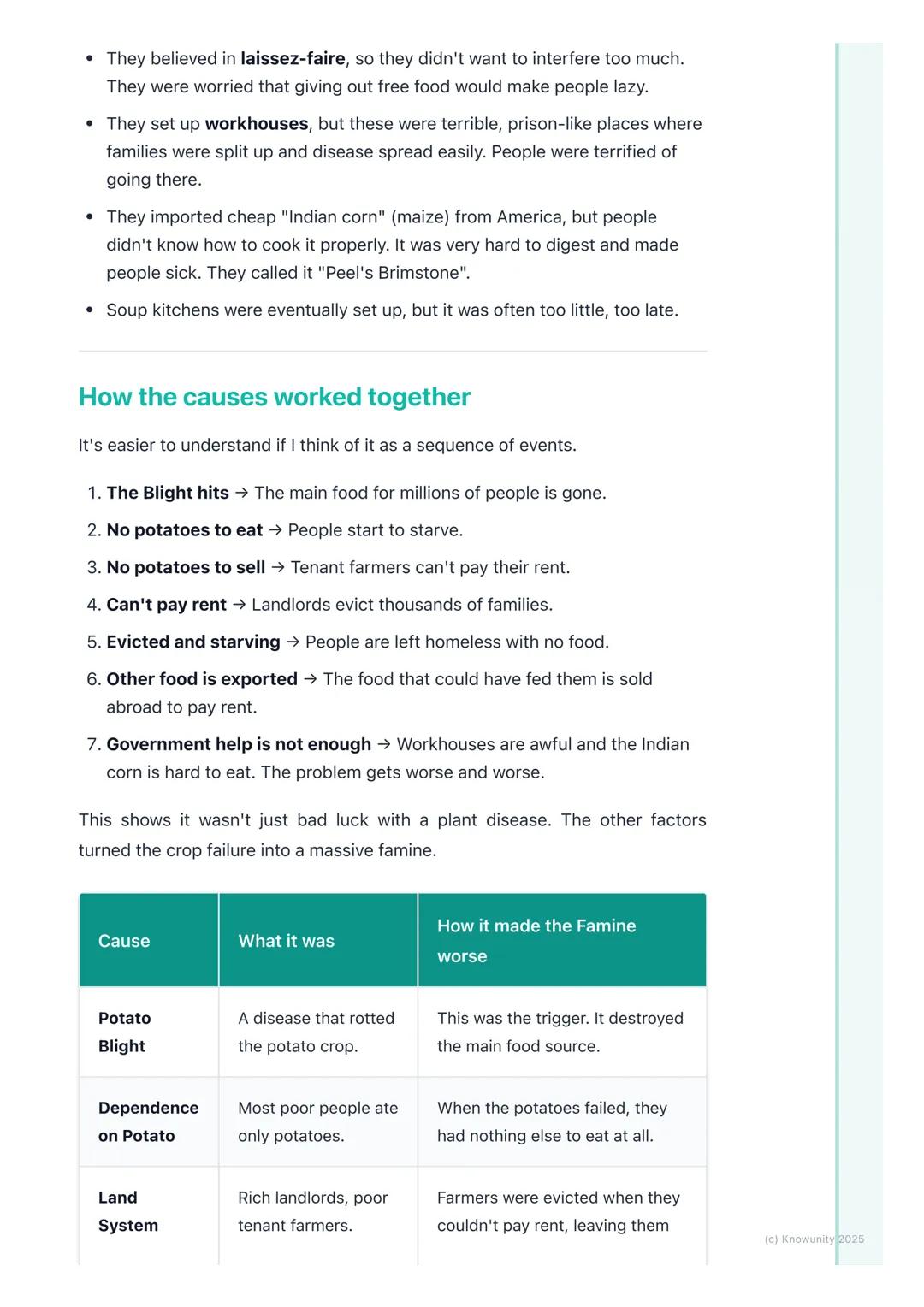
Government Failure
The British government's response was shockingly inadequate, and their attitudes made things much worse. They believed in laissez-faire (a French phrase meaning "let it be") - basically, they thought the government shouldn't interfere too much in people's lives or the economy.
Politicians worried that giving out free food would make Irish people "lazy" and dependent. Instead, they set up workhouses - horrible, prison-like places where families were split up and disease spread rapidly. People were terrified of going there.
The government did import cheap "Indian corn" (maize) from America, but it was a disaster. Irish people didn't know how to cook it properly, it was incredibly hard to digest, and it made people sick. They nicknamed it "Peel's Brimstone" after the Prime Minister.
Eventually, soup kitchens were established, but by then it was often too little, too late. Hundreds of thousands had already died or been forced to emigrate.
Government attitude: They genuinely believed that interfering too much would somehow make the situation worse, even as people died in the streets.
5
of 5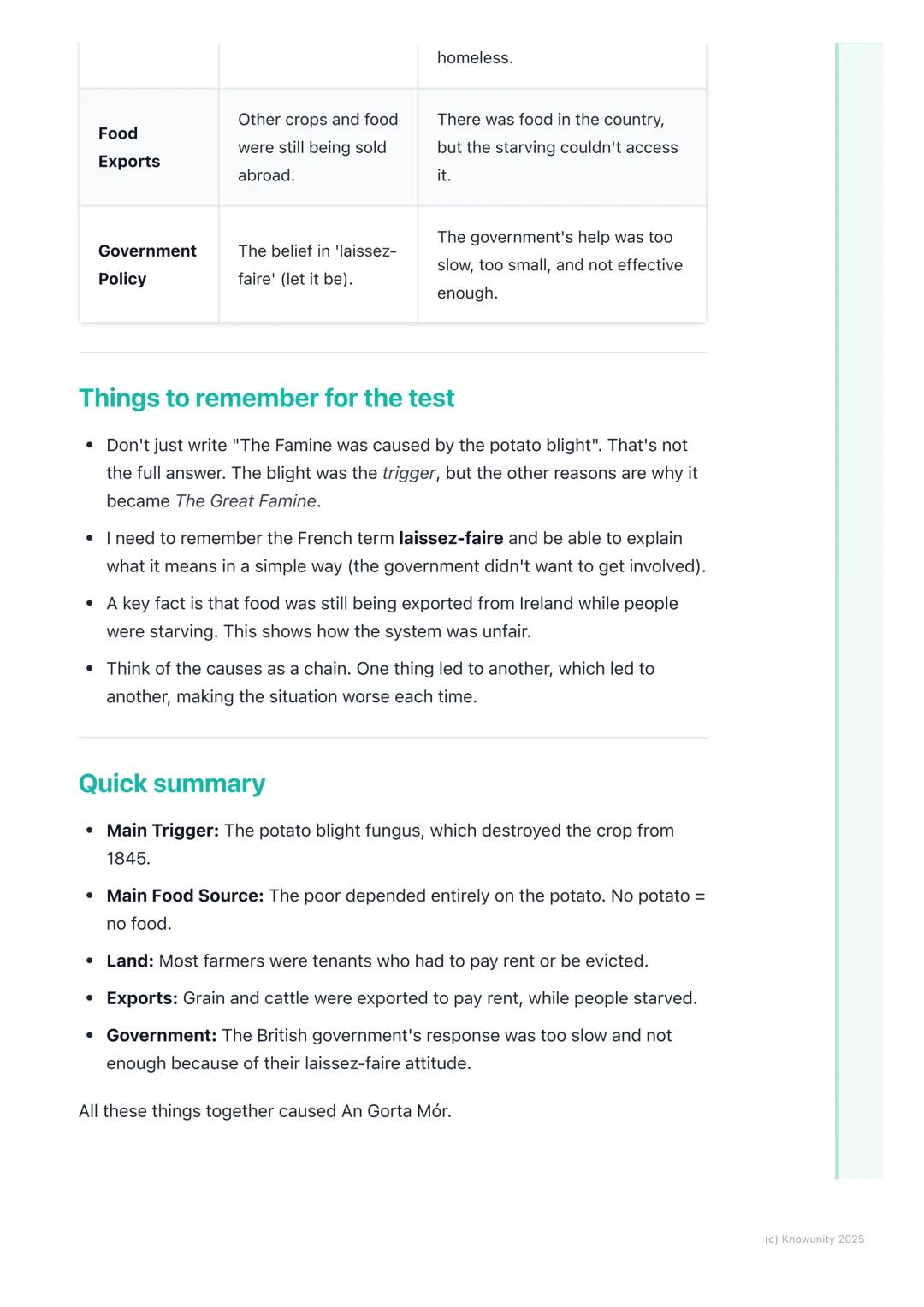
How Everything Connected
Understanding the famine means seeing how these causes created a chain reaction that turned a crop disease into a massive human catastrophe. It started with blight destroying the potatoes, which left millions without food.
When people couldn't sell potatoes, they couldn't pay rent to their landlords. This led to mass evictions, leaving families homeless and starving. Meanwhile, other food that could have saved lives was being shipped abroad to pay those same rents.
The government's laissez-faire approach meant help was too slow and too small. Their workhouses were so awful that many people preferred to starve rather than enter them. The imported corn was poorly prepared and often made people sicker.
This shows why the Great Famine was about much more than just a plant disease. It was about a social and economic system that failed to protect its most vulnerable people when they needed help most.
Key lesson: Natural disasters become human catastrophes when unfair systems prevent people from accessing help and resources.
Pensamos que nunca lo preguntarías...
¿Qué es Knowunity AI companion?
Nuestro compañero de IA está específicamente adaptado a las necesidades de los estudiantes. Basándonos en los millones de contenidos que tenemos en la plataforma, podemos dar a los estudiantes respuestas realmente significativas y relevantes. Pero no se trata solo de respuestas, el compañero también guía a los estudiantes a través de sus retos de aprendizaje diarios, con planes de aprendizaje personalizados, cuestionarios o contenidos en el chat y una personalización del 100% basada en las habilidades y el desarrollo de los estudiantes.
¿Dónde puedo descargar la app Knowunity?
Puedes descargar la app en Google Play Store y Apple App Store.
¿Knowunity es totalmente gratuito?
¡Sí lo es! Tienes acceso totalmente gratuito a todo el contenido de la app, puedes chatear con otros alumnos y recibir ayuda inmeditamente. Puedes ganar dinero utilizando la aplicación, que te permitirá acceder a determinadas funciones.
Contenidos más populares de History
9Contenidos más populares
9¿No encuentras lo que buscas? Explora otros temas.
Mira lo que dicen nuestros usuarios. Les encantó — y a ti también te encantará.
4.6/5App Store
4.7/5Google Play
La app es muy fácil de usar y está muy bien diseñada. Hasta ahora he encontrado todo lo que estaba buscando y he podido aprender mucho de las presentaciones. Definitivamente utilizaré la aplicación para un examen de clase. Y, por supuesto, también me sirve mucho de inspiración.
Pablousuario de iOS
Esta app es realmente genial. Hay tantos apuntes de clase y ayuda [...]. Tengo problemas con matemáticas, por ejemplo, y la aplicación tiene muchas opciones de ayuda. Gracias a Knowunity, he mejorado en mates. Se la recomiendo a todo el mundo.
Elenausuaria de Android
Vaya, estoy realmente sorprendida. Acabo de probar la app porque la he visto anunciada muchas veces y me he quedado absolutamente alucinada. Esta app es LA AYUDA que quieres para el insti y, sobre todo, ofrece muchísimas cosas, como ejercicios y hojas informativas, que a mí personalmente me han sido MUY útiles.
Anausuaria de iOS
History3 visualizaciones·Actualizado Jun 5, 2026·5 páginasThe Irish Potato Famine: Causes and Impact
The Great Famine (An Gorta Mór) devastated Ireland from 1845 to 1852, killing over one million people. It wasn't just bad luck with crops - it was a disaster created by multiple problems happening all at once. Understanding these causes... Mostrar más
1
of 5Inscríbete para ver los apuntes. ¡Es gratis!
- Acceso a todos los documentos
- Mejora tus notas
- Únete a millones de estudiantes
Understanding the Famine's Beginning
Ever wondered how a plant disease could kill a million people? The Great Famine started when a nasty fungus called potato blight arrived from America in 1845. This disease turned Ireland's main food source into black, smelly mush while it was still in the ground.
The blight spread like wildfire because Ireland's weather was perfect for it - mild and damp. What made this particularly devastating was that it kept coming back year after year, giving families no chance to recover or find alternatives.
Before the famine, about one-third of Ireland's population lived almost entirely on potatoes. This might sound mental, but potatoes were actually brilliant for poor families - you could grow enough on just one acre to feed everyone for a whole year, and they're packed with vitamins.
Did you know? A family of six could survive healthily on just potatoes and a bit of milk. But when that single food source disappeared, they had absolutely nothing left to eat.
2
of 5Inscríbete para ver los apuntes. ¡Es gratis!
- Acceso a todos los documentos
- Mejora tus notas
- Únete a millones de estudiantes
The Unfair Land System
Picture this: you're a farmer, but you don't own your land. That was reality for most Irish people - they were tenant farmers who had to rent tiny plots from wealthy landlords. Most of these landlords lived comfortably in Britain and cared more about their rent money than their tenants' lives.
When the potato crop failed, tenant farmers faced an impossible choice. They had no food to eat and no crop to sell to pay their rent. The punishment for not paying? Eviction - being thrown out of your home with nowhere to go.
The land was divided into smaller and smaller plots because Ireland's population had grown massively. Families were squeezed onto tiny pieces of poor-quality land, making them completely dependent on the high-yield potato crop.
Think about it: If you couldn't pay rent today, imagine being kicked out onto the street with your entire family and having your house knocked down behind you.
3
of 5Inscríbete para ver los apuntes. ¡Es gratis!
- Acceso a todos los documentos
- Mejora tus notas
- Únete a millones de estudiantes
Food Leaving While People Starved
Here's the maddest part - whilst millions of Irish people were literally starving to death, ships loaded with food were sailing out of Irish ports every single day. These ships carried oats, wheat, butter, and livestock to Britain and other countries.
This wasn't an accident or oversight. Landlords demanded their rent money, so tenant farmers had to keep growing and selling cash crops (crops grown for money, not food) to pay what they owed. The British government could have stopped these exports but chose not to.
The harsh truth is that there was actually plenty of food in Ireland during the famine. The problem wasn't shortage - it was that starving people had no money to buy the food that was there.
Remember this key fact: The famine wasn't really about lack of food in Ireland - it was about poor people having no access to the food that existed.
4
of 5Inscríbete para ver los apuntes. ¡Es gratis!
- Acceso a todos los documentos
- Mejora tus notas
- Únete a millones de estudiantes
Government Failure
The British government's response was shockingly inadequate, and their attitudes made things much worse. They believed in laissez-faire (a French phrase meaning "let it be") - basically, they thought the government shouldn't interfere too much in people's lives or the economy.
Politicians worried that giving out free food would make Irish people "lazy" and dependent. Instead, they set up workhouses - horrible, prison-like places where families were split up and disease spread rapidly. People were terrified of going there.
The government did import cheap "Indian corn" (maize) from America, but it was a disaster. Irish people didn't know how to cook it properly, it was incredibly hard to digest, and it made people sick. They nicknamed it "Peel's Brimstone" after the Prime Minister.
Eventually, soup kitchens were established, but by then it was often too little, too late. Hundreds of thousands had already died or been forced to emigrate.
Government attitude: They genuinely believed that interfering too much would somehow make the situation worse, even as people died in the streets.
5
of 5Inscríbete para ver los apuntes. ¡Es gratis!
- Acceso a todos los documentos
- Mejora tus notas
- Únete a millones de estudiantes
How Everything Connected
Understanding the famine means seeing how these causes created a chain reaction that turned a crop disease into a massive human catastrophe. It started with blight destroying the potatoes, which left millions without food.
When people couldn't sell potatoes, they couldn't pay rent to their landlords. This led to mass evictions, leaving families homeless and starving. Meanwhile, other food that could have saved lives was being shipped abroad to pay those same rents.
The government's laissez-faire approach meant help was too slow and too small. Their workhouses were so awful that many people preferred to starve rather than enter them. The imported corn was poorly prepared and often made people sicker.
This shows why the Great Famine was about much more than just a plant disease. It was about a social and economic system that failed to protect its most vulnerable people when they needed help most.
Key lesson: Natural disasters become human catastrophes when unfair systems prevent people from accessing help and resources.
Pensamos que nunca lo preguntarías...
¿Qué es Knowunity AI companion?
Nuestro compañero de IA está específicamente adaptado a las necesidades de los estudiantes. Basándonos en los millones de contenidos que tenemos en la plataforma, podemos dar a los estudiantes respuestas realmente significativas y relevantes. Pero no se trata solo de respuestas, el compañero también guía a los estudiantes a través de sus retos de aprendizaje diarios, con planes de aprendizaje personalizados, cuestionarios o contenidos en el chat y una personalización del 100% basada en las habilidades y el desarrollo de los estudiantes.
¿Dónde puedo descargar la app Knowunity?
Puedes descargar la app en Google Play Store y Apple App Store.
¿Knowunity es totalmente gratuito?
¡Sí lo es! Tienes acceso totalmente gratuito a todo el contenido de la app, puedes chatear con otros alumnos y recibir ayuda inmeditamente. Puedes ganar dinero utilizando la aplicación, que te permitirá acceder a determinadas funciones.
Contenidos más populares de History
9Contenidos más populares
9¿No encuentras lo que buscas? Explora otros temas.
Mira lo que dicen nuestros usuarios. Les encantó — y a ti también te encantará.
4.6/5App Store
4.7/5Google Play
La app es muy fácil de usar y está muy bien diseñada. Hasta ahora he encontrado todo lo que estaba buscando y he podido aprender mucho de las presentaciones. Definitivamente utilizaré la aplicación para un examen de clase. Y, por supuesto, también me sirve mucho de inspiración.
Pablousuario de iOS
Esta app es realmente genial. Hay tantos apuntes de clase y ayuda [...]. Tengo problemas con matemáticas, por ejemplo, y la aplicación tiene muchas opciones de ayuda. Gracias a Knowunity, he mejorado en mates. Se la recomiendo a todo el mundo.
Elenausuaria de Android
Vaya, estoy realmente sorprendida. Acabo de probar la app porque la he visto anunciada muchas veces y me he quedado absolutamente alucinada. Esta app es LA AYUDA que quieres para el insti y, sobre todo, ofrece muchísimas cosas, como ejercicios y hojas informativas, que a mí personalmente me han sido MUY útiles.
Anausuaria de iOS