
Ever wondered how much paint you'd need for your bedroom...
 Applied Mathematics4 visualizaciones·Actualizado Jun 13, 2026·9 páginas
Mastering Perimeter, Area, and Volume Calculations
1 / 9
1
of 9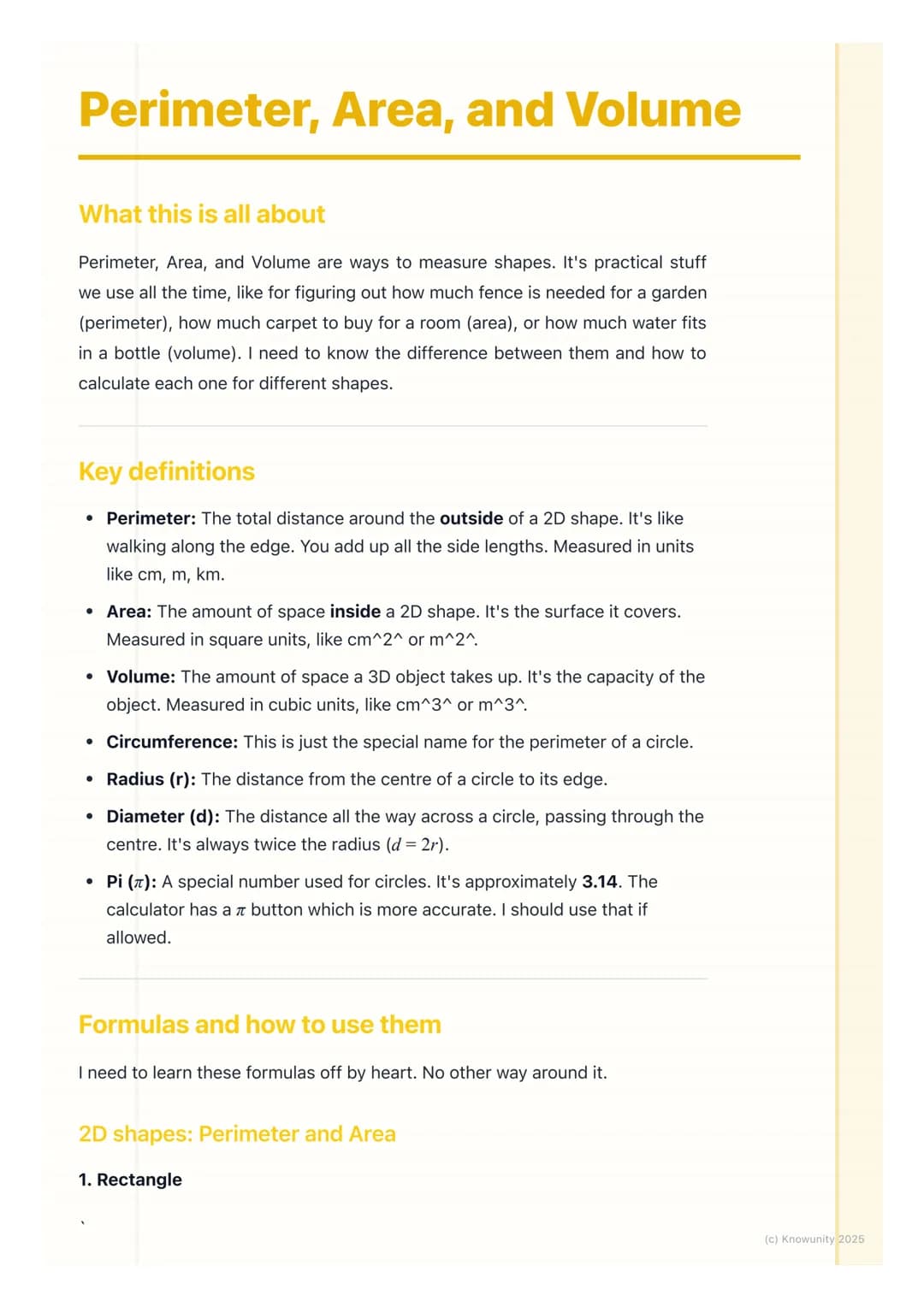
What Are Perimeter, Area, and Volume?
Think of perimeter as walking around the edge of your school yard - it's the total distance around any 2D shape. You just add up all the side lengths and measure it in units like centimetres or metres.
Area tells you how much space is inside a shape, like how much carpet you'd need to cover your bedroom floor. It's always measured in square units like cm² or m².
Volume is all about 3D objects and how much they can hold - imagine filling a bottle with water or packing a box with books. Volume uses cubic units like cm³ or m³.
Quick tip: For circles, we call the perimeter "circumference" and use two special measurements - radius (r) is from centre to edge, and diameter (d) goes all the way across through the centre.
2
of 9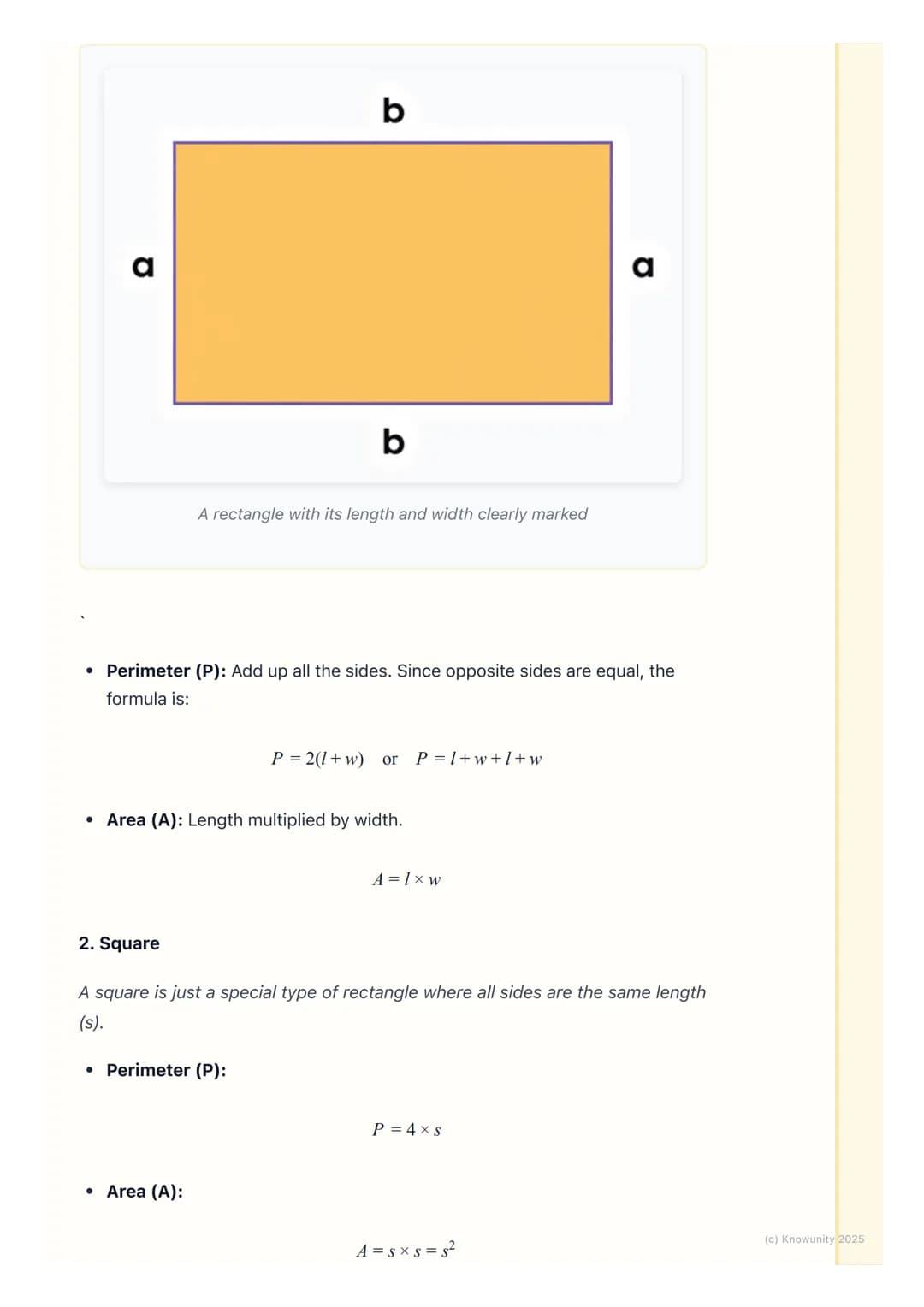
Rectangles and Squares Made Simple
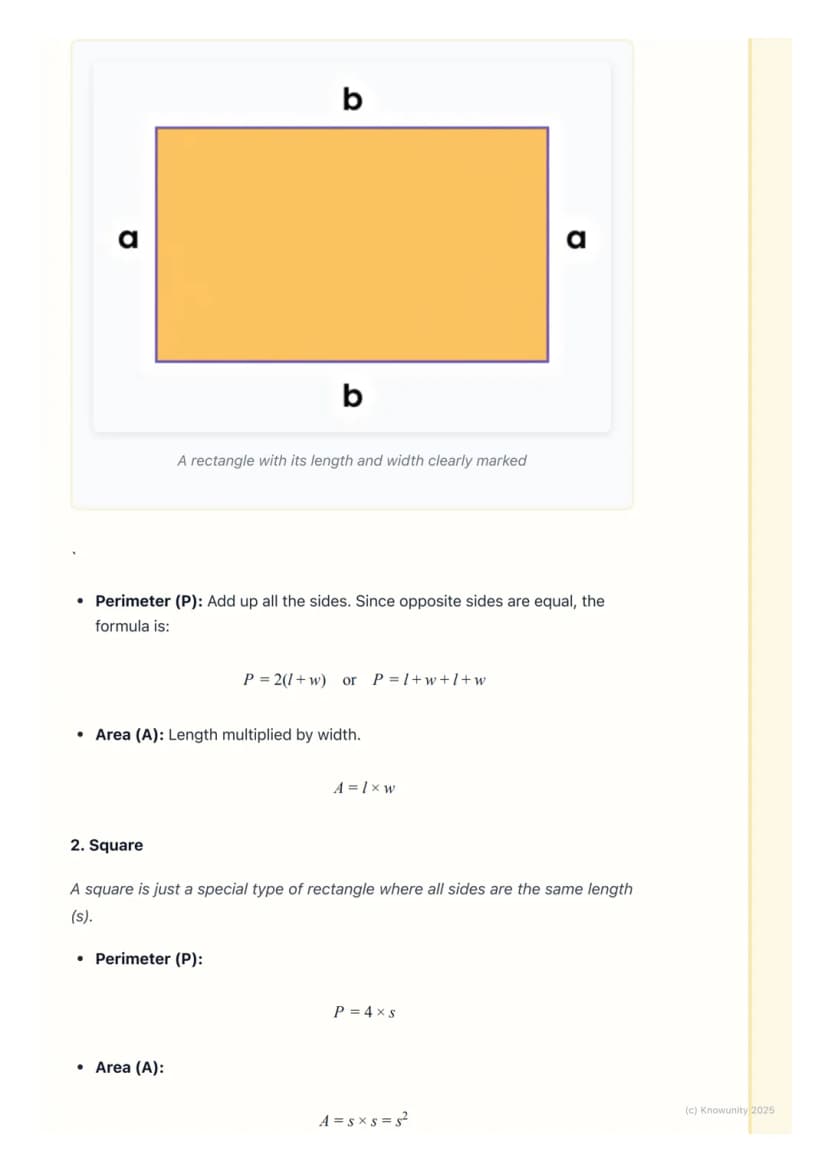
Rectangles are everywhere - your phone screen, a football pitch, even this page! To find the perimeter, use P = 2 because opposite sides are equal. For area, just multiply length times width: A = l × w.
Squares are just rectangles where all sides are the same length. This makes the maths even easier! Perimeter becomes P = 4s (four times one side), and area is A = s² (side times itself).
These formulas work for any size - whether you're measuring a postage stamp or a football pitch. The key is remembering that perimeter adds up distances, whilst area multiplies length and width.
Remember: Always check your units! Perimeter uses normal units (cm, m) but area needs square units (cm², m²).
3
of 9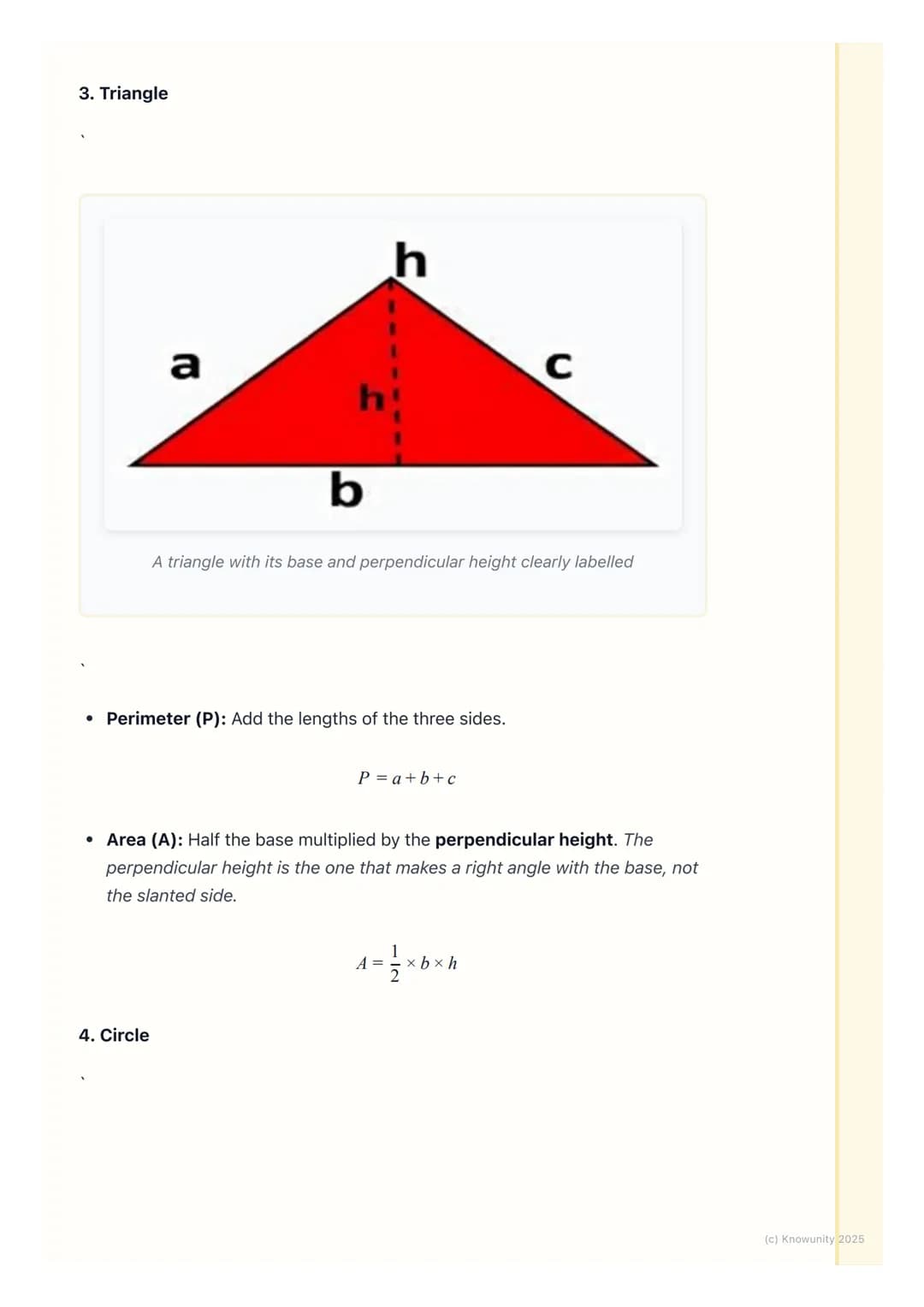
Triangles and Circles
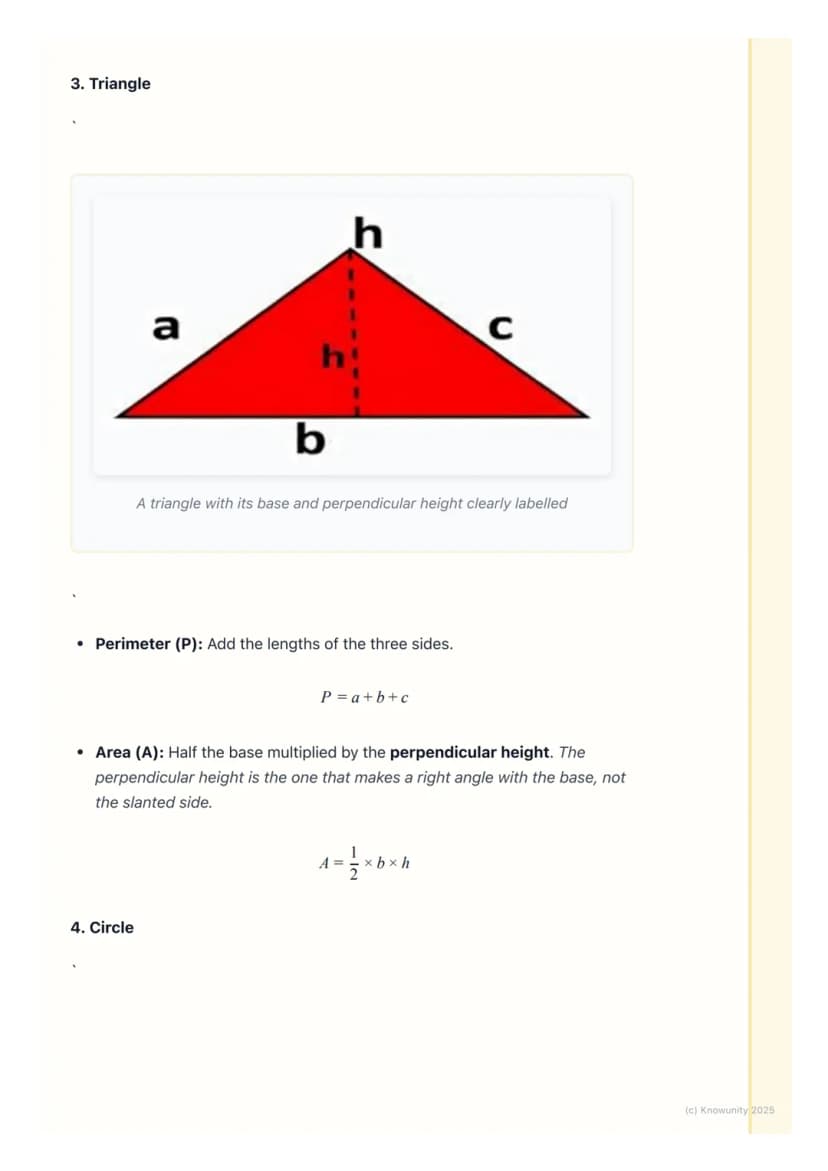
Triangles might look tricky, but they're straightforward once you know the rules. Perimeter is easy - just add the three sides: P = a + b + c. For area, use A = ½ × base × height, but make sure you use the perpendicular height (the one that makes a right angle with the base).
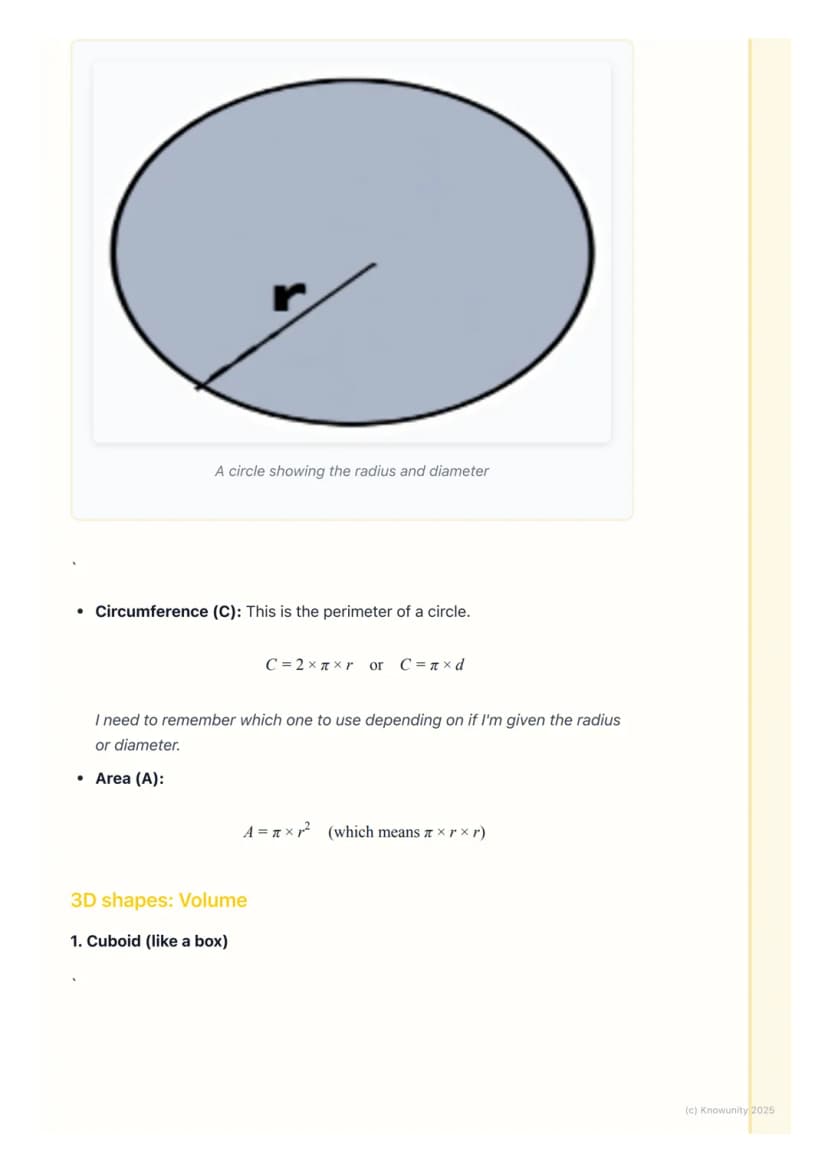
Circles need that special number π (pi ≈ 3.14). For circumference, you can use C = 2πr or C = πd, depending on whether you're given the radius or diameter. Circle area is A = πr², which means π times radius times radius.
The trickiest bit with circles is remembering whether you have the radius or diameter. If you've got the diameter, just halve it to get the radius before using the area formula.
Pro tip: Use the π button on your calculator instead of 3.14 for more accurate answers!
4
of 9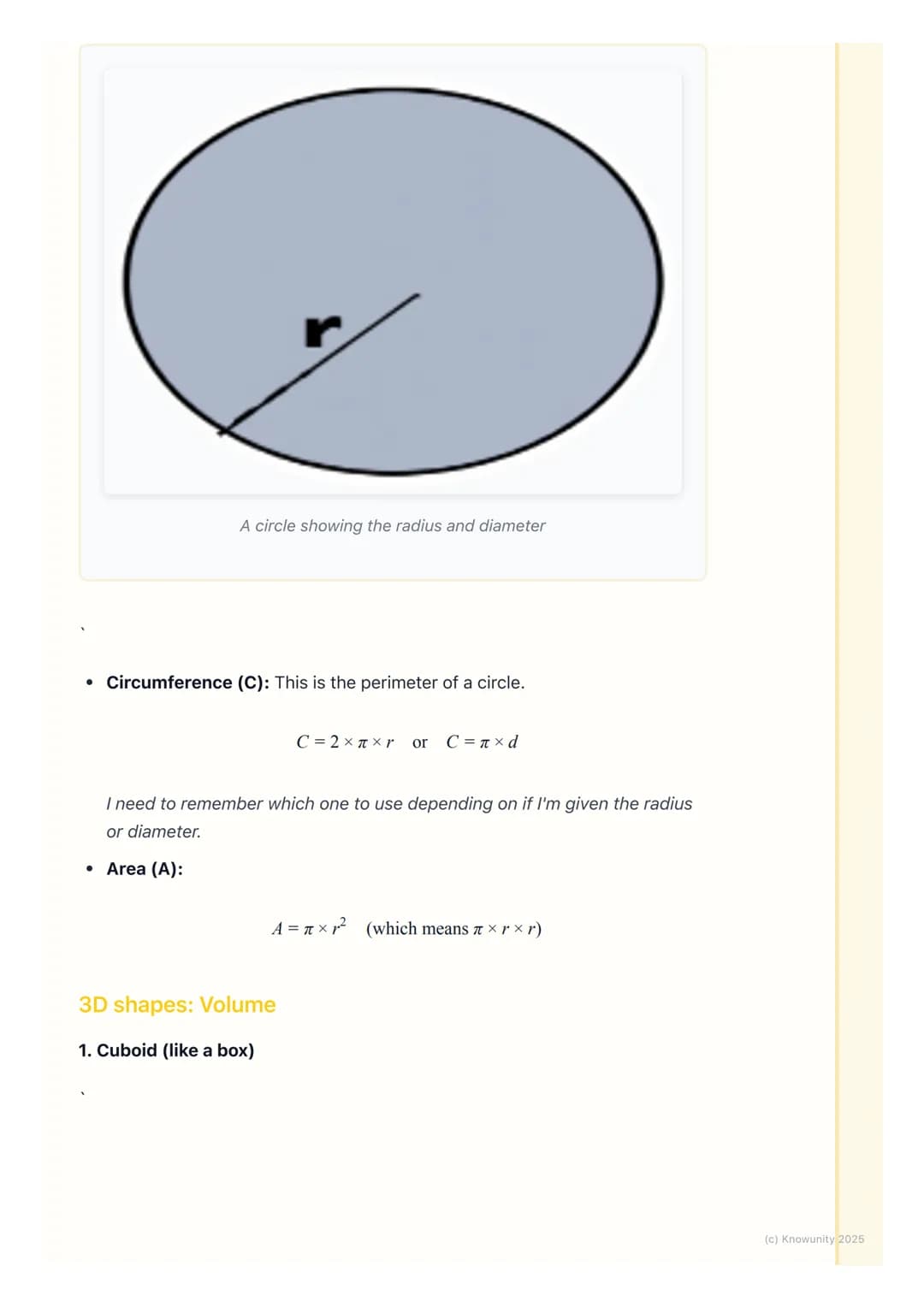
3D Shapes and Volume
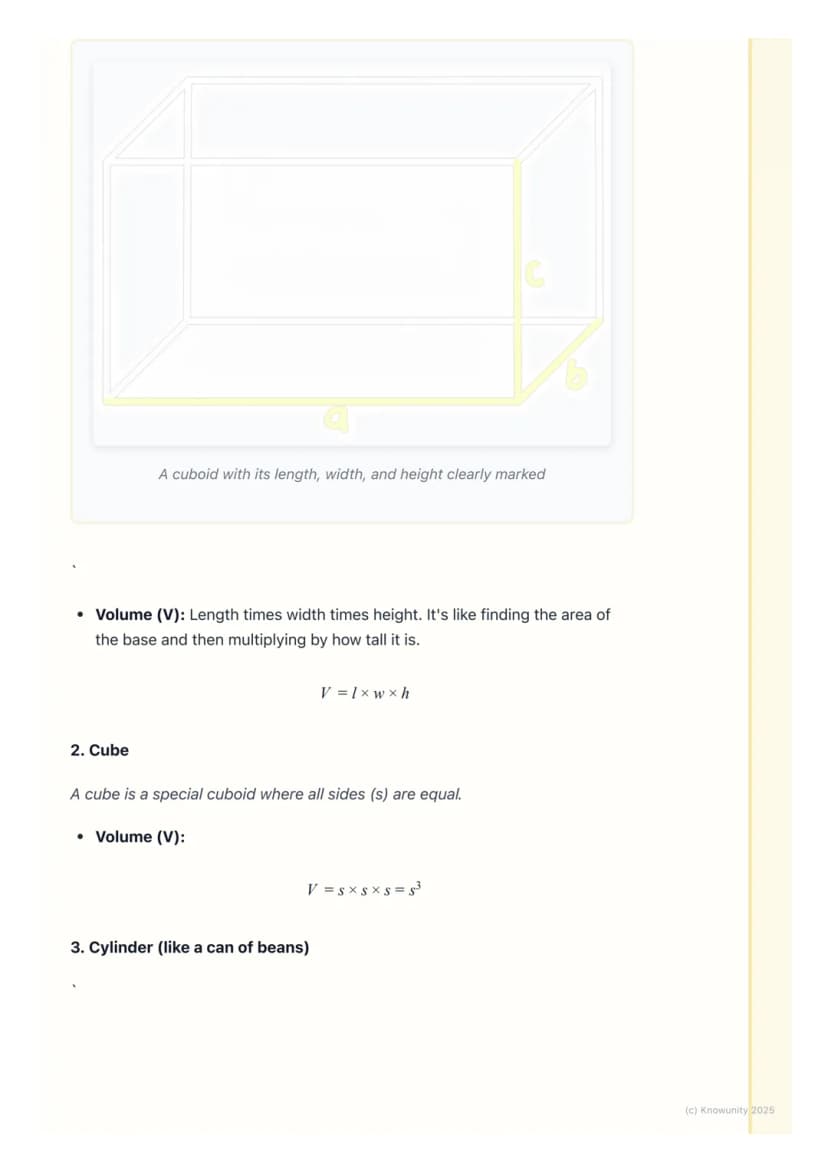
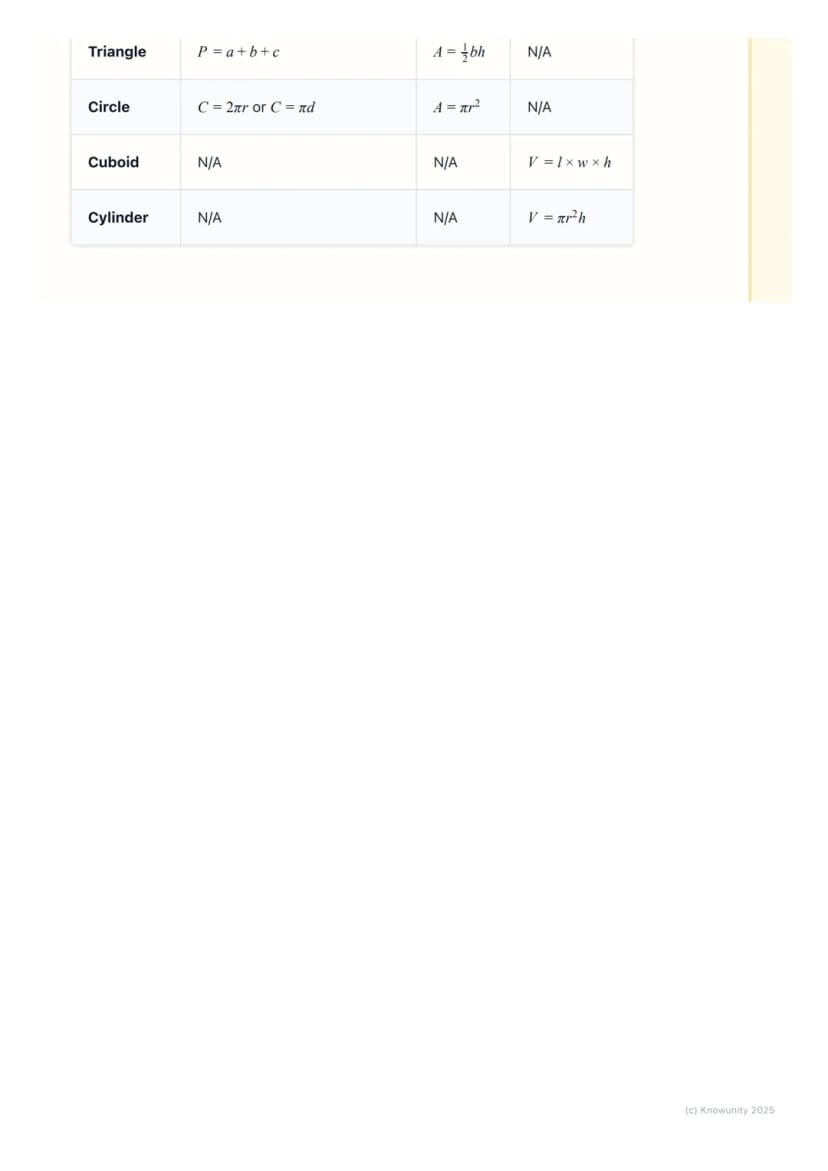
Cuboids (box shapes) are brilliant for understanding volume because you can actually visualise stacking layers. The formula V = l × w × h basically finds the area of the bottom layer, then multiplies by how many layers you can stack up.
Cubes are even simpler - since all sides are equal, it's just V = s³ (side cubed). Think of dice or Rubik's cubes.
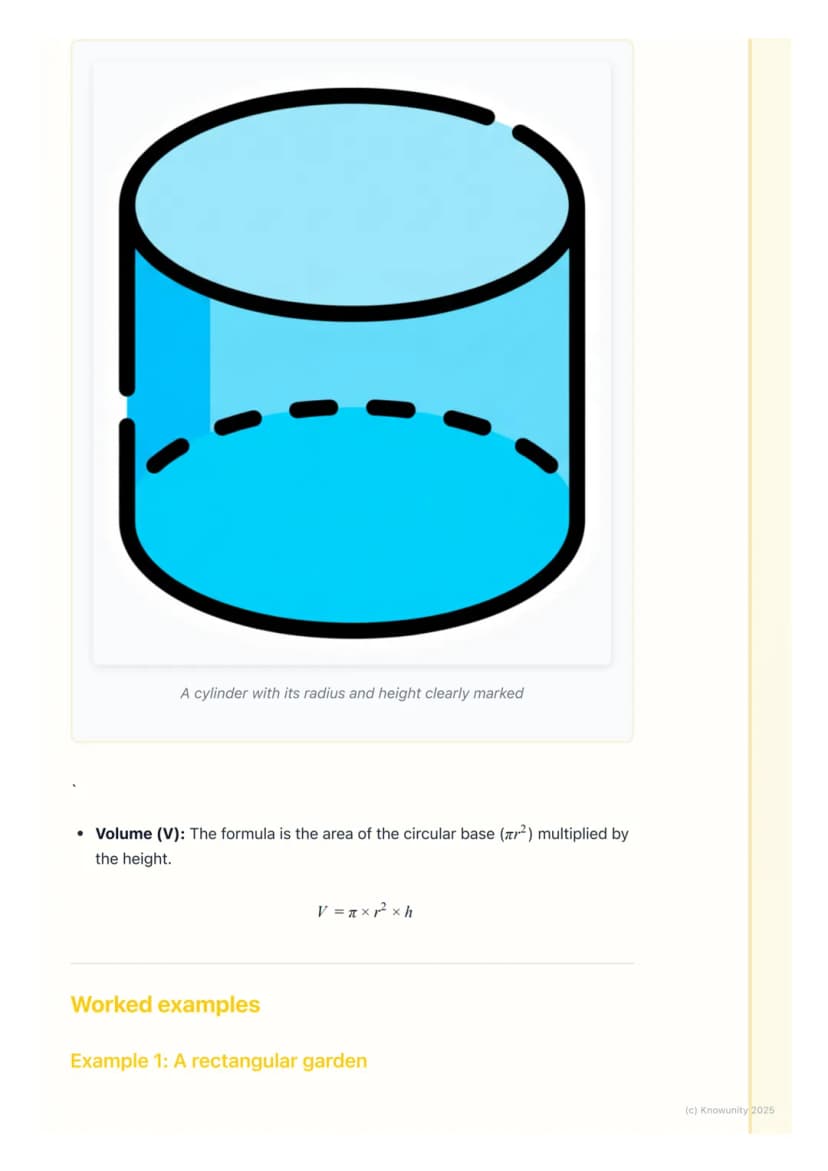
Cylinders (like cans or bottles) combine circles with height. Find the area of the circular base (πr²) and multiply by the height: V = πr² × h. It's like stacking circular layers on top of each other.
Memory trick: Volume always involves multiplying three measurements together, which is why the units are always cubed (cm³, m³).
5
of 9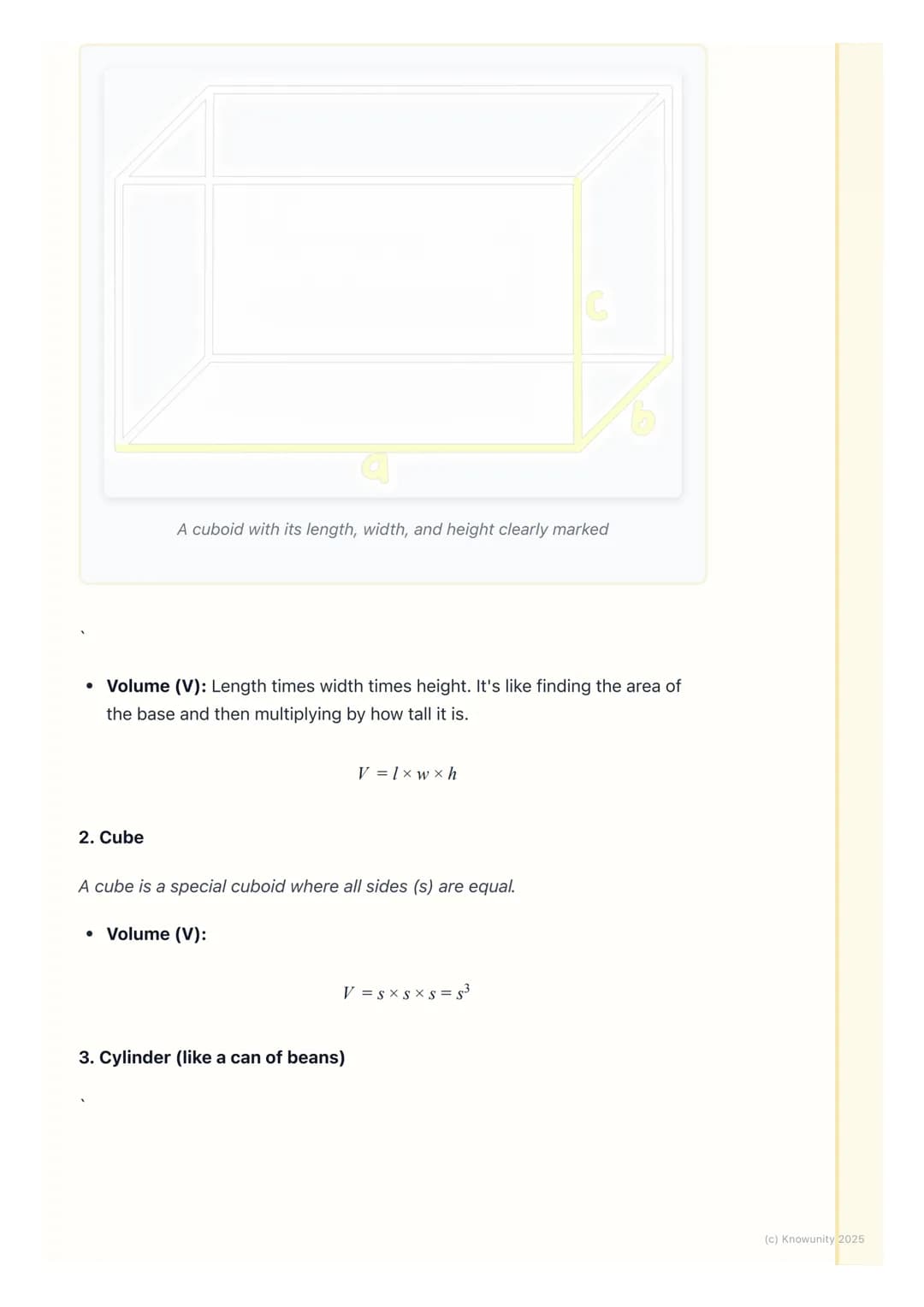
Working Through Real Examples
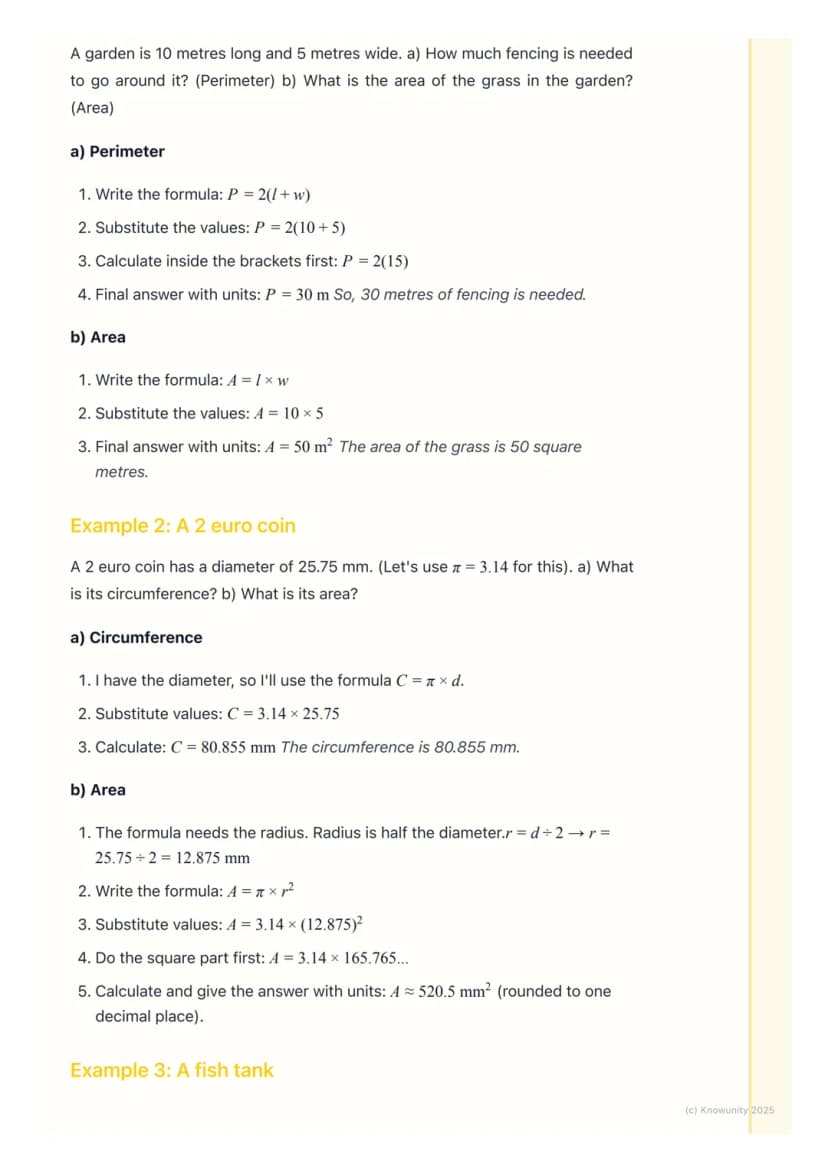
Let's say you're planning a garden that's 10m long and 5m wide. For the perimeter (fencing needed): P = 2(10 + 5) = 30m. For the area (grass space): A = 10 × 5 = 50m².
Here's a circle example using a 2 euro coin with diameter 25.75mm. For circumference: C = π × 25.75 = 80.9mm. For area, first find the radius , then A = π × (12.875)² = 520.5mm².
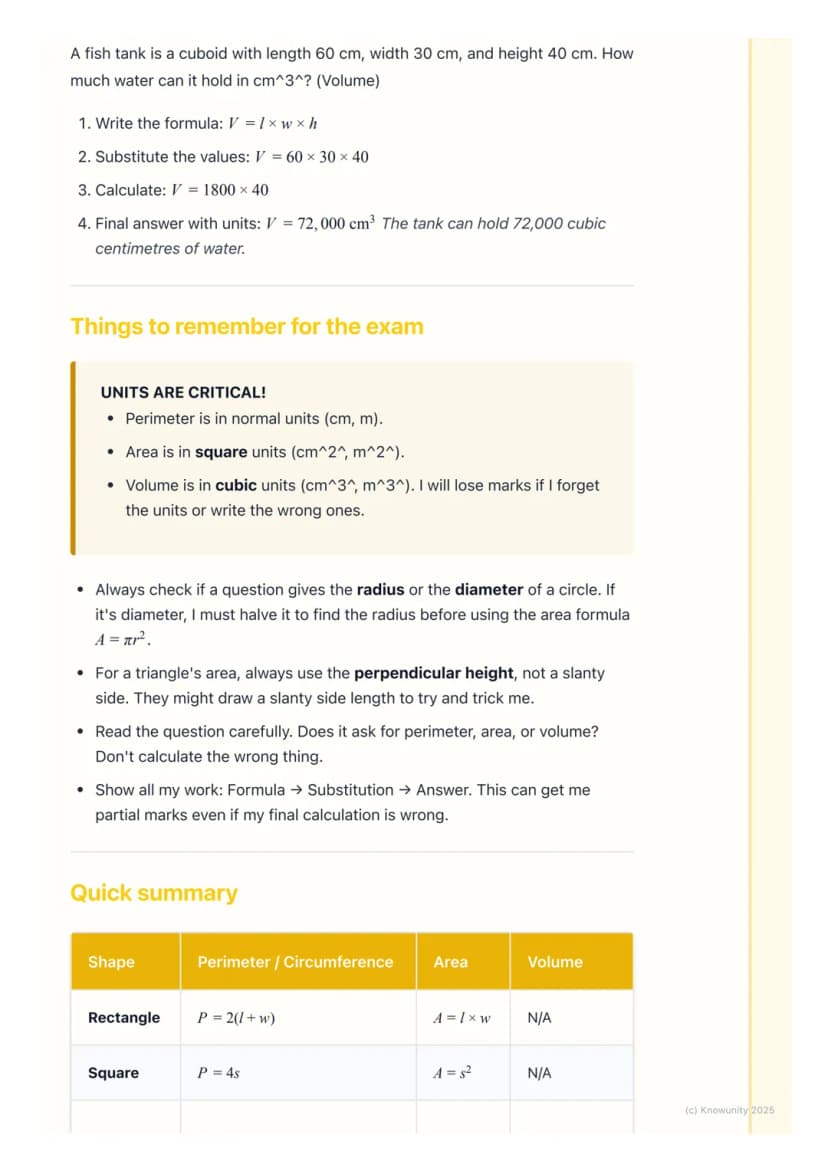
A fish tank measuring 60cm × 30cm × 40cm has volume: V = 60 × 30 × 40 = 72,000cm³. That's how much water it holds!
Exam strategy: Always write the formula first, substitute your numbers, then calculate step by step for partial credit.
6
of 9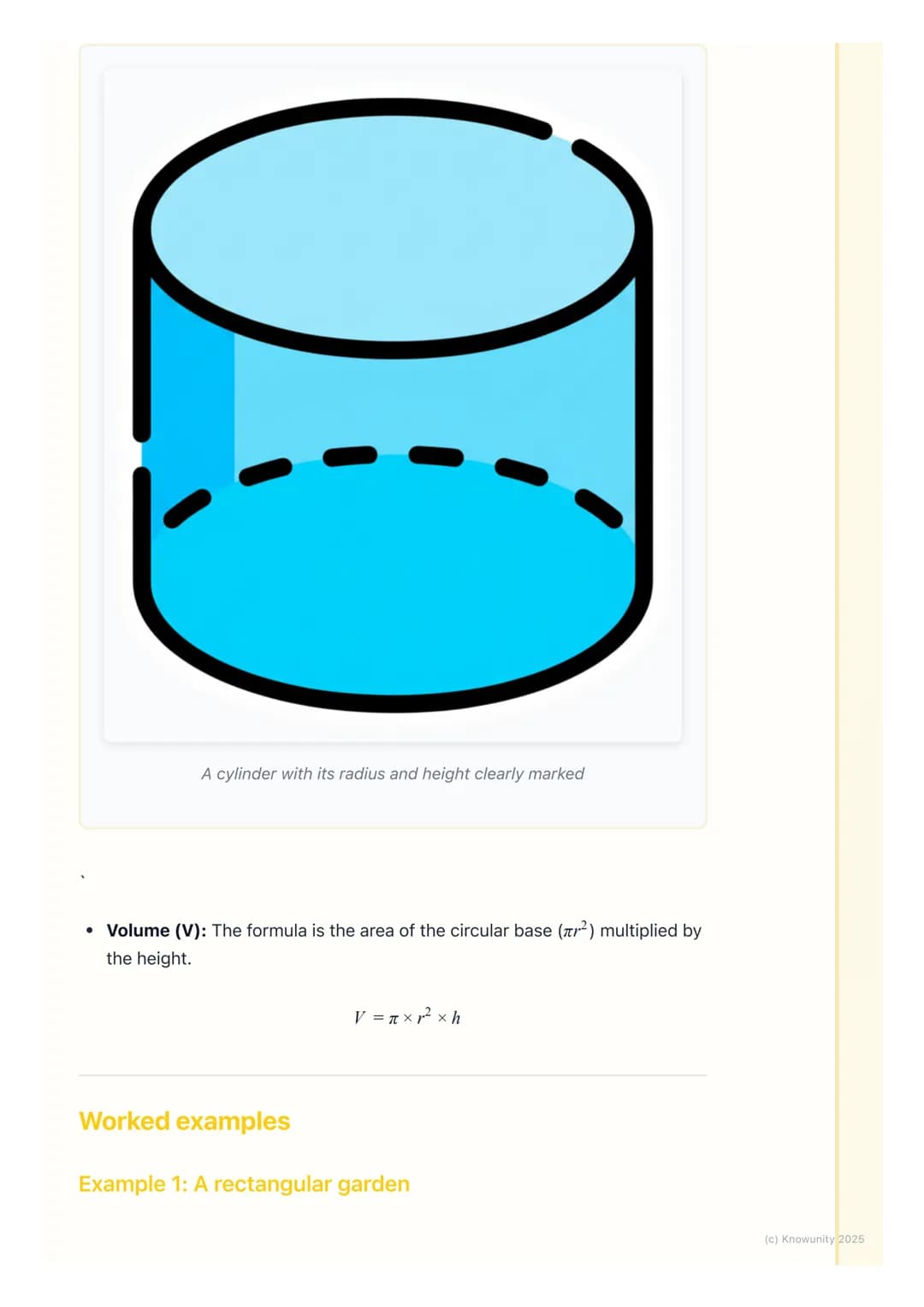
Quick Reference and Exam Tips
Units are absolutely crucial - you'll lose marks for forgetting them! Perimeter uses normal units (cm, m), area needs squares (cm², m²), and volume requires cubes (cm³, m³).
Watch out for common traps: always use perpendicular height for triangles, check if you're given radius or diameter for circles, and read questions carefully to know whether they want perimeter, area, or volume.
Your essential formulas: Rectangle P = 2, A = l × w; Square P = 4s, A = s²; Triangle P = a + b + c, A = ½bh; Circle C = 2πr, A = πr²; Cuboid V = l × w × h; Cylinder V = πr²h.
Final tip: Show all your working - formula, substitution, then answer. Even if your final answer is wrong, you can still get most of the marks!
7
of 9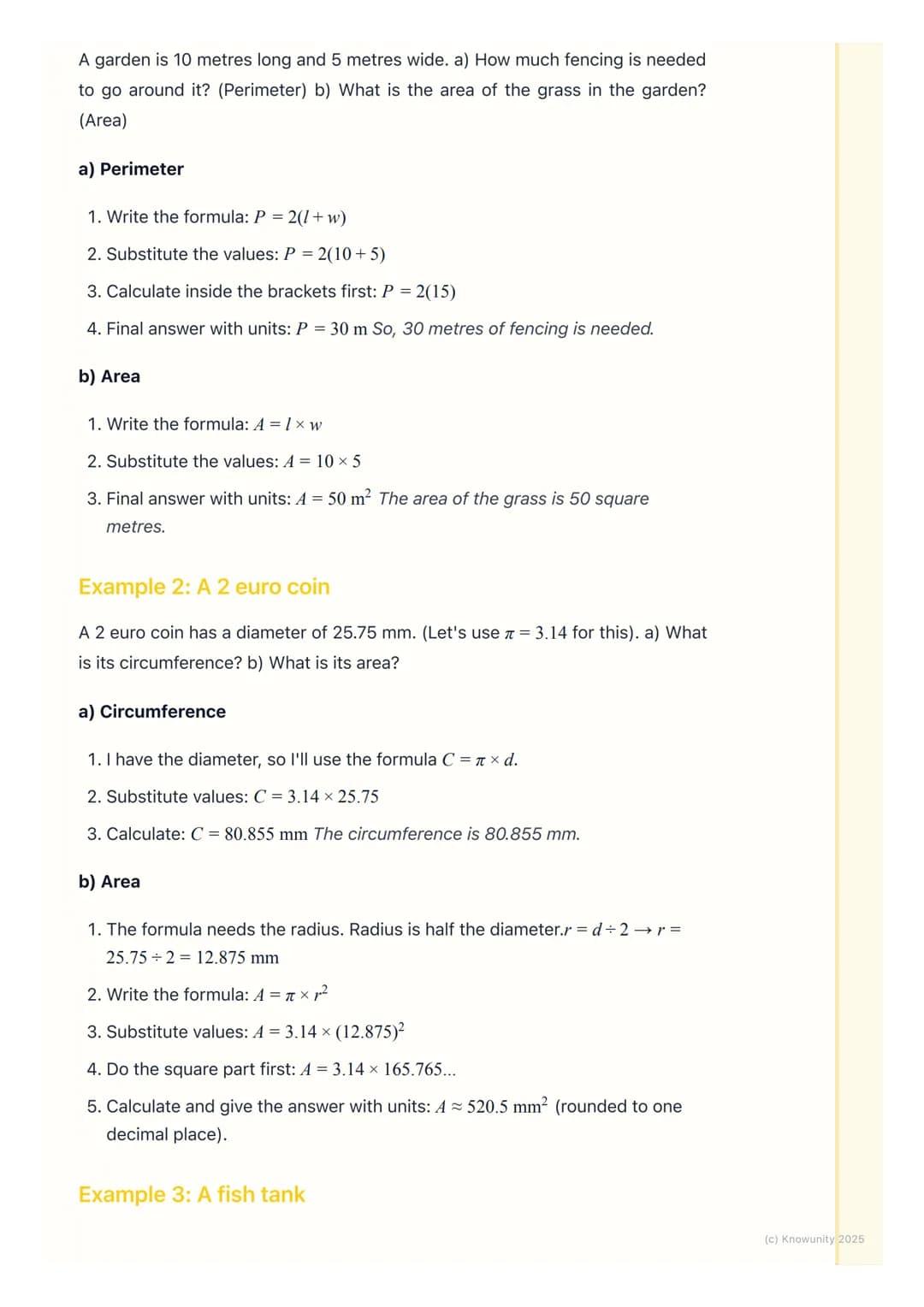
8
of 9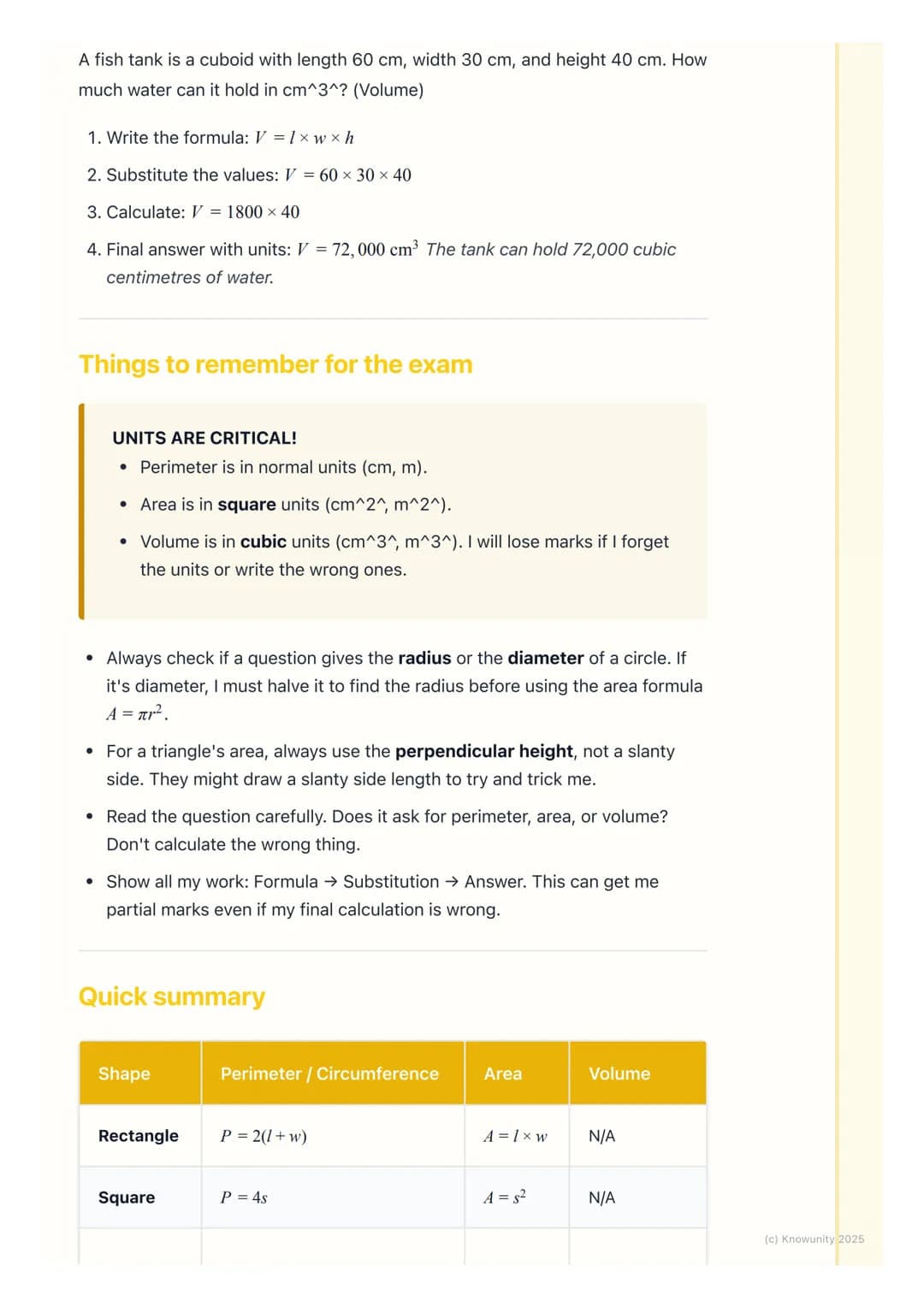
9
of 9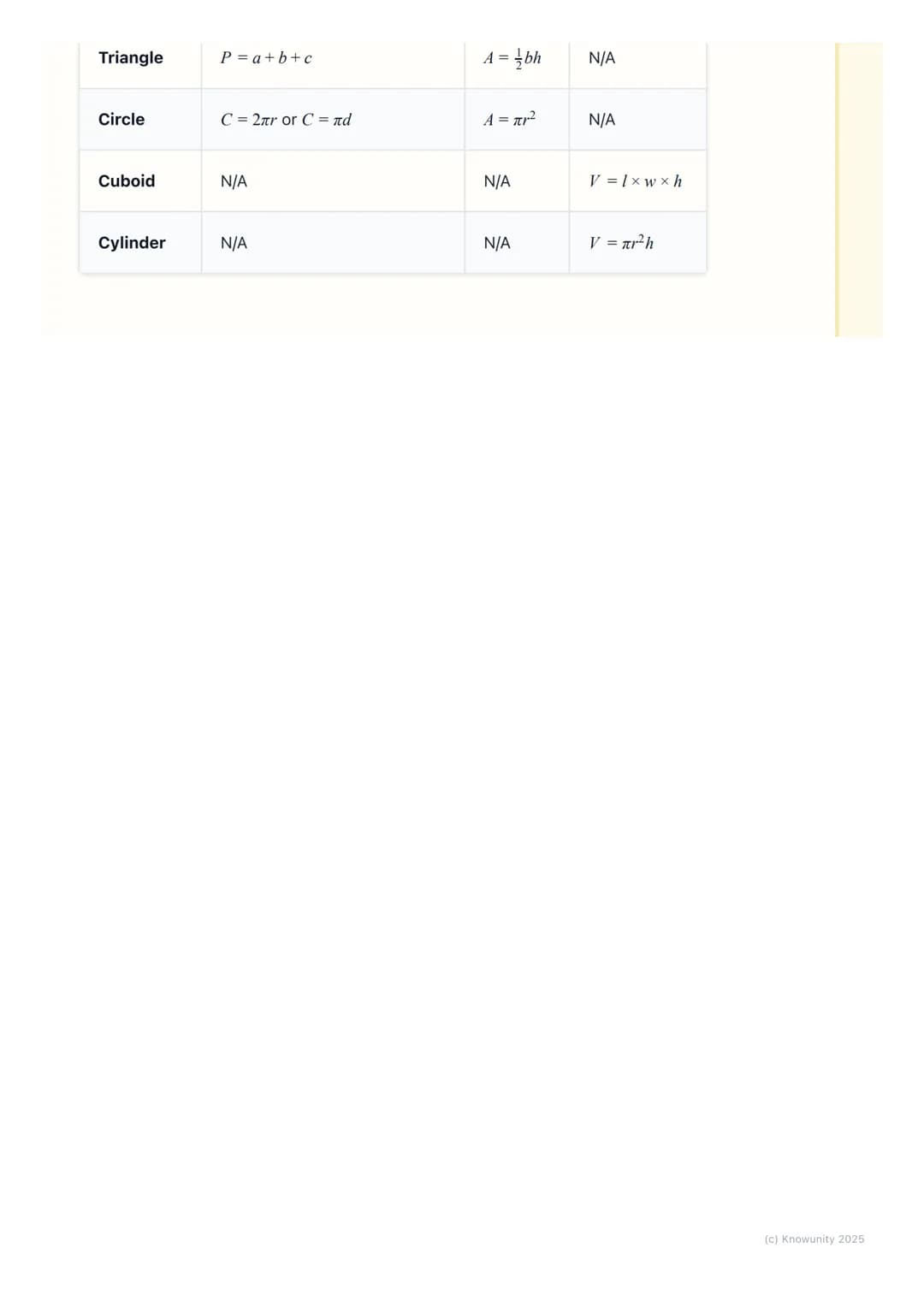
Pensamos que nunca lo preguntarías...
¿Qué es Knowunity AI companion?
Nuestro compañero de IA está específicamente adaptado a las necesidades de los estudiantes. Basándonos en los millones de contenidos que tenemos en la plataforma, podemos dar a los estudiantes respuestas realmente significativas y relevantes. Pero no se trata solo de respuestas, el compañero también guía a los estudiantes a través de sus retos de aprendizaje diarios, con planes de aprendizaje personalizados, cuestionarios o contenidos en el chat y una personalización del 100% basada en las habilidades y el desarrollo de los estudiantes.
¿Dónde puedo descargar la app Knowunity?
Puedes descargar la app en Google Play Store y Apple App Store.
¿Knowunity es totalmente gratuito?
¡Sí lo es! Tienes acceso totalmente gratuito a todo el contenido de la app, puedes chatear con otros alumnos y recibir ayuda inmeditamente. Puedes ganar dinero utilizando la aplicación, que te permitirá acceder a determinadas funciones.
Contenidos más populares
9 Irish
IrishIrish oral questions and answers
Questions and answers for the leaving cert oral
5th Year4264
 English
Key Quotes : Sive
Key Quotes and explanations: Sive
6th Year2842
IrishIrish oral questions
Outline of oral questions
5th Year2055
IrishIníon- le hÁine Durkin
Aine Durkin’s poem, Iníon: Themes & summary
5th Year850
IrishIrish poetry 2027
Iníon + Dínit an Bhróin
5th Year1133
IrishLC HL notes- Iníon (poem)
Includes poem in English and Irish, theme, key words & phrases
5th Year2284
EnglishCultural Context : Shawshank Redemption : Sive : Small Things Like These
Comparative Study : Cultural Context : Shawshank Redemption, Sive and Small Things Like These
6th Year1430
IrishMo Ghrá-sa (Idir Lúibíní)
Notes on mo ghrá-sa
5th Year380
IrishAn Gaeilge Aiste
Irish Language essay
6th Year1320
¿No encuentras lo que buscas? Explora otros temas.
Mira lo que dicen nuestros usuarios. Les encantó — y a ti también te encantará.
4.6/5App Store
4.7/5Google Play
La app es muy fácil de usar y está muy bien diseñada. Hasta ahora he encontrado todo lo que estaba buscando y he podido aprender mucho de las presentaciones. Definitivamente utilizaré la aplicación para un examen de clase. Y, por supuesto, también me sirve mucho de inspiración.
Pablousuario de iOS
Esta app es realmente genial. Hay tantos apuntes de clase y ayuda [...]. Tengo problemas con matemáticas, por ejemplo, y la aplicación tiene muchas opciones de ayuda. Gracias a Knowunity, he mejorado en mates. Se la recomiendo a todo el mundo.
Elenausuaria de Android
Vaya, estoy realmente sorprendida. Acabo de probar la app porque la he visto anunciada muchas veces y me he quedado absolutamente alucinada. Esta app es LA AYUDA que quieres para el insti y, sobre todo, ofrece muchísimas cosas, como ejercicios y hojas informativas, que a mí personalmente me han sido MUY útiles.
Anausuaria de iOS
Applied Mathematics4 visualizaciones·Actualizado Jun 13, 2026·9 páginasMastering Perimeter, Area, and Volume Calculations
Ever wondered how much paint you'd need for your bedroom walls or how much water fits in a swimming pool? That's where perimeter, area, and volume come in handy! These three measurements help us figure out distances around shapes, spaces...
1
of 9
Inscríbete para ver los apuntes. ¡Es gratis!
- Acceso a todos los documentos
- Mejora tus notas
- Únete a millones de estudiantes
What Are Perimeter, Area, and Volume?
Think of perimeter as walking around the edge of your school yard - it's the total distance around any 2D shape. You just add up all the side lengths and measure it in units like centimetres or metres.
Area tells you how much space is inside a shape, like how much carpet you'd need to cover your bedroom floor. It's always measured in square units like cm² or m².
Volume is all about 3D objects and how much they can hold - imagine filling a bottle with water or packing a box with books. Volume uses cubic units like cm³ or m³.
Quick tip: For circles, we call the perimeter "circumference" and use two special measurements - radius (r) is from centre to edge, and diameter (d) goes all the way across through the centre.
2
of 9Inscríbete para ver los apuntes. ¡Es gratis!
- Acceso a todos los documentos
- Mejora tus notas
- Únete a millones de estudiantes
Rectangles and Squares Made Simple
Rectangles are everywhere - your phone screen, a football pitch, even this page! To find the perimeter, use P = 2 because opposite sides are equal. For area, just multiply length times width: A = l × w.
Squares are just rectangles where all sides are the same length. This makes the maths even easier! Perimeter becomes P = 4s (four times one side), and area is A = s² (side times itself).
These formulas work for any size - whether you're measuring a postage stamp or a football pitch. The key is remembering that perimeter adds up distances, whilst area multiplies length and width.
Remember: Always check your units! Perimeter uses normal units (cm, m) but area needs square units (cm², m²).
3
of 9Inscríbete para ver los apuntes. ¡Es gratis!
- Acceso a todos los documentos
- Mejora tus notas
- Únete a millones de estudiantes
Triangles and Circles
Triangles might look tricky, but they're straightforward once you know the rules. Perimeter is easy - just add the three sides: P = a + b + c. For area, use A = ½ × base × height, but make sure you use the perpendicular height (the one that makes a right angle with the base).
Circles need that special number π (pi ≈ 3.14). For circumference, you can use C = 2πr or C = πd, depending on whether you're given the radius or diameter. Circle area is A = πr², which means π times radius times radius.
The trickiest bit with circles is remembering whether you have the radius or diameter. If you've got the diameter, just halve it to get the radius before using the area formula.
Pro tip: Use the π button on your calculator instead of 3.14 for more accurate answers!
4
of 9Inscríbete para ver los apuntes. ¡Es gratis!
- Acceso a todos los documentos
- Mejora tus notas
- Únete a millones de estudiantes
3D Shapes and Volume
Cuboids (box shapes) are brilliant for understanding volume because you can actually visualise stacking layers. The formula V = l × w × h basically finds the area of the bottom layer, then multiplies by how many layers you can stack up.
Cubes are even simpler - since all sides are equal, it's just V = s³ (side cubed). Think of dice or Rubik's cubes.
Cylinders (like cans or bottles) combine circles with height. Find the area of the circular base (πr²) and multiply by the height: V = πr² × h. It's like stacking circular layers on top of each other.
Memory trick: Volume always involves multiplying three measurements together, which is why the units are always cubed (cm³, m³).
5
of 9Inscríbete para ver los apuntes. ¡Es gratis!
- Acceso a todos los documentos
- Mejora tus notas
- Únete a millones de estudiantes
Working Through Real Examples
Let's say you're planning a garden that's 10m long and 5m wide. For the perimeter (fencing needed): P = 2(10 + 5) = 30m. For the area (grass space): A = 10 × 5 = 50m².
Here's a circle example using a 2 euro coin with diameter 25.75mm. For circumference: C = π × 25.75 = 80.9mm. For area, first find the radius , then A = π × (12.875)² = 520.5mm².
A fish tank measuring 60cm × 30cm × 40cm has volume: V = 60 × 30 × 40 = 72,000cm³. That's how much water it holds!
Exam strategy: Always write the formula first, substitute your numbers, then calculate step by step for partial credit.
6
of 9Inscríbete para ver los apuntes. ¡Es gratis!
- Acceso a todos los documentos
- Mejora tus notas
- Únete a millones de estudiantes
Quick Reference and Exam Tips
Units are absolutely crucial - you'll lose marks for forgetting them! Perimeter uses normal units (cm, m), area needs squares (cm², m²), and volume requires cubes (cm³, m³).
Watch out for common traps: always use perpendicular height for triangles, check if you're given radius or diameter for circles, and read questions carefully to know whether they want perimeter, area, or volume.
Your essential formulas: Rectangle P = 2, A = l × w; Square P = 4s, A = s²; Triangle P = a + b + c, A = ½bh; Circle C = 2πr, A = πr²; Cuboid V = l × w × h; Cylinder V = πr²h.
Final tip: Show all your working - formula, substitution, then answer. Even if your final answer is wrong, you can still get most of the marks!
7
of 9Inscríbete para ver los apuntes. ¡Es gratis!
- Acceso a todos los documentos
- Mejora tus notas
- Únete a millones de estudiantes
8
of 9Inscríbete para ver los apuntes. ¡Es gratis!
- Acceso a todos los documentos
- Mejora tus notas
- Únete a millones de estudiantes
9
of 9Inscríbete para ver los apuntes. ¡Es gratis!
- Acceso a todos los documentos
- Mejora tus notas
- Únete a millones de estudiantes
Pensamos que nunca lo preguntarías...
¿Qué es Knowunity AI companion?
Nuestro compañero de IA está específicamente adaptado a las necesidades de los estudiantes. Basándonos en los millones de contenidos que tenemos en la plataforma, podemos dar a los estudiantes respuestas realmente significativas y relevantes. Pero no se trata solo de respuestas, el compañero también guía a los estudiantes a través de sus retos de aprendizaje diarios, con planes de aprendizaje personalizados, cuestionarios o contenidos en el chat y una personalización del 100% basada en las habilidades y el desarrollo de los estudiantes.
¿Dónde puedo descargar la app Knowunity?
Puedes descargar la app en Google Play Store y Apple App Store.
¿Knowunity es totalmente gratuito?
¡Sí lo es! Tienes acceso totalmente gratuito a todo el contenido de la app, puedes chatear con otros alumnos y recibir ayuda inmeditamente. Puedes ganar dinero utilizando la aplicación, que te permitirá acceder a determinadas funciones.
Contenidos más populares
9IrishIrish oral questions and answers
Questions and answers for the leaving cert oral
5th Year4264
EnglishKey Quotes : Sive
Key Quotes and explanations: Sive
6th Year2842
IrishIrish oral questions
Outline of oral questions
5th Year2055
IrishIníon- le hÁine Durkin
Aine Durkin’s poem, Iníon: Themes & summary
5th Year850
IrishIrish poetry 2027
Iníon + Dínit an Bhróin
5th Year1133
IrishLC HL notes- Iníon (poem)
Includes poem in English and Irish, theme, key words & phrases
5th Year2284
EnglishCultural Context : Shawshank Redemption : Sive : Small Things Like These
Comparative Study : Cultural Context : Shawshank Redemption, Sive and Small Things Like These
6th Year1430
IrishMo Ghrá-sa (Idir Lúibíní)
Notes on mo ghrá-sa
5th Year380
IrishAn Gaeilge Aiste
Irish Language essay
6th Year1320
¿No encuentras lo que buscas? Explora otros temas.
Mira lo que dicen nuestros usuarios. Les encantó — y a ti también te encantará.
4.6/5App Store
4.7/5Google Play
La app es muy fácil de usar y está muy bien diseñada. Hasta ahora he encontrado todo lo que estaba buscando y he podido aprender mucho de las presentaciones. Definitivamente utilizaré la aplicación para un examen de clase. Y, por supuesto, también me sirve mucho de inspiración.
Pablousuario de iOS
Esta app es realmente genial. Hay tantos apuntes de clase y ayuda [...]. Tengo problemas con matemáticas, por ejemplo, y la aplicación tiene muchas opciones de ayuda. Gracias a Knowunity, he mejorado en mates. Se la recomiendo a todo el mundo.
Elenausuaria de Android
Vaya, estoy realmente sorprendida. Acabo de probar la app porque la he visto anunciada muchas veces y me he quedado absolutamente alucinada. Esta app es LA AYUDA que quieres para el insti y, sobre todo, ofrece muchísimas cosas, como ejercicios y hojas informativas, que a mí personalmente me han sido MUY útiles.
Anausuaria de iOS